This is the final part of The Dogs of Science Hall, an article originally published in Madison’s Tone Magazine. Read part 1 here, part 2 here, part 3 here, part 4 here and part 5 here.
Want Oddsconsin delivered to your inbox each week? Subscribe here.
What is the truth, and where did it go?
- Bob Dylan, Murder Most Foul
We can’t be sure exactly what went on in Science Hall’s fourth floor dog rooms back in the First World War. That was over one hundred years ago, and the rooms – like the rest of the building – have been modified extensively over the years. The eyewitnesses – people like Meek, Eyster and Loevenhart – are no longer with us. History evaporates like steam if we don’t make an effort to preserve it.
However, there certainly is a lot of evidence pointing to the conclusion that chemical warfare experiments were conducted here. The rooms were self-contained and isolated from the rest of the building, permitting work to be carried out in secrecy. The fact that there are no windows on the upper level of the rooms suggests a desire for privacy, while the soundproof construction would have inhibited noises such as barking – one of the symptoms of gassing – from annoying or alerting other tenants of the building. The cadaver winch on the north wing would also have been convenient to move dogs to the basement for X-rays or to be disposed of after death.
It also seems plausible that the large roof vents in the dog rooms (seen on floorplans and period photographs) were designed to vent gas through the flue in Underhill’s dog-gassing apparatus. Science Hall has only one group of windows on the fourth floor in the rear of the building, which means there was little chance of vented gas wafting into other parts of the building.
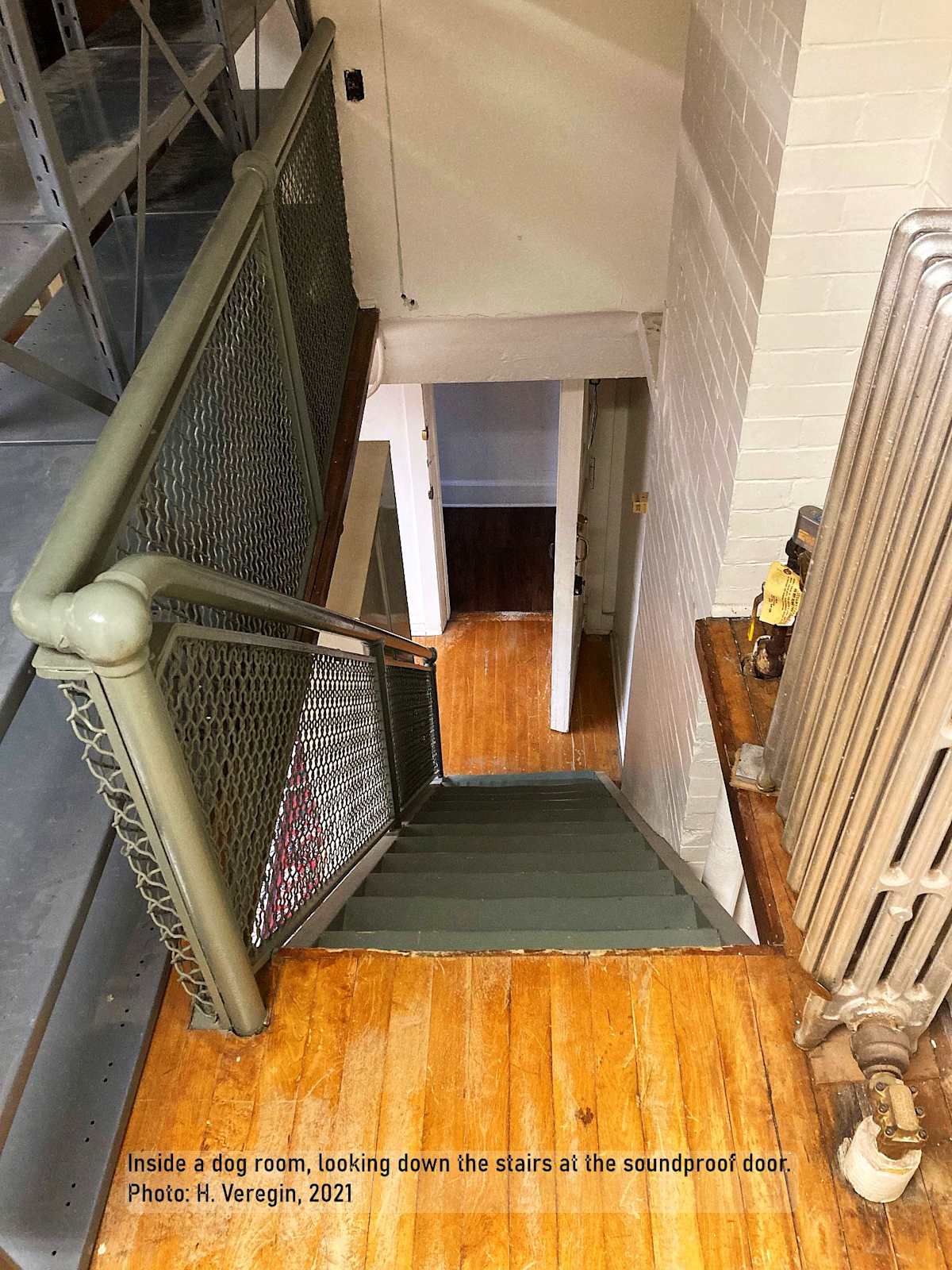
There are other clues too: the stairs to the upper level with their protective wire mesh balustrade; the various chambers on the upper level, which could have been used to prepare dogs for experiments and observe them after gassing; the sink and drain, which would have been useful for disposing of waste.
And we do know – from floorplans and eyewitnesses – that there were dog kennels in these rooms. Would it not make sense to kennel the dogs close to the location of the experiments? It’s hard to imagine dogs being led through the corridors of Science Hall from one room to the next.
Would the scientists conducting the experiments have been allowed to store and release poison gas in Science Hall at this time? If so, did other building tenants know this was going on? Our ancestors seem to have had a more accepting attitude toward such dangers. At this time poison gases were sometimes literally delivered to labs by mail. Occasionally they arrived at their destination in damaged or leaking condition. [1]
There are also many documented accidents at American University – the main chemical warfare research hub – including accidental gas releases, explosions and exposures to deadly chemicals leading to death. [2] And there were probably many other dangerous chemicals being used in Science Hall at the time, including ether, formaldehyde and gaseous fuels. One floor below the dog rooms was Professor Bunting’s bacteriology lab. In those days Science Hall was a dangerous place.
But of course the evidence is still circumstantial. We would need eyewitness accounts or photographic evidence to prove unequivocally that these activities actually occurred here. Given the confidentiality requirements the Army imposed on scientists during the war [3] it is possible that such confirmation will never be found.
After the dogs were moved out when the Medical School left Science Hall, the dog rooms were converted to more conventional uses. The 1929 renovation plan for Science Hall indicates they were to receive “new tile and furring, and plastering on walls and ceiling” along with a new cement floor. The plan also shows that the partitions on both levels were to be removed.
Today the rooms seem unusual but innocuous. The upper level is a curiosity, suitable for storing old books and maps. It has lost its skylight and ventilators. With its low ceiling and lack of windows it feels claustrophobic, but not ominous. The sink and drain on the lower level have been removed, patched by a piece of wood. The original stairs with their metal netting balusters are still in existence, and the massive soundproof doors – which must be three inches thick – still hang on oversized hinges. But these are the exceptions and for the most part the rooms feel quite ordinary. It takes some effort to imagine how they would have looked at the end of the First World War, with the dogs in their kennels and strange equipment lying about.
History is so easily forgotten, especially when the spaces where history happened are covered in layers of plaster and paint. It’s hard to see the history that unfolds from everyday events in everyday spaces. Historical significance is often only appreciated in retrospect. In the meantime, rooms are clumsily altered for new uses, walls are erected or removed, doorways and windows are closed off, and the historic fabric is torn to pieces. Not only is history unknowable, it is also irreversible.
Like other parts of Science Hall, the dog rooms of the fourth floor are largely mute about their history. The building’s interior has been so thoroughly transformed over the decades that it is almost impossible to mentally reconstruct the original floor plan let alone picture what it was like to work there. Our Science Hall is not the same Science Hall that Meeks and Eyster knew, and we have limited opportunities to interact with the building the way they did, not to mention the thousands of other people who have worked or studied in the building over its history.
All that we really have to help us build connections to the building’s historic spaces and the people who used them are a few fragments from the historic record and our own imaginations. We may never know how many dogs were involved in the Science Hall experiments, or if their deaths reduced suffering in any meaningful way for factory workers or soldiers.
Science Hall is about to undergo a major renovation. Let’s hope the dog rooms are not modified further in a way that will make their connection to this unique historical event even harder to understand.
Sources
[1] Daniel P. Jones, The Role of Chemists in Research on War Gases in The United States During World War I. (PhD Dissertation, University of Wisconsin-Madison, 1969), p. 109.
[2] Theo Emery, Hellfire Boys. (New York: Little, Brown and Company, 2017), p. 294.
[3] Emery, Hellfire Boys, pp. 172, 298.