This is the second part of The Dogs of Science Hall, an article originally published in Madison’s Tone Magazine in 2022. Read part 1 here.
Gas! GAS! Quick, boys! — An ecstasy of fumbling
Fitting the clumsy helmets just in time,
But someone still was yelling out and stumbling
And flound’ring like a man in fire or lime.
- Wilfred Owen, Dulce et Decorum Est
The first use of poison gas in the First World War was a German chlorine attack against British and French troops in April 1915. Gas was a new weapon, and the troops had no gas masks for protection. It is estimated that over a thousand soldiers died in the attack. Initially outraged, Britain and France soon decided to fight fire with fire and an arms race escalated quickly. [1] Within a few years, the chemical arsenal of the combatants had grown to include asphyxiants like phosgene, lung irritants like chloropicrin, various compounds of arsenic and cyanide, and blistering agents like mustard gas.
After declaring war in April 1917, the US government quickly launched a program focused on large-scale gas production and the creation of new gases and methods of delivery. The effort would require involvement from the country’s industrial and research institutions. As an editorial in the December 1917 issue of Illustrated World Magazine put it,
[C]hemical knowledge of destructive substances is not limited to the German mind or German textbooks. There are among us chemists who can meet them upon their own ground and go them one better in devilish inventiveness if it is so desired. [2]
In early 1917, Vannoy Manning, the Director of the Bureau of Mines in the US Department of the Interior, offered the Bureau’s services to the War Department for chemical warfare research. [3] This would seem surprising, were it not for the fact that the Bureau was already involved in research on mine gases and self-contained breathing devices. [4] The Bureau’s work was simply refocused on military needs. Initially, then, chemical warfare research in the US was coordinated by a civilian agency.
Manning’s offer was made via the National Research Council, which had been formed in 1916 under the National Academy of Sciences to mobilize scientists to conduct military research. [5] In 1917, the Council’s Military Committee added a Subcommittee on Noxious Gases – chaired by Manning – and charged with conducting research into the generation of toxic gases and developing antidotes to them. [6][7] During the war, the Military Committee acted as an intermediary between the Army, who posed research problems, and scientists at universities, who carried out the work. [8]
Universities were quick to sign on, at least twenty-one of them joining the effort by the end of 1917. [9] The list eventually included some of the country’s top research institutions, including Chicago, Clark, Columbia, Cornell, Harvard, Johns Hopkins, Michigan, MIT, Ohio State, Princeton, Yale and Wisconsin. [10] The arrangement with the Bureau of Mines and the National Research Council continued until 1918, when the Army’s Chemical Warfare Service was created.
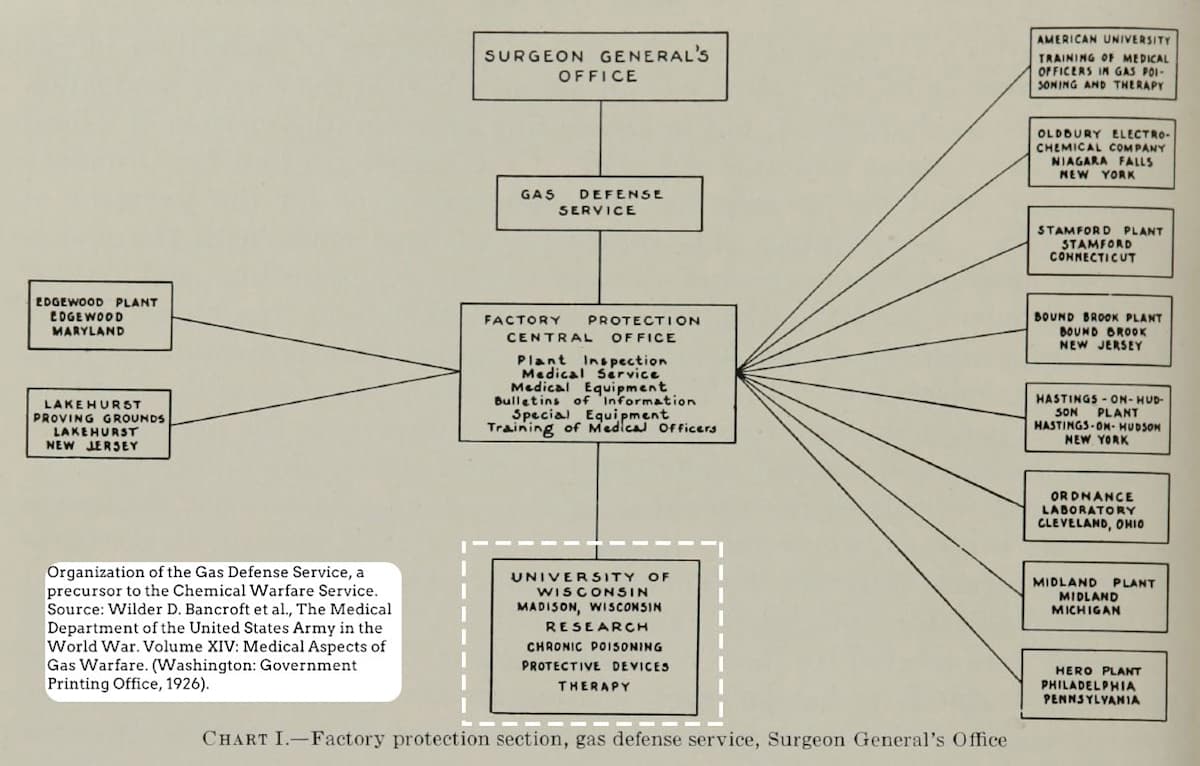
By the end of the war in November 1918, the US was producing twice as much poison gas as Britain, France and Germany combined. Production had grown to encompass at least ten facilities. [11] The Army’s main chemical warfare plant, Edgewood Arsenal in Maryland, had more than ten thousand workers at peak production. [11] Other plants included re-purposed commercial chemical factories in Ohio, New York, Michigan and Connecticut. At full capacity, this network of plants could produce over four thousand tons of poison gas per month, including chlorine, phosgene, chloropicrin, mustard gas and lewisite, the latter being a US innovation. [12]
When the war was over almost eleven thousand tons of gas had been produced domestically. [13] The US Army’s First Gas Regiment reached the front lines in the spring of 1918 and deployed thousands of gas shells and canisters against the German Army. [14] But as this was already late in the war, gas use by US forces never matched its domestic production levels let alone its planned capacity. In fact, despite soaring domestic production levels, the US Army did not employ any domestically produced gas in the war, relying instead on British and French supplies. [15]
If the war had continued into 1919, the US and its allies were prepared to use their stockpiles in massive gas attacks, including aerial bombardments, against Germany. [16] But at the end of the war, these plans were abandoned and instead hundreds of tons of surplus gas in barrels and artillery shells were dumped into the Atlantic Ocean. [17]
It was the rapidity with which production facilities were established that spurred on much of the poison gas research in the US. Injuries to plant workers from accidental exposure to toxic chemicals were taking a toll. At the Edgewood plant there were 279 casualties in one month alone in 1918. [18] The focus of much war gas research was protection of workers in gas production facilities. As we will see in future posts, this was a major focus of the research effort at the University of Wisconsin.
Note: My novel, Dog 137, loosely based on the poison gas experiments performed during the war, is now available. More information can be found here.
Sources
[1] Jeffrey A. Johnson, “Military-Industrial Interactions in the Development of Chemical Warfare, 1914-1918: Comparing National Cases within the Technological System of the Great War,” in One Hundred Years of Chemical Warfare: Research, Deployment, Consequences, ed. B. Friedrich, D. Hoffmann, J. Renn, F. Schmaltz and M. Wolf (Cham: Springer, 2017), p. 146.
[2 Quoted in Daniel P. Jones, The Role of Chemists in Research on War Gases in The United States During World War I. (PhD Dissertation, University of Wisconsin-Madison, 1969), p. 91.
[3] Leo P. Brophy, Wyndham D. Miles and Rexmond C. Cochrane, The Chemical Warfare Service: From Laboratory to Field. (Washington: Center of Military History, US Army, 1988), pp. 2-3.
[4] Vannoy H. Manning, War Gas Investigations: Advance Chapter from Bulletin 178, War Work of the Bureau of Mines. (Washington: Government Printing Office, 1919), p. 2; Wilder D. Bancroft et al., The Medical Department of the United States Army in the World War. Volume XIV: Medical Aspects of Gas Warfare. (Washington: Government Printing Office, 1926), p. 35; Brophy et al., Chemical Warfare Service, p. 2; Jones, Role of Chemists, p. 92.
[5] Manning, War Gas, p. 2; Jones, Role of Chemists, p. 14; Jeffery K. Smart, “History of Chemical and Biological Warfare: An American Perspective,” in Medical Aspects of Chemical and Biological Warfare. (Washington: Office of the Surgeon General, 1997), p. 17.
[6] Manning, War Gas, p. 4; Jones, Role of Chemists, p. 93.
[7] Brophy et al., Chemical Warfare Service, p. 3; Smart, History, p. 17.
[8] Jones, Role of Chemists, pp. 16-17.
[9] Jones, Role of Chemists, p. 111; Bancroft et al., Medical Department, pp. 35-36; Brophy et al., Chemical Warfare Service, pp. 5, 26.
[10] Manning, War Gas.
[11] Bancroft et al., Medical Department, p. 25.
[12] Theo Emery, Hellfire Boys. (New York: Little, Brown and Company, 2017), p. 352.
[13] Emery, Hellfire, pp. 369, 377.
[14] Daniel A. Gross, Chemical Warfare: From the European Battlefield to the American Laboratory. (Science History Institute, 2015).
[15] DENIX (DoD Environment, Safety and Occupational Health Network and Information Exchange), History of United States' Involvement in Chemical Warfare. www.denix.osd.mil/rcwmprogram/history/index.html
[16] Johnson, Military-Industrial Interactions, p. 145.
[17] Emery, Hellfire, p. 369; DENIX, History.
[18] Emery, Hellfire, p. 296.