Note. The Dogs of Science Hall was originally published in Madison’s Tone Magazine in 2022. As Tone is no longer in operation, I am making the article available here, in a series of posts over the next month.
Progress is a storm blowing the angel of history back into the future. As the wreckage of history piles up, the angel wants to go back, wake the dead, and repair the things that have been broken. But of course, this is impossible.
- Philosopher Walter Benjamin, reflecting on Paul Klee’s painting, Angelus Novus. [1]
As one of the earliest buildings on the UW-Madison campus, Science Hall has experienced many of the indignities that accompany old age. The building – completed in 1887 in the Romanesque Revival style reminiscent of medieval fortresses – has been home to many of the university’s academic programs, including geology, physics, zoology, limnology, botany, anatomy, bacteriology and medicine. As these programs came and went over the years, Science Hall’s interior was repeatedly adapted to accommodate the needs of the next generation of tenants. The building’s open wings were partitioned, mezzanine floors were added and classrooms and labs were reconfigured dozens of times.
The scars are everywhere – doorways that have been bricked in, stairways that seem to lead nowhere and ornate columns that poke out of the plaster like broken bones. If the walls could speak, perhaps they would scream in agony.
Some of the more significant changes to Science Hall are associated with the Medical School, which occupied the building in the first decades of the twentieth century. Due the School’s rapid growth, previously underused areas of Science Hall were opened up. The fourth and fifth floors, used as storage areas when the building was first constructed, were reconfigured to house anatomy and dissection rooms. To provide the necessary cadavers, the north rear tower held a winch connected to an embalming room in the basement. Cadavers were delivered to the building via a stairway in the rear of the north wing, which has since been reconfigured as a ground-floor window. [2]
Medical School faculty also worked in physiology, pathology, pharmacology and medical microbiology. Teaching and research labs were scattered around the building. But as student demand increased, Science Hall became too small and expansion into a new building became necessary. This was solved when the Legislature approved funds for the Wisconsin General Hospital and Service Memorial Institutes, which opened in the 1920s. Only the Anatomy Department stayed on in Science Hall, occupying rooms on the upper floors until it too departed in 1957. Students were apparently still finding human bones hiding in unused storage spaces well into the 1970s. Grisly stories like this are central to the building’s mythology.
But of all the alterations made to Science Hall over the decades, perhaps none is as puzzling as the addition of two rooms on the fourth floor over a hundred years ago. This is the only significant renovation of the building that affected its exterior. The rooms can be seen from the rear parking lot today. The brick is of a different color than the rest of the building and the architecture is much less ornate. Today these rooms are used as faculty offices. They are located just off the main staircase, with one room on each side, each a mirror image of the other.
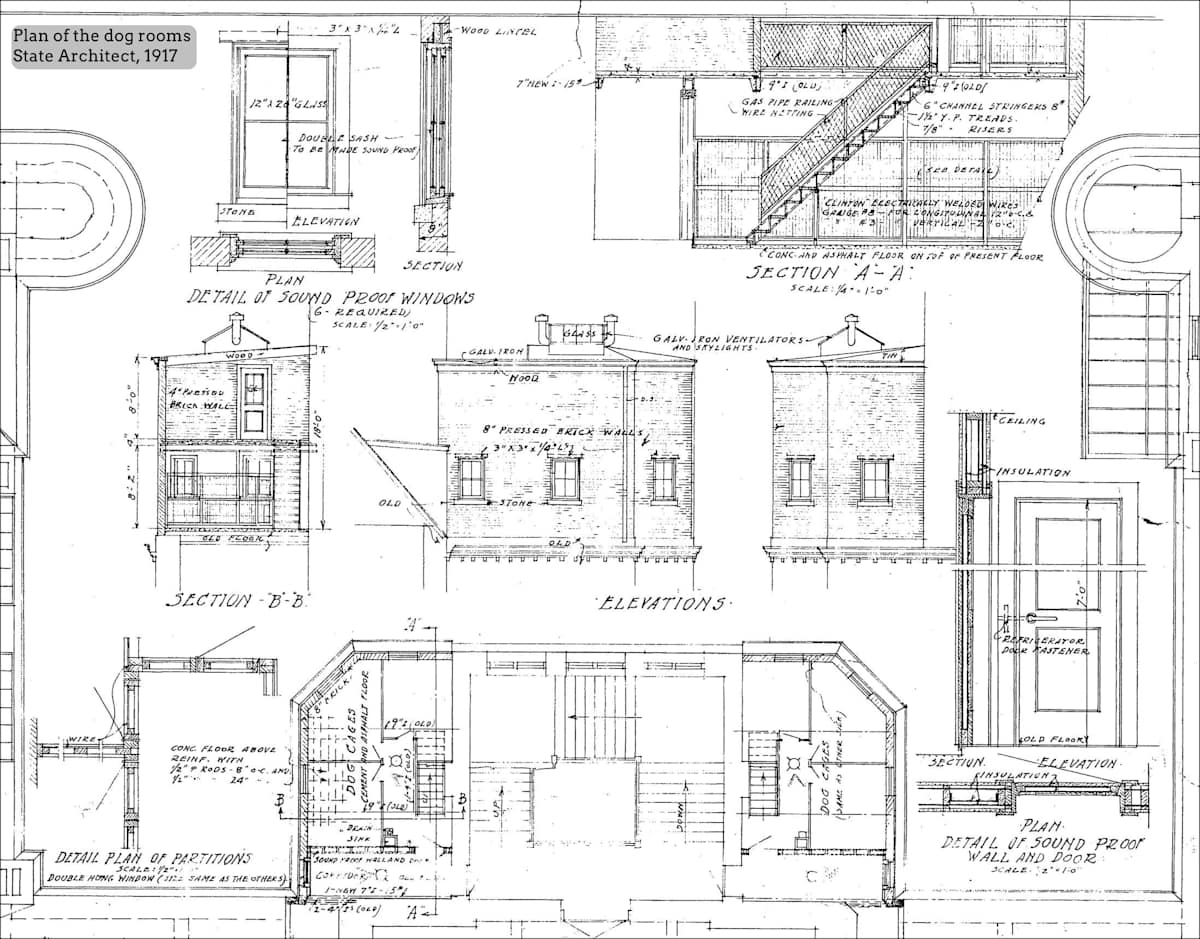
An early photograph of Science Hall confirms that these rooms are not original to the building. A photograph dating from the late 1920s or early 1930s shows the two rooms after their construction. This evidence agrees with building histories stating that the rooms were added sometime before 1924. Additional evidence comes from a set of 1917 renovation plans, which depict these rooms as new additions and provide details about their construction. The plans – officially titled “Diagram for Remodelling of Science Hall, University of Wisconsin” – were produced by the Office of the State Architect in Madison in the summer of 1917. (See the image at the top of this post.)
These rooms have some curious features, to say the least. For a start, they were designed to hold dogs. The 1917 remodeling plan show “dog cages” on a concrete and asphalt floor. There are two tiers of cages made from “Clinton Electrically Welded Wires” of specified gauge and spacing. The plans show the room partitioned into four chambers, each with a door. There are two chambers for the dog cages, an antechamber with a drain and sink leading to the building corridor, and a chamber leading up the stairs to the second level.
This points to a second oddity – the fact that the rooms have two levels. On the upper level, the renovation plans show six chambers. The largest extends over the building corridor and contains a drain. The smallest chambers – there are three of these – are only about three feet wide. In contrast to the lower level, the upper level is completely windowless. A large glass skylight and two galvanized iron ventilators provide light and ventilation (visible on the 1920s-1930s photograph). The two levels are connected with a metal stair with a balustrade constructed of wire netting.
A final oddity of these rooms is that they were designed to be soundproof – soundproof double-hung windows on the lower level, soundproof walls stuffed with insulation and a thick soundproof door.
What does all of this signify? To answer that question we need to consider three sets of facts. First, there are the rooms themselves, with their dog cages, windowless chambers, ceiling ventilation and soundproof construction. Second, we know that medical research was being conducted in the building at this time and that medical labs were nearby.
Third, there is the historical context to consider. In April of 1917, a few months before these renovation plans were drafted, the United States declared war on Germany and entered the First World War. An immediate concern was poison gas, which Britain, France and Germany were all using as a chemical weapon. By mid-1917, a war gas research program had been launched in the United States, led by the federal government and the War Department, that eventually enrolled hundreds of scientists from universities and private labs across the country. Animals, especially dogs, were involved from the very beginning as experimental subjects.
In subsequent Oddsconsin posts, we’ll explore in more detail the dog rooms and their connection to chemical weapons research during the First World War. It’s a fascinating story.
Sources
[1] Stuart Jeffries, The Storm Blowing from Paradise: Walter Benjamin and Klee’s Angelus Novus, Verso, 2 August 2016, www.versobooks.com/blogs/2791-the-storm-blowing-from-paradise-walter-benjamin-and-klee-s-angelus-novus. See also Laurie Anderson’s song, “The Dream Before,” which quotes Benjamin.
[2] For details of Science Hall’s history see: National Register of Historic Places, University of Wisconsin Science Hall National Historic Landmark Nomination, 1993; Merle Curti & Vernon Carstensen, The University of Wisconsin: A History, 1848-1925. Madison: University of Wisconsin Press, 1949; Jim Feldman, The Buildings of the University of Wisconsin. Madison: The University Archives, 1997; Clarence W. Olmstead, Science Hall: The First Century. Madison: Department of Geography, UW-Madison, 1987.