This is the fourth part of The Dogs of Science Hall, an article originally published in Madison’s Tone Magazine in 2022. Read part 1 here, part 2 here and part 3 here.
But the poor Dog, in life the firmest friend,
The first to welcome, foremost to defend,
Whose honest heart is still his Masters own,
Who labours, fights, lives, breathes for him alone,
Unhonour'd falls, unnotic'd all his worth,
Deny'd in heaven the Soul he held on earth.
- Epitaph to a Dog, Lord Byron (George Gordon Byron), 1809
Toxic gas research at the University of Wisconsin during World war I involved at least fifteen members of the faculty studying gas manufacturing, physiological effects, remedies and gas masks. [1] There were in addition thirty-three enlisted personnel, nineteen civilian assistants and many graduate students. [2][3] Some faculty, such as Professor of Chemistry J. H. Mathews, served with the British Army abroad studying German war gases. [4] On campus, factory safety research was primarily conducted in the Medical School under the direction of Dr. Harold C. Bradley, Professor of Physiological Chemistry. [5] In late 1917, Bradley began research on chronic gas poisoning aided by Dr. John A. E. Eyster and Dr. Walter J. Meek – both Professors of Physiology – and Dr. Arthur S. Loevenhart, Professor of Pharmacology-Toxicology. The research program resulted in a large experimental laboratory at Wisconsin. [5]
Bradley, Eyster, Meek and Loevenhart came from the best schools in the country. Bradley graduated from Yale in 1906. [6] Eyster received his MD from Johns Hopkins in 1905 and was appointed Professor of Physiology at Wisconsin in 1911. Meek obtained his PhD from the University of Chicago in 1909 and joined Wisconsin that same year. Loevenhart came to Madison from Johns Hopkins and became the first chair of Wisconsin’s Department of Pharmacology-Toxicology in 1908. [7] Eyster, Meek and Loevenhart all held wartime commissions in the Army Medical Corps. [8][9] At the time, there was no easy way for the military to channel research funds to universities, but one method that did work was to grant commissions to faculty members. [10]
Eyster and Meek were responsible for much of the work carried out in the university’s chemical warfare unit from 1917 to 1919, including investigations into the biological effects of phosgene, mustard gas and lewisite, the latter an American contribution to the chemical arsenal. Another of Meek’s duties was procurement of dogs for research purposes. [11] According to his biographer, this required him to appear regularly before the state legislature to justify the use of animals against “the criticisms and actions of the antivivisectionists.” [12]
Loevenhart took on many tasks for the war effort, including testing of new offensive compounds, care and breeding of animals, and supervision of the toxicological aspects of large-scale field tests. [13] His work included experiments on dogs, rabbits, guinea pigs, mice, rats, monkeys and even people. [14]
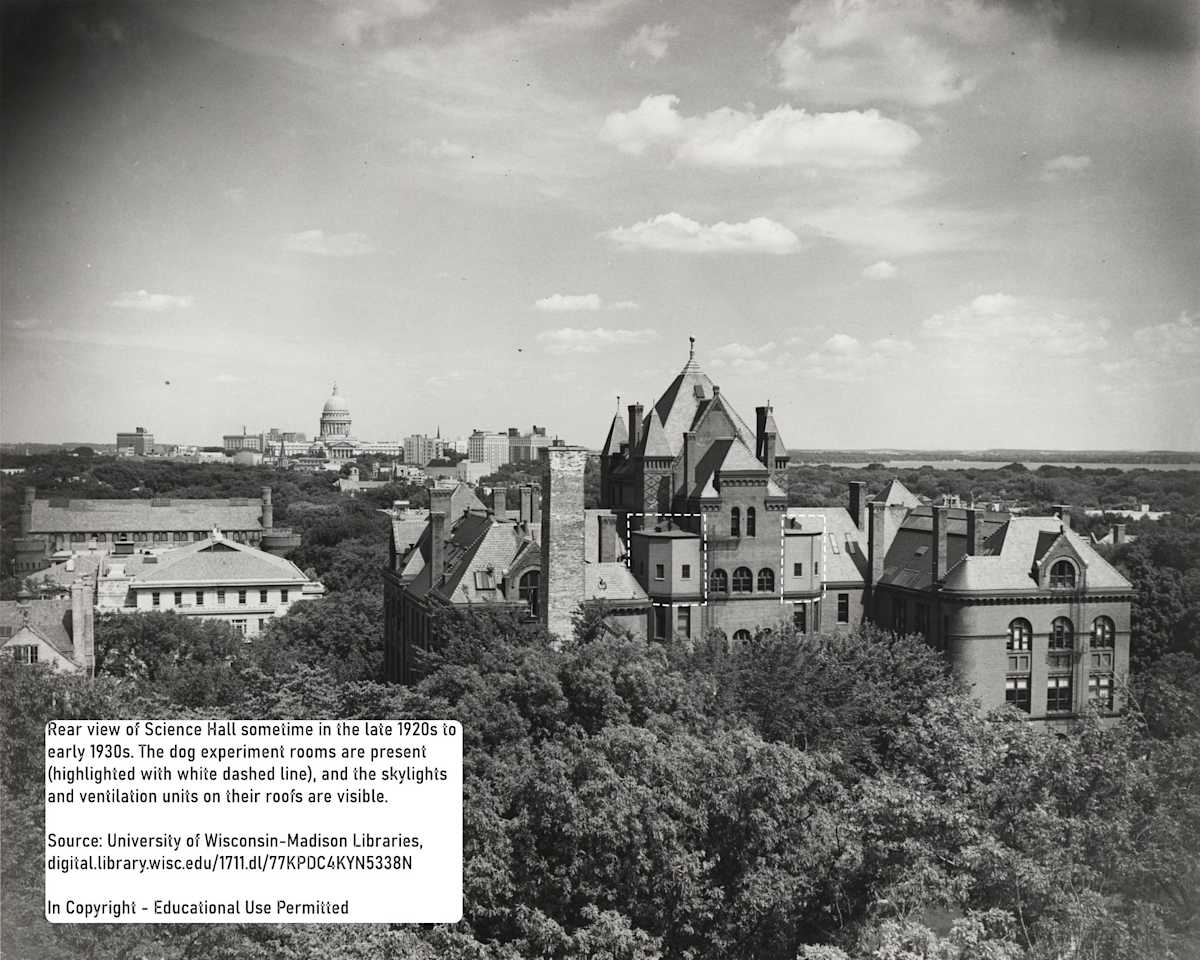
Eyster, Meeks and Loevenhart all worked in Science Hall. Eyster’s office and private lab were on the first floor. Through his lab Eyster had access to a physiology lab located next to a large lecture hall (still in use today). Loevenhart had an office and private lab in the north wing of the first floor, adjacent to an even larger physiology lab. Meek had an office on the first floor and a private lab in the basement.
As noted in an earlier post, the use of dogs in chemical warfare research originated at Yale under Yandell Henderson. Another Yale faculty member involved in this research was Frank Underhill, Professor of Experimental Medicine. Underhill received an Army commission in 1918 and became commanding officer of the Yale Station of the Chemical Warfare Service. [15] By the end of the war, Underhill had thirty-eight staff members, both civilian and military, including seven staff responsible for “gassing of animals.” [16] Underhill focused on “therapeutic work” involving the examination of gassed animals and the effects and treatment of gas poisoning. [17]
At over three hundred pages, Underhill’s 1920 book, The Lethal War Gases, describes the Yale gas experiments in excruciating detail. [18] The 1926 compendium by Bancroft and others titled, Medical Aspects of Gas Warfare, at almost nine hundred pages, offers even more details on the experiments done at universities across the country. [19] It is difficult to say how many dogs (and other animals) were killed, but given the statistics shown in tables and appendixes, the number must have been in the thousands.
The research program was exhaustive. Scientists at Yale, American, Wisconsin and elsewhere studied most of the major war gasses, focusing the most attention on chlorine, phosgene, chloropicrin and mustard gas. They examined the effects of these gases on seemingly every body part: heart atria, lung tissue, bronchial tubes, capillaries and blood vessels, kidneys, intestines, and even the skin and eyes. They examined the effects on respiration, pulse, body temperature, metabolism, blood concentration, blood oxygen levels and hemoglobin. They looked for signs of burns, pneumonia, bronchiolitis (lung infection), emphysema, pulmonary edema (fluid in the lungs), pleurisy (lung inflammation), leukocytosis (high white blood cell count), heart dilation, acidosis (acidic blood) and decline in kidney function.
Tests on humans were initially improvised but later became more systematic. One experiment in 1917 involved Henderson (at Yale) entering a gas chamber to test the effectiveness of a new gas mask on chlorine. He remained in the chamber for fifteen minutes. The gas bleached his socks and hair, and dissolved his shirt, but he survived. [20] Another researcher stayed with a dog in a gas chamber filled with hydrocyanic acid “until the dog had been killed,” proving that humans are less sensitive to this gas than dogs. [21] A “man-test section” was eventually established at American University, where various experiments were performed. Subjects were exposed to tear gases to determine their lachrymatory (tear-producing) effects. They were sprayed with mustard gas to determine the lowest level that would incapacitate the subject. (This led in some cases to temporary blindness). They were daubed with blistering agents that caused pustules to form. [22] It seems every possible contingency was explored.
Sources
[1] Charles R. van Hise, “The War Work of the University of Wisconsin,” The American Review of Reviews, Vol. LVIII, pp. 69.
[2] Daniel P. Jones, The Role of Chemists in Research on War Gases in The United States During World War I. (PhD Dissertation, University of Wisconsin-Madison, 1969), p. 114.
[3] Jones, Role of Chemists, p. 125.
[4] B. E. Powell, “The Long Arm of Learning: How the ‘Land-Grant Colleges’ are Backing Uncle Sam,” The American Review of Reviews, Vol. LVIII, p. 65.
[5] Vannoy H. Manning, War Gas Investigations: Advance Chapter from Bulletin 178, War Work of the Bureau of Mines. (Washington: Government Printing Office, 1919), p. 23.
[6] “Hoofers Founder Dr. Bradley, 97, Dies,” Wisconsin State Journal, 6 Jan 1976, p. 1; “Harold Bradley Obituary,” Wisconsin State Journal, 8 Jan 1976, p. 10.
[7] Merle Curti and Vernon Carstensen, The University of Wisconsin: A History, 1848-1925. (Madison: University of Wisconsin Press, 1949).
[8] “Memorial Resolutions of the Faculty of the University of Wisconsin,” University of Wisconsin. kb.wisconsin.edu/images/group222/53539/MemorialResolutionsFacDocs1450-16521959-12to1964-05.pdf
[9] Jones, Role of Chemists, p. 114.
[10] Jones, Role of Chemists, pp. 100-101.
[11] Chandler Mcc. Brooks, Walter Joseph Meeks, 1878-1963. (Washington: National Academy of Sciences, 1983).
[12] Brooks, Meeks, p. 259.
[13] George A. Burrell, “Contributions from the Chemical Warfare Service, USA: The Research Division.” Journal of Industrial and Engineering Chemistry, Vol. 11 (1919), p. 98.
[14] Burrell, “Contributions,” p. 98.
[15] Frank P. Underhill, The Lethal War Gases: Physiology and Experimental Treatment. (New Haven: Yale University Press, 1920), p. xi.
[16] Underhill, Lethal War Gases, pp. ix-x.
[17] Manning, War Gas, p. 25.
[18] Underhill, Lethal War Gases.
[19] Wilder D. Bancroft et al., The Medical Department of the United States Army in the World War. Volume XIV: Medical Aspects of Gas Warfare. (Washington: Government Printing Office, 1926).
[20] Jones, Role of Chemists, p. 96; Theo Emery, Hellfire Boys. (New York: Little, Brown and Company, 2017), pp. 80-81.
[21] Bancroft et al., Medical Department, p. 305.
[22] Burrell, “Contributions”; Bancroft et al., Medical Department; Emery, Hellfire.