This is the third part of The Dogs of Science Hall, an article originally published in Madison’s Tone Magazine in 2022. Read part 1 here and part 2 here.
The gas defense work [at the University of Wisconsin] involves investigations of gas warfare abroad, the methods of manufacture of gases in quantity to be used in attack, the physiological effects of the gases, and the remedies for them, and gas mask protection. Fifteen members of the faculty are devoting themselves to different aspects of these problems. Important results have been obtained.
- Charles R. van Hise (President of the University of Wisconsin), “War Work of the University of Wisconsin,” The American Review of Reviews, Vol. LVIII, July 1918.
The research program of the Bureau of Mines – the civilian agency initially responsible for coordinating research on toxic gases during the war – involved several of the Bureau’s engineers and chemists as well as university partners. Dr. Yandell Henderson, Professor of Physiology at Yale University, was put in charge of medical research. [1] This included:
“physiological investigations of gas masks, pharmacological gassing experiments on men and on animals, pathological gross and microscopic study of gassed animals, and pathological chemistry of disorders of gassed animals.” [2]
Henderson set up a makeshift lab under the bleachers on the baseball field at Yale to begin gas experiments on animals. [3] Apparently the demand for subjects was so great that even the dog pounds in New Haven could not keep up, and Yale made requests for stray animals to the mayors of cities up and down the east coast. [4] Eventually Henderson became Director of the Toxicology, Therapeutic, Pathological and Physiological divisions at Yale, which accounted for over forty military personnel and almost twenty civilian employees. [5] Like other universities, Yale was eager to contribute to the war effort by supplying lab space and releasing faculty from their teaching duties. [6]
With scientists and lab space in short supply, the Subcommittee on Noxious Gases – formed in 1917 under the National Research Council’s Military Committee – was granted authority to accept offers of assistance from scientists in the private sector and universities. Vannoy Manning, Director of the Bureau of Mines, probed for interest by conducting a nation-wide census of chemists that eventually received over 22,000 responses. [7] The census was conducted with the assistance of the American Chemical Society, a strong advocate for the involvement of chemists in the war effort and one of the groups that successfully lobbied the government to continue chemical warfare research after the war ended. [8][9][10]
This level of cooperation was possible because US and European chemical industries were highly industrialized and marked by a well-developed academic/industrial network. The chemical dye industry in particular was highly evolved, although in the US dominated (ironically) by German companies. [11] The German chemical industry was already deeply enmeshed in military research. Fritz Haber, who received a Nobel Prize in 1918 for his work on chemical fertilizers, is often called “The Father of Chemical Warfare” thanks to his work on chlorine and other poison gases.
In the US, an important partner for the Bureau of Mines was American University in Washington, DC, which offered its buildings and grounds for free to the Army for the duration of the war. [12] American quickly became the main center of chemical warfare research in the United States. [13] By late 1917, the research facilities constructed at American included kennels to hold over seven hundred dogs. Experimental equipment, including animals, were transferred to American from other university labs, including Henderson’s lab at Yale. [14]
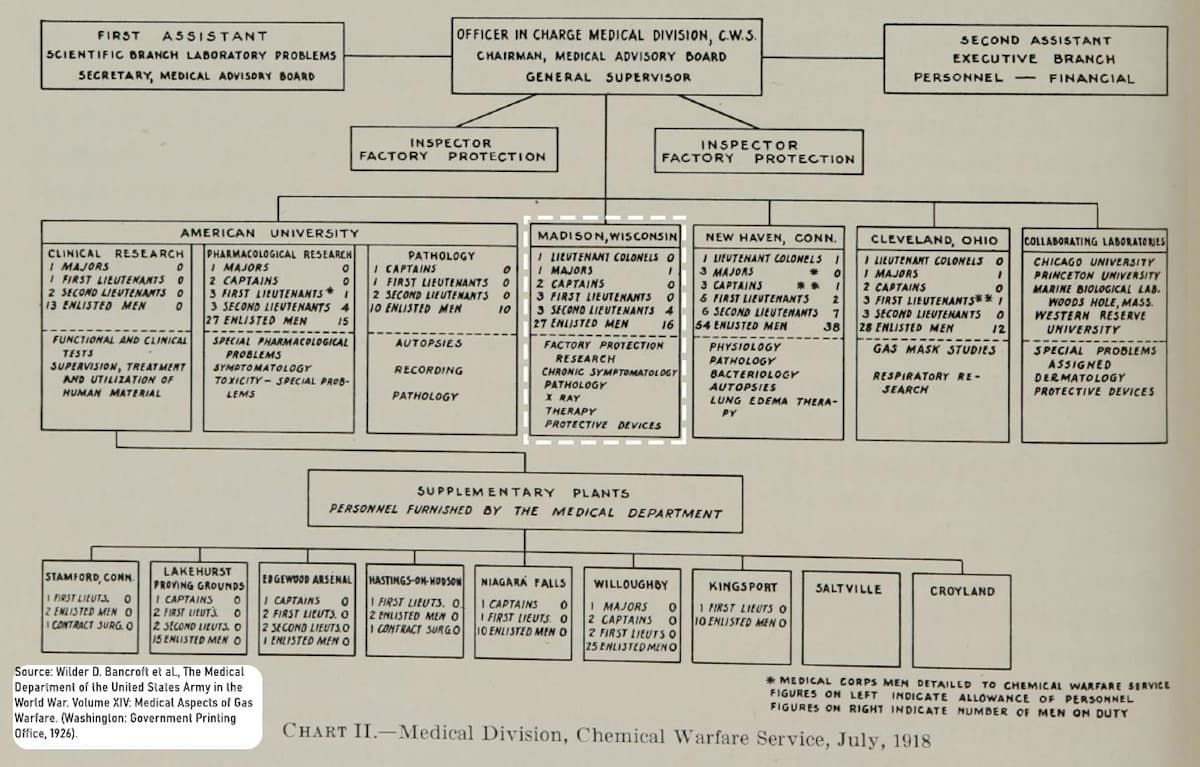
By September 1917, students and professors at the University of Wisconsin had begun researching safety measures for workers at gas-production facilities. [15] The University’s role in this area became more formalized in February 1918, when the Factory Protection Section of the Gas Defense Service was created to study the chronic effects of exposure to war gases and test protective devices and therapeutic treatments. [16]
The Gas Defense Service was created by the US Army in that year to provide military oversight of chemical warfare research and training. As the functions of the Gas Defense Service expanded, the Army created a new Chemical Warfare Service in the summer of 1918. [17] Under a directive from President Woodrow Wilson, the new Service absorbed the civilian research organization of the Bureau of Mines and leading researchers were given Army commissions [18]. At this time there were almost seventeen hundred employees conducting chemical warfare research for the Bureau of Mines, including military and civilian personnel. [19] According to a report by the American Chemical Society, the workforce included not just chemists and other scientists but also a “clerical force, electricians, glass blowers, engineers, mechanics, photographers and laborers.” [20]
The University of Wisconsin continued to play a central role in factory protection research including chronic symptomology, pathology, X-Ray, therapy and protective devices, with twenty-one military personnel on duty. [21]
But toxic gas was only one avenue of research conducted at the University of Wisconsin to support the war effort. In 1918 University of Wisconsin President Charles van Hise observed that 187 members of the faculty were on leave conducting war work, while an even greater number were performing this work while also continuing their other responsibilities. [22] The university was eager to support the war effort, giving leaves of absence to faculty who requested them.
As van Hise noted, war research at Wisconsin touched on many fields, including “psychology, economics, history, industry, medicine, engineering, foods, gas, aerial work, and the submarine.” [22] The submarine work is well-known: Max Mason, Professor of Physics, and seven of his colleagues developed a submarine detector they tested in the waters of nearby Lake Mendota. [23] At the Forest Products Laboratory in Madison (technically a US Department of Agriculture facility), researchers developed and tested new gas masks and wood products for use in war products. [24] From Wisconsin also came the idea of establishing “piggeries” at military camps to convert garbage into food. [25]
Next week, we’ll explore the toxic gas experiments conducted by the University of Wisconsin’s Medical School.
Sources
[1] Daniel P. Jones, The Role of Chemists in Research on War Gases in The United States During World War I. (PhD Dissertation, University of Wisconsin-Madison, 1969), p. 95.
[2] Vannoy H. Manning, War Gas Investigations: Advance Chapter from Bulletin 178, War Work of the Bureau of Mines. (Washington: Government Printing Office, 1919), p. 17.
[3] Theo Emery, Hellfire Boys. (New York: Little, Brown and Company, 2017), p. 76, 146.
[4] Emery, Hellfire, p. 146.
[5] Jones, Role of Chemists, p. 113.
[6] Frank P. Underhill, The Lethal War Gases: Physiology and Experimental Treatment. (New Haven: Yale University Press, 1920).
[7] Emery, Hellfire, p. 147; Jones, "Role of Chemists," p. 100.
[8] Charles L. Parsons, “The American Chemist in Warfare,” Science, Vol. 48, No. 1242 (1918), pp. 377-386.
[9] Leo P. Brophy, “Origins of the Chemical Corps,” Military Affairs, Vol. 20, No. 4 (1956), pp. 217-226; Emery, Hellfire.
[10] Jones, "Role of Chemists," p. 111; Wilder D. Bancroft et al., The Medical Department of the United States Army in the World War. Volume XIV: Medical Aspects of Gas Warfare. (Washington: Government Printing Office, 1926), pp. 35-36; Leo P. Brophy, Wyndham D. Miles and Rexmond C. Cochrane, The Chemical Warfare Service: From Laboratory to Field. (Washington: Center of Military History, US Army, 1988), pp. 5, 26.
[11] Jeffrey A. Johnson, “Military-Industrial Interactions in the Development of Chemical Warfare, 1914-1918: Comparing National Cases within the Technological System of the Great War,” in One Hundred Years of Chemical Warfare: Research, Deployment, Consequences, ed. B. Friedrich, D. Hoffmann, J. Renn, F. Schmaltz and M. Wolf (Cham: Springer, 2017), p. 138.
[12] Manning, War Gas, p. 6; Brophy et al., Chemical Warfare Service, p. 5.
[13] Emery, Hellfire.
[14] Jones, "Role of Chemists," p. 159; Emery, Hellfire, pp. 146-47.
[15] Jones, "Role of Chemists," p. 113; Brophy et al., Chemical Warfare Service, p. 8.
[16] Bancroft et al., Medical Department, p. 33.
[17] Brophy et al., Chemical Warfare Service, p. 13; Jeffery K. Smart, “History of Chemical and Biological Warfare: An American Perspective,” in Medical Aspects of Chemical and Biological Warfare. (Washington: Office of the Surgeon General, 1997), p. 19.
[18] Brophy et al., Chemical Warfare Service, p. 13.
[19] Manning, War Gas, p. 10.
[20] Parsons, "The American Chemist," p. 380.
[21] Bancroft et al., Medical Department, p. 33.
[22] Charles R. van Hise, “The War Work of the University of Wisconsin,” The American Review of Reviews, Vol. LVIII, pp. 68.
[23] “Patriotism and Poison Gas,” On Wisconsin, Spring 2017, onwisconsin.uwalumni.com/features/patriotism-and-poison-gas; van Hise, "War Work," p. 69; B. E. Powell, “The Long Arm of Learning: How the ‘Land-Grant Colleges’ are Backing Uncle Sam,” The American Review of Reviews, Vol. LVIII, p. 64.
[24] “Patriotism and Poison Gas.”
[25] Powell, "Long Arm," p. 66.