This is the fifth part of The Dogs of Science Hall, an article originally published in Madison’s Tone Magazine in 2022. Read part 1 here, part 2 here, part 3 here and part 4 here.
Want Oddsconsin delivered to your inbox each week? Subscribe here.
Why participate in a system that is killing itself? It seems counter-productive. Counter-evolutionary, if you will. Unless there is a hand guiding evolution, and it wants us to be eliminated.
- Pyotr Engel, Dog 137
Some of the toxic gas experiments conducted on dogs at the University of Wisconsin Medical School are documented in a study by Drs. Walter Meek and John Eyster, published in 1920 in the American Journal of Physiology. [1] The study appears in modified form in a compendium on the medical aspects of gas warfare edited by Wilder Bancroft in 1926. [2] The Meek/Eyster study focused on phosgene, a lung irritant that causes fluid to build up in the lung’s alveoli (air sacs). Used as a chemical weapon in World War I, phosgene killed tens of thousands of soldiers.
Meek and Eyster tested exposure to the gas using dogs as test subjects. Their study pays particular attention to the physiological reactions associated with fatal phosgene poisoning, including
“arterial blood pressure, venous blood pressure, pulse rate, hemoglobin determinations, blood volume, red blood cell counts, histological examination of the lungs, x-ray studies of heart and lungs, alkaline reserve, respiratory rate and volume of respiratory ventilation.” [3]
Dogs were used as subjects throughout their experiments. The animals were gassed with phosgene for thirty minutes at concentrations high enough to cause death within sixteen to twenty-four hours. The method of gassing was similar to that described by Frank Underhill at Yale, in his1920 book, The Lethal War Gases. The dogs were placed
“in a one-hundred-liter air-tight glass box through which air was drawn at the rate of one hundred liters per minute. The phosgene cylinder was connected to the air inlet tube, the gas outflow being regulated by a needle valve and the rate roughly determined by a flowmeter.” [3]
One hundred liters is approximately 3.5 cubic feet – a cube with sides just a little over 1.5 feet long – which suggests the dogs were not very large. All dogs were tied to operating boards by their limbs to facilitate rapid and frequent observations. According to the authors, the animals “lay quietly and comfortably until the usual asphyxia stimulations occurred shortly before death.” [3]
Like their counterparts at other universities, Wisconsin gas researchers probed the dogs in various ways following gassing. W. S. Miller of the Anatomy Department conducted histological analyses (tissue examinations under a microscope) of lung tissue, using special methods of his own development. [4] X-rays of the thorax were made at regular intervals after gassing to measure changes in the lungs and heart. [5] At the time, the X-ray room in Science Hall was in the basement, suggesting the dogs were lowered there after gassing. And, in addition to phosgene, a variety of other toxic gases were also examined.
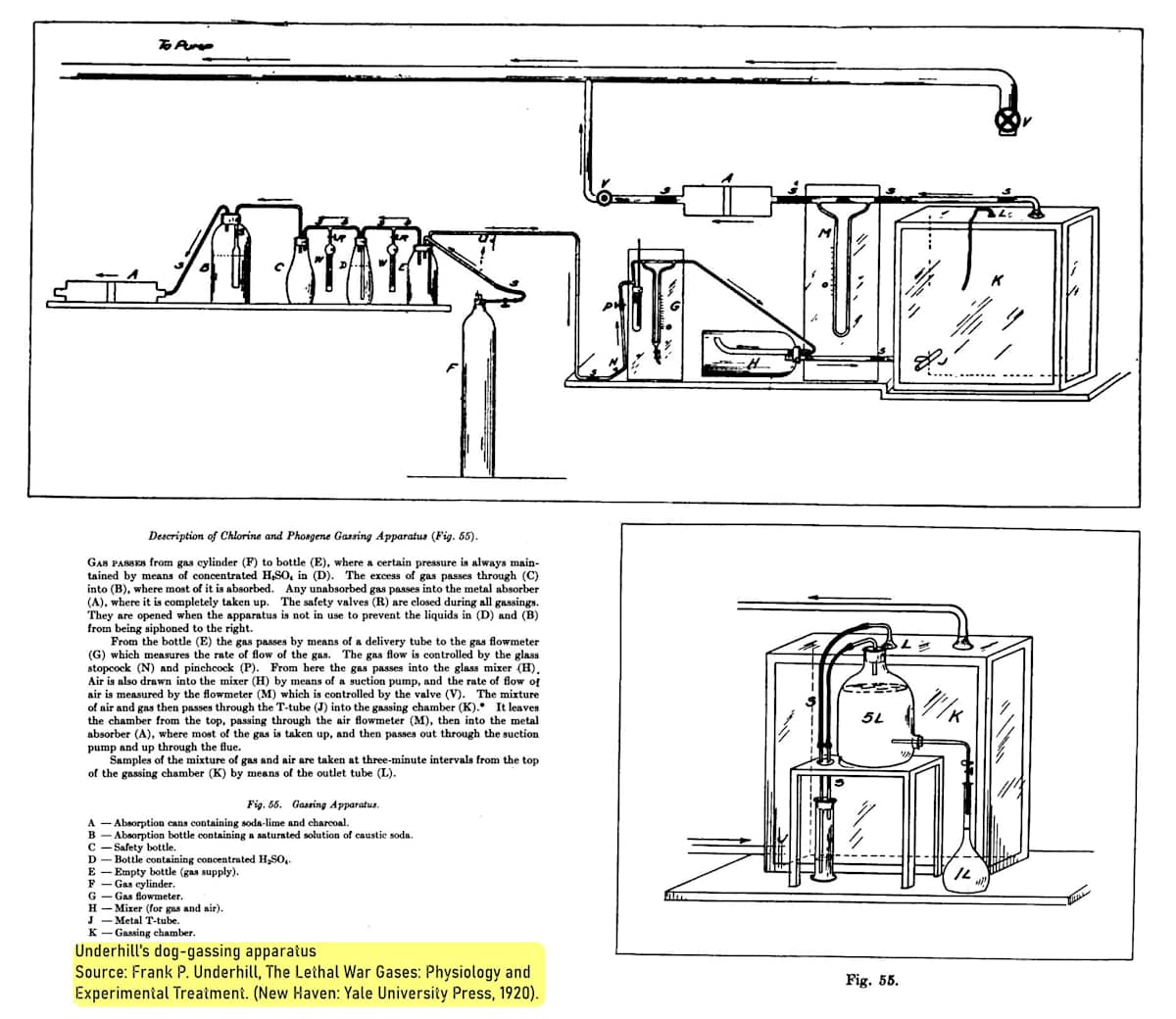
To obtain consistent results, researchers followed a standard “experimental method of gassing” consisting of passing a mixture of gas and air through an air-tight chamber containing the dog for a definite period at a determined rate. [6] Dogs were always gassed singly rather than in groups. [7] Dogs of both sexes and various breeds, ages and states of health were selected. [7]
Depending on the gas administered, symptoms could include restlessness, barking, urination, defecation, blinking, dizziness, sneezing, coughing, nasal secretion, salivation, retching, vomiting, dyspnea, cyanosis and convulsions. [8] Underhill’s book contains a drawing of the animal gas chamber, reproduced in the image at the top of this post. [9] Yandell Henderson (Yale) designed the original apparatus, but Underhill and others improved upon it. [10]
Researchers found that dogs generally died from three to twelve hours after gassing, although this depended on the concentration of gas administered. Dogs gassed at low concentrations often lived for weeks or recovered completely. [11] However, dogs that recovered were not necessarily safe, as some were gassed a second time to determine whether they were more susceptible due to repeated exposure. [12]
Other dogs who survived were killed (e.g., by strychnine injection) to enable researchers to take and examine tissue samples. [13] Some dogs were starved before being gassed to obtain a picture of metabolic changes expressed in urine samples or were “water starved” to explore toxicity rates at different levels of hydration. [14]
Meek and Eyster, like Underhill, concluded that death by phosgene poisoning was attributable to some combination of pulmonary edema (fluid in the lungs) and reduced oxygen-carrying capacity of the blood, with the latter probably being a more important factor. [15][16] In an effort to identify remedies, the Wisconsin researchers were able to keep some gassed dogs alive up to seventy-two hours by placing them in oxygen-rich chambers. Unfortunately, the effects were not restorative, and if released from the chambers the dogs typically fell into “asphyxia convulsion which quickly terminated in death.” [17] Administration of oxygen was just a palliative.
Several antidotes were also tested, including venesection (blood-letting), infusion (injection of a salt solution or other chemicals, including morphine), and administration of water and oxygen. Typical of the results is the recommended treatment for poisoning by chlorine (another poison gas used in the war): Venesection of one percent of body weight in blood, intravenous infusion of warm sterile isotonic solution, and administration of sodium bicarbonate orally, to be carried out one to two hours after gas exposure. [18]
Meek and Eyster continued using dogs for research purposes at least into the 1920s, although these research efforts did not involve toxic gases. The pair published several articles on research involving dogs while still working in Science Hall. [19] According to Harland W. Mossman, Professor of Anatomy in Science Hall from 1924 to 1957, at least one of the “dog rooms” on the fourth floor still held dogs for the Physiology Department in 1924. [20] He recalled that the room needed a thorough cleaning after Physiology moved to the university’s Service Memorial Institutes in 1928. [20] William B. Youmans, a student of Meek’s in the 1930s, was responsible for dogs in the Service Memorial Institutes. [21] Youmans prepared them for experiments, which included eliciting the assistance of the “lab handyman” to administer an anesthetic.
After Physiology moved out of Science Hall, toxic gas research there ceased, and the scientists who were involved moved on to other areas of study, including sleeping sickness and neurosyphilis. But that story is for a future Oddsconsin post.
Next week: The "dog rooms" today.
Sources
[1] Walter J. Meek and John A. E. Eyster, "Experiments on the Pathological Physiology of Acute Phosgene Poisoning," American Journal of Physiology, Vol. 51, No. 2 (1920), pp. 303-320.
[2] Wilder D. Bancroft et al., The Medical Department of the United States Army in the World War. Volume XIV: Medical Aspects of Gas Warfare. (Washington: Government Printing Office, 1926), pp. 356-368.
[3] Meek and Eyster, “Experiments,” pp. 303-04.
[4] Meek and Eyster, “Experiments,” p. 313.
[5] Meek and Eyster, “Experiments,” p. 314.
[6] Bancroft et al., Medical Department, p. 307.
[7] Bancroft et al., Medical Department, p. 309.
[8] Bancroft et al., Medical Department, pp. 307-08.
[9] Frank P. Underhill, The Lethal War Gases: Physiology and Experimental Treatment. (New Haven: Yale University Press, 1920), p. 183.
[10] Vannoy H. Manning, War Gas Investigations: Advance Chapter from Bulletin 178, War Work of the Bureau of Mines. (Washington: Government Printing Office, 1919).
[11] Underhill, Lethal War Gases, p. 4.
[12] Bancroft et al., Medical Department, p. 315.
[13] Bancroft et al., Medical Department, p. 334.
[14] Underhill, Lethal War Gases, pp. 2, 157.
[15] Underhill, Lethal War Gases, p. 137
[16] Meek and Eyster, “Experiments,” p. 320.
[17] Meek and Eyster, “Experiments,” p. 319.
[18] Underhill, Lethal War Gases, p. 148.
[19] For example: Walter J. Meek and John A. E. Eyster, “Reactions to Hemorrhage,” American Journal of Physiology, Vol. 56, No. 1 (1921), pp. 1-15; Walter J. Meek and John A. E. Eyster, “The Effect of Plethora and Variations in Venous Pressure on Diastolic Size and Output of the Heart,” American Journal of Physiology, Vol. 61, No. 1 (1922), pp. 186-202.
[20] Clarence W. Olmstead, Science Hall: The First Century. (Madison: Department of Geography, UW-Madison, 1987), p. 24.
[21] “Oral History Interview: William B. Youmans,” Minds@UW, University of Wisconsin-Madison Libraries, minds.wisconsin.edu/handle/1793/67490