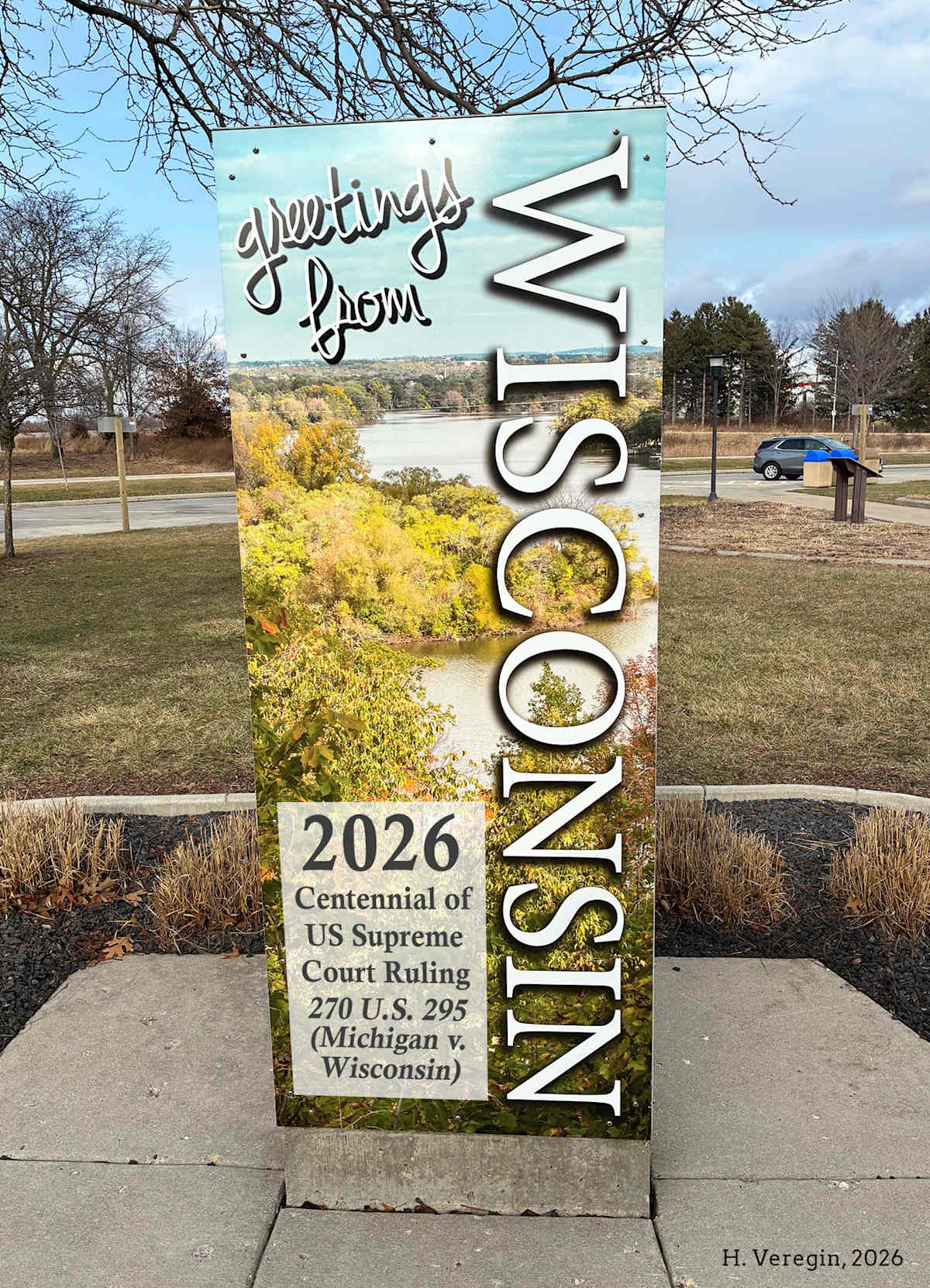
This is the final installment in a series on Wisconsin’s boundaries. The previous posts are Oddsconsin 50 (Illinois boundary), Oddsconsin 51 and Oddsconsin 52 (Minnesota boundary) and Oddsconsin 53 (Michigan boundary, part 1). This post ends the series with a final look at the Michigan boundary.
It seems Michigan was never completely satisfied with the boundary description in Wisconsin’s 1846 Enabling Act and 1848 constitution. Even though the boundary was surveyed and monumented in 1847, Michigan’s 1850 constitution (Michigan has revised its constitution several times) defined the boundary as running to the headwaters of the Montreal River without mentioning Cram’s point. Michigan’s 1908 constitution went a step further, stating that the line went through the main channel of the west branch of the Montreal River to its headwaters in Island Lake, ten miles southwest of Cram’s point. [1]
In 1923, Michigan sued Wisconsin to redetermine the boundary based on these claims. The result was a wedge of disputed territory about 400 square miles in extent within Iron and Vilas Counties. [2] Michigan’s proposed boundary is shown on the map accompanying Oddsconsin 53.
The suit involved thousands of pages of printed evidence, exhibits, photographs, maps and sworn testimony. Hearings were held in eight different locations over almost a year to evaluate testimony. [3] The Supreme Court’s decision in 1926 [4] was almost anticlimactic. It rejected Michigan’s claims and upheld the boundary as originally surveyed and monumented, pointing out that Wisconsin had exercised effective administration of the disputed area since it became a state in 1848.
The court’s ruling also noted Michigan’s long-standing acquiescence of the border, even though the mistaken assumption that the Montreal River connected to Lake of the Desert “was discovered as early as 1841, of which discovery Michigan, long prior to the admission of Wisconsin, had knowledge.” [4] Furthermore, Michigan not only assented to the survey and monumentation of the boundary by the federal government in 1847, “but actively participated in securing the insertion of the description of that line in the Wisconsin Enabling Act.” [4]
Thus, for a period of almost seventy-five years, Michigan “stood by without objection with full knowledge of the possession, acts of dominion, and claim and exercise of jurisdiction on the part of Wisconsin over the area in question.” [4] The lawsuit was dismissed.
The ruling also addressed some other parts of the Wisconsin-Michigan boundary, including the islands in the Menominee River, in Green Bay and in Lake Michigan north of Door County. The language of the ruling caused confusion about these islands, and so a second lawsuit was launched by Michigan in the 1930s. That dispute will need to be the topic for a future Oddsconsin post, as the details are quite involved. [5]
Between 1928 and 1929, the boundary was resurveyed by a Michigan-Wisconsin Joint Boundary Commission. Concrete monuments topped with small metal tablets replaced the original wood posts. These monuments still exist today and are maintained by Wisconsin and Michigan county surveyors. [6]
What was Michigan after? Geographer Martin Lawrence, writing in 1930, stated that “the spoils awaiting Michigan” included iron ore reserves, hydroelectric power sites, profitable summer resorts, agricultural land and the region’s “prosperous people.” [3]
Lawrence – a professor at the University of Wisconsin from 1906-17 – was certainly speaking from a Wisconsin perspective. He called the lawsuit a costly “comedy of errors.” But in any case, given that Congress had already established the boundary decades earlier, and had paid to survey and establish monuments along the boundary, the likelihood that Michigan would prevail was small from the start.
The mistaken assumption about the course of the Montreal River – the main source of the dispute – isn’t easily erased. In the Wisconsin Constitution, Cram’s point is defined as being at the headwaters of the Montreal River. This may have been the belief at the time of Cram’s expedition, but today the source of the river is known to be Pine Lake, several miles to the south of Cram’s point. [7] This is yet another example of how geographical misinformation becomes a legal fact that time – and lawsuits – cannot undo.
Sources and Notes
[1] 1908 Michigan Constitution. https://www.legislature.mi.gov/documents/historical/miconstitution1908.htm
[2] Wisconsin Historical Records Survey, Origin and Legislative History of County Boundaries in Wisconsin. Madison, WI, 1942.
[3] Lawrence Martin, The Michigan-Wisconsin Boundary Case in the Supreme Court of the United States, 1923–26, Annals of the Association of American Geographers, Vol. 20, No. 3, 1930, pp. 105-163.
[4] Michigan v. Wisconsin, 270 U.S. 295 (1926). https://supreme.justia.com/cases/federal/us/270/295/
[5] Lawrence Martin, The Second Wisconsin-Michigan Boundary Case in the Supreme Court of the United States, 1932–1936, Annals of the Association of American Geographers, Vol. 28, No. 2, 1938, pp. 77-126.
[6] For an example, see Mile Marker 33, established by William A. Burt, U.S. Deputy Surveyor, in 1847. The original monument was replaced with a concrete post with a brass template in 1928. https://maps.vilascountywi.gov/webdocs/corners/4308142708.pdf
[7] Wisconsin Department of Natural Resources, Surface Water Viewer. https://apps.dnr.wi.gov/water/waterDetail.aspx?WBIC=2940300