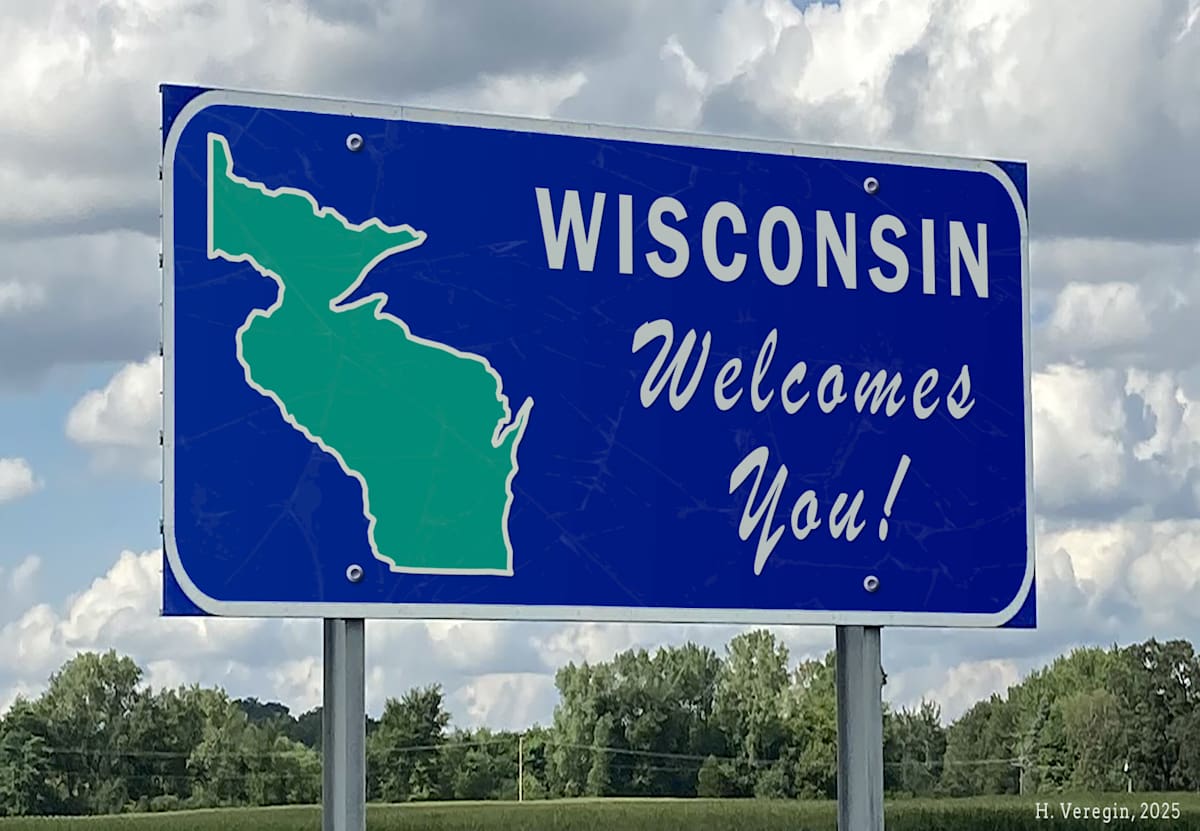
This is the third post in a series on Wisconsin’s state boundaries. Oddsconsin 50 examined the boundary with Illinois, while Oddsconsin 51 began exploring the boundary with Minnesota. This post continues with the Minnesota case.
To understand why the Wisconsin-Minnesota boundary is where it is, we need to go back to the Northwest Ordinance of 1787, which created the Northwest Territory from lands ceded by the eastern states. The Northwest Ordinance stipulated that no more than five states were to be carved out of the Northwest Territory. Wisconsin would be the fifth state, after Ohio, Indiana, Illinois and Michigan. [1]
The western boundary of the Northwest Territory was the Mississippi River up to its source in what is now the state of Minnesota, then in a direct line north to the international border with Britain (now Canada). This became the western boundary of Wisconsin Territory in the 1830s, after Michigan was admitted as a state. [2] But that changed in the Enabling Act of 1846, which Congress passed to pave the way for Wisconsin statehood.
The Enabling Act is where we first see Wisconsin’s modern boundary with Minnesota. It’s no coincidence that this followed close on the heels of the publication of Nicolett’s 1843 map, with its accurate (for the time) depiction of the geography of the region.
In the two years between the Enabling Act (1846) and statehood (1848), this portion of the Wisconsin-Minnesota boundary was redrawn several times. The debate was heated and emotional, in large part because it affected the balance of power in the US Senate between free states and slave states.
The Missouri Compromise of 1820 prohibited slavery in new northern states, so many southern politicians wanted the Wisconsin boundary to be as far west as possible to ensure that no additional free states could be created out of the old Northwest Territory. In contrast to these so-called “fifth-staters,” a coalition of northern interests known as the “sixth-staters” wanted Wisconsin to be much smaller, so that an additional sixth free state to the west of Wisconsin could be created.
Others who took an interest in the boundary debate included settlers in the St. Croix River valley, who did not want to be part of Wisconsin, viewing their interests (logging, mining and trapping) to be antithetical to the government in Madison. This group, along with the sixth-staters, proposed various boundaries to the east of the current Wisconsin-Minnesota line. These proposals would have left Wisconsin much smaller than it is today.
At the first Wisconsin Constitutional Convention in 1847, an alliance of sixth-staters and St. Croix settlers were able to get one of their boundary proposals into the constitution. This boundary ran north to the St. Louis River from present-day Pepin County, many miles to the east of the present boundary along the St. Croix River.
However, this version of the constitution was rejected by Wisconsin voters and, when the second Constitutional Convention was held in 1848, things had changed. Wisconsin business interests now realized the value of the natural resources in the St. Croix River valley and wanted to claim them. They proposed a boundary that extended to the confluence of the Mississippi and Rum Rivers, near the present city of Anoka, Minnesota, ten miles northwest of Minneapolis. And, in fact, this proposal was approved by voters and included in the version of the state’s constitution sent to Congress.
The conclusion to the story is anticlimactic. The Rum River boundary was never seriously considered by Congress, since they had already made a boundary offer to Wisconsin in the 1846 Enabling Act, viewing a more westerly boundary as indefensible. The state’s constitution was redrafted using the language of the Enabling Act to produce the boundary we see today. The two years of debate, in which Wisconsin’s western boundary bounced back and forth across the St. Croix River, was all for nothing. [3]
There’s one more section of the Wisconsin-Minnesota boundary we haven’t discussed – the portion that goes “down the center of the main channel” of the Mississippi River. This part of the boundary warrants an entire blog post of its own, but we’ll leave that for another time. The problem here is that no one really knows where the center of the main channel was when Wisconsin became a state. Detailed maps from 1848 don’t exist. Trying to reconstruct the old channel is difficult today, because the river has been heavily impacted by dredging and reshaping in the construction of dams, locks and other engineering projects. The boundary lies somewhere within the shorelines of the Mississippi River, but its exact location is a matter of debate. [4]
The story of the Wisconsin-Minnesota boundary shows how much history is obscured behind the simple boundary lines we see on maps. Portions of the state’s boundary with Minnesota are in the wrong place, some have uncertain locations and others are the result of complicated political and historical factors.
Next week, Oddsconsin will examine the boundary with Michigan, which was the subject of two US Supreme Court lawsuits in the early 20th century.
Want Oddsconsin delivered right to your inbox? Subscribe here.
Sources and Notes
[1] National Archives, Northwest Ordinance (1787). https://www.archives.gov/milestone-documents/northwest-ordinance
[2] This is a somewhat simplified history, which omits the addition of territories acquired via the Louisiana Purchase in 1803. For two years, from 1836 to 1838, the western boundary of Wisconsin Territory stretched west to the Dakotas.
[3] This history is based on the following sources: a) Wisconsin Historical Records Survey, Origin and Legislative History of County Boundaries in Wisconsin. Madison, WI, 1942. b) Franklin K. van Zandt, Boundaries of the United States and the Several States. Geological Survey Professional Paper 909, Washington, DC, 1976. c) William E. Lass, Minnesota’s Separation from Wisconsin, Minnesota History, Winter 1987, pp. 309-320. d) Colin Mustful, 2021, The Original Border Battle. https://www.colinmustful.com/borderbattle/
[4] Bryan Meyer, The “Lost” Wisconsin-Minnesota State Line. https://umgeocon.org/the-lost-wisconsin-minnesota-state-line/