I am fully convinced that a poor house is a most unsuitable place in which to rear children, and take the liberty to recommend the foundation of a ‘Children's Home’ where they can be reared under more healthful and elevating influences.
- Mary Blanchard Lynde, Milwaukee Social Reformer [1]
Oddsconsin’s coverage of Wisconsin reform schools (see Oddsconsin 96 and 97) would not be complete without a post about the Industrial School for Girls. When the State Reform School opened in Waukesha in 1860, girls were admitted along with boys, but the facility became male-only in 1870 and then changed its name to the Industrial School for Boys. This made a separate facility for girls necessary, but the state did not immediately move to create one. As a result, the first school for girls was a private institution.
Initially known as the Milwaukee Industrial School, the school for girls was founded by a benevolent organization of Milwaukee women in 1875. [2][3] Prominent among these women was Mary Blanchard Lynde, social reformer, abolitionist, advocate of prison reform and figure in the suffrage movement. In the 1840s, Lynde organized the Ladies Benevolent Society, which later founded the Milwaukee Orphan Asylum. She was also instrumental in creating the National Soldiers’ Home for veterans after the Civil War. [1] The Soldiers’ Home is now part of Milwaukee’s Clement J. Zablocki Veterans Affairs Medical Center.
Lynde was appointed to the Wisconsin State Board of Charities and Reform in 1871, the first woman in the US to hold such a position. The Board oversaw the operations of the state’s prisons, poorhouses, asylums and other public institutions. The purpose of the Board was to ensure that the “administration of public charity and correction may be conducted upon sound principles of economy, justice and humanity.” [1]
Lynde served on the Board for five years and during that time, the state’s population of homeless and destitute girls was one of her top priorities. Early in her term she advocated for an industrial school for girls to provide care and vocational training. In a report submitted to the governor, she argued for the creation of a school for girls on the grounds of the National Soldiers’ Home, to cost the state $25,000 per year. [1]
But the state took no action, citing the cost as prohibitive. Lynde continued her advocacy efforts with the legislature for several years, then decided the time had come to move in a different direction. In 1873 she organized a meeting of the Ladies Benevolent Society which resolved to create a private Industrial School for Girls in Milwaukee. The facility opened in 1875 in a rented four-room building. [4] The school was run by women volunteers and funded by private donations, solicited by going door to door.
After petitioning the state, the school was allowed to incorporate. But as a private institution, the legislature was under no obligation to fund the facility and did so reluctantly and sporadically. [5] By 1878, the capacity of the school building had reached its upper limit, and members of the school’s Board of Managers (all women) travelled to Madison to petition the legislature for funds for a new building. [5] The legislature was persuaded – or perhaps shamed – into action, appropriating $15,000 for a school if the city of Milwaukee would donate the land. [6]
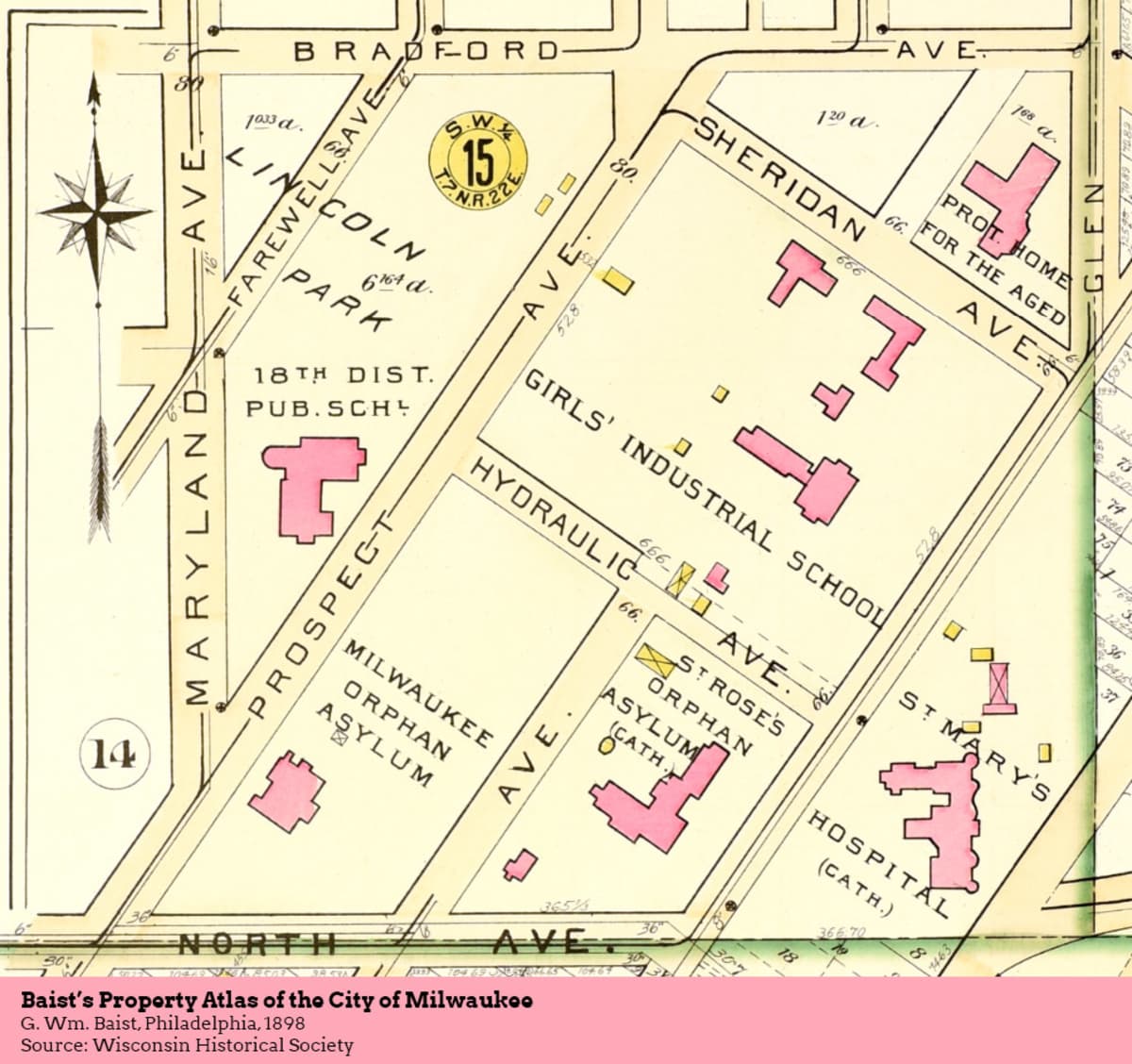
The parcel donated by the city was eight acres in size and at $16,000 was worth more than the legislature had allocated for the school itself. The location was at 2385 N. Lake Drive in Northport, close to the North Point Water Tower (see Oddsconsin 31) and only a few blocks from Bradford Beach and Lake Michigan. Eventually, the school campus would grow to encompass nine buildings. [6] As shown on the 1898 map at the head of this post, it was surrounded on all sides by benevolent institutions, including St. Mary’s Hospital (Catholic), St. Rose’s Orphan Asylum (Catholic), the Milwaukee Orphan Asylum (which Lynde was instrumental in creating), the Protestant Home for the Aged and the 18th District Public School. With the state providing funding, the Industrial School for Girls was renamed at this time to the Wisconsin Industrial School for Girls, which reflected its statewide mission. [2][3]
What kinds of girls were sent to the school? They included – in the language of the time – the viciously inclined, the stubborn and unruly, truants, vagrants, beggars, those found in danger of falling into habits of vice and immorality and those who had committed offenses punishable by fine or imprisonment. [5][6] But the school’s mission was reform, not punishment. Like the Industrial School for Boys in Waukesha, it was a place to build practical skills and receive moral instruction, inculcate discipline and education, and provide the care and restraints of a “well regulated Christian family.” [5] Its mission was to prevent “neglected and unfortunate young children from growing up in habits that would lead to pauperism, vice and crime.” [5] And so the girls learned cooking, dress-making, hat-making, weaving, sewing, knitting, housekeeping and laundry in addition to academic subjects through the eighth grade. [6]
Next week’s post will look at the factors that led to the abandonment of the school in Milwaukee and the state’s efforts to build a new school for girls elsewhere.
Sources
[1] Ellen D. Langill, Speaking with an Equal Voice: The Reform Efforts of Milwaukee’s Mary Blanchard Lynde, Wisconsin Magazine of History, Autumn 2003.
[2] Wisconsin Historical Society, Division of Library, Archives, and Museum Collections. Wisconsin School for Girls: Inmate Case History Books, 1875-1926. https://digicoll-dev.library.wisc.edu/cgi/f/findaid/findaid-idx?c=wiarchives;cc=wiarchives;view=text;rgn=main;didno=uw-whs-ser01381
[3] Asylum Projects, Wisconsin Industrial School for Girls. https://www.asylumprojects.org/index.php?title=Wisconsin_Industrial_School_for_Girls
[4] Young boys were also to be included, since at the time, boys below the age of ten could not be sent to the Reform School in Waukesha.
[5] National Register of Historic Places, Wisconsin Industrial School for Girls. https://npgallery.nps.gov/NRHP/GetAsset/NRHP/91001391_text
[6] Cynthia Sommer, An Evident Need – Citizens Responded, Murray Hill Neighborhood Association. https://murrayhillna.org/aboutus/neighborhood-history/milwaukee-industrial-school-for-girls/