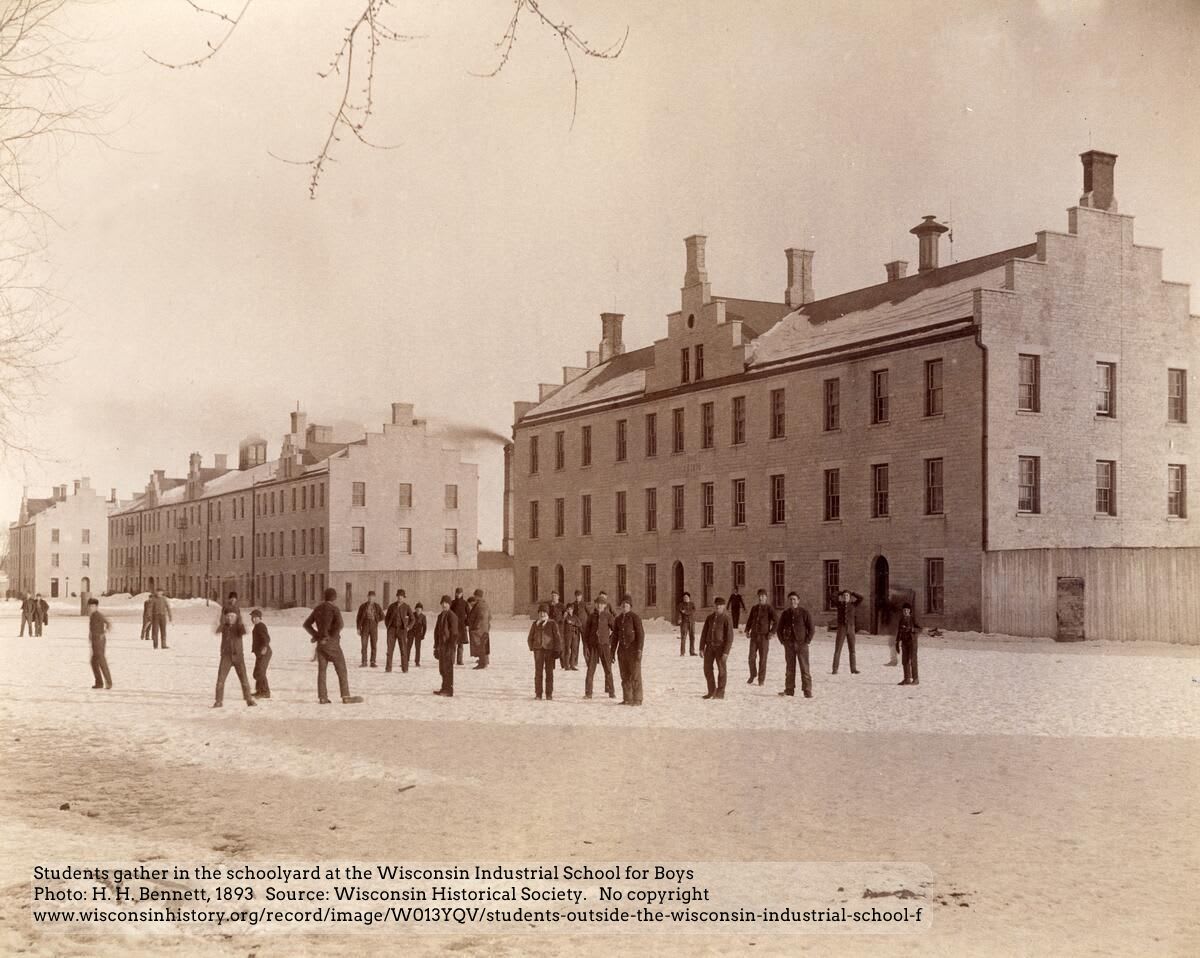
Brought up yonder grassy slope at first a careless and wayward vagrant, he shall go away in due time, manly and free, self-reliant, yet impressed with a sense of moral responsibility.
- J. B. D. Cogswell of Milwaukee, dedicatory address at opening of School for Boys, July 23, 1860. [1, pp. 402-03]
This is Part 2 of a two-part post. For Part 1 click here.
The Wisconsin Industrial School for Boys grew out of an 1857 act of the Wisconsin State Legislature authorizing a “House of Refuge for Juvenile Delinquents.” It was known as the State Reform School when it opened in Waukesha in 1860. The idea of housing juveniles separately from adult criminals was an innovation of the mid-nineteenth century reform movement. Prior to the establishment of the Reform School, juveniles convicted of crimes and misdemeanors might find themselves imprisoned alongside adults at the State Prison in Waupun. [1, p. 409]
According to contemporary accounts, those committed to the school included juveniles with vicious tempers and low, brutal tendencies as well as victims of unfortunate marriages and intelligent children with an extra amount of mischievousness. [1, p. 401] State statutes allowed for the incarceration of common drunkards, lewd and lascivious persons (in speech or behavior) and children with no visible means of support. Children under the age of ten could be incarcerated if they were found begging or selling items on the street, had no home, had a parent in prison, or were found in the company of lewd or lascivious characters. [1, p. 408]
The school was initially open to both boys and girls, but changed its name to the Industrial School for Boys when it became male-only in 1870. [2] The switch occurred, allegedly, due to the connection of some of the female residents with “low dance-houses or houses of ill-fame.” [1, p. 404] Girls were moved to the Wisconsin Industrial School for Girls in Milwaukee and, later, to the Wisconsin School for Girls just north of Oregon (Dane County). The Milwaukee school was demolished but the Oregon campus still exists and now operates as the minimum-security Oakhill Correctional Institution. [3]
The School for Boys was a place for training for future employment and to mold moral character. Trade instruction included shoemaking, manufacturing of apparel and furniture-making. Dairy cows, chickens and hogs were added later to facilitate agricultural training. The goods produced at the School for Boys were sold to help offset the costs of running the facility. In 1879, for example, the school turned out 40,000 pairs of socks and mittens and fifty cases of boots and shoes per week. The Chicago, Milwaukee and St Paul Railway established a side-track near the school to make shipping more convenient. [1, pp. 404-5] The sale of goods manufactured at the school was later abandoned as Wisconsin’s child labor laws became more restrictive. [4]
The reform movement of the mid-nineteenth century affected the entire country. Orphanages, mental asylums and poor houses were established nationwide. Some of these institutions were notoriously bad – such as the infamous National Soldiers’ Orphans’ Homestead in Gettysburg, Pennsylvania [5] – but they were actually the product of the enlightened idea that those who could not care for themselves should be provided for by the state.
In Wisconsin, partial funding for such institutions was provided by the state and soon they sprang up everywhere. From the middle of the nineteenth century to the first decade of the twentieth, for example, asylums for the mentally ill were established in at least one-half of Wisconsin’s counties. [2] Some of these facilities were large enough to hold hundreds of residents. But attitudes changed. By the mid-twentieth century, almost every one of these old buildings had been demolished in what can only be described as a violent repudiation of earlier standards of care.
And so it was with the Wisconsin Industrial School for Boys. All that remains of the once vast campus is the elementary school on the corner of Walton and West College Avenues.
When the School for Boys closed in the 1960s, the boys were moved to the Ethan Allen School for Boys in nearby Wales and the Kettle Moraine Boys School near Plymouth (Sheboygan County). Ethan Allen was built in 1907 as a tuberculosis sanatorium known as Statesan (state sanatorium). [6] It operated as a juvenile center until 2011. Kettle Moraine Boys School operated until 1974 and is now a facility for adult males. [7] Today the Department of Corrections operates Lincoln Hills School and Copper Lake School in Irma (Lincoln County) as a juvenile correctional facility for boys and girls. [8]
In terms of understanding what life was like at the School for Boys, maps and reports only go so far. Photographs, films and sound recordings exist, but Wisconsin’s juvenile confidentiality laws restrict general access to these materials. The Wisconsin Historical Society has some photographs online providing views of the buildings, interior rooms and recreation activities. [9] An early official history of the school – colored by nineteenth century attitudes and prejudices – is given in the History of Waukesha County, published in 1880, starting on page 401. [1] Here you’ll learn everything you might want to know about the rules of the institution, its buildings and assets, its annual budget, the products it made, the kinds of meals served, the names of the superintendents and staff, numbers of residents and much, much more. The only things lacking are the voices and perspectives of the residents.
Sources
[1] The History of Waukesha County, Wisconsin. Western Historical Company, Chicago, 1880. https://archive.org/details/cu31924028871627/page/n7/mode/2up
[2] Asylum Projects, Wisconsin Industrial School for Boys. https://www.asylumprojects.org/index.php?title=Wisconsin_Industrial_School_for_Boys
[3] Wisconsin Department of Corrections, Oakhill Correctional Institution. https://doc.wi.gov/Pages/OffenderInformation/AdultInstitutions/OakhillCorrectionalInstitution.aspx
[4] National Register of Historic Places, Wisconsin Industrial School for Boys. https://npgallery.nps.gov/GetAsset/3b1a0a36-8531-4200-bcd6-86de6b87de72
[5] Gettysburg History, National Soldiers’ Orphans’ Homestead. https://gettysburghistory.org/national-soldiers-orphans-homestead/
[6] National Register of Historic Places, Statesan Historic District. https://npgallery.nps.gov/NRHP/GetAsset/NRHP/88000454_text
[7] Wisconsin Department of Corrections, Kettle Moraine Correctional Institution. https://doc.wi.gov/Pages/OffenderInformation/AdultInstitutions/KettleMoraineCorrectionalInstitution.aspx
[8] Wisconsin Department of Corrections, Lincoln Hills and Copper Lakes Schools. https://doc.wi.gov/Pages/AboutDOC/JuvenileCorrections/LincolnHillsCopperLake.aspx
[9] Wisconsin Historical Society, Search results for ‘School for Boys’. https://www.wisconsinhistory.org/global-content/global-search/?keyword=school%20for%20boys&fq=community%3AWaukesha