On July 2, 1881, Charles Guiteau shot US President James Garfield at a train station in Washington, DC. Garfield, the twentieth President, had been elected only a few months earlier. Guiteau was clearly mentally disturbed. Born in Freeport, Illinois – just south of Green County, Wisconsin – Guiteau as an adult developed a passion for politics. He was a member of the Stalwart faction of the Republican Party, who advocated for a political spoils system in which supporters were rewarded with government jobs.
The attitude of the Stalwarts goes some way to explaining Guiteau’s actions. His decision to kill Garfield was apparently instigated by his obsession with being named to a diplomatic post, a position he was wholly unqualified for and never received. He concluded that killing Garfield was a political necessity.
Garfield lingered on until September 1881, when he died of an aneurysm, although there is speculation that the real cause of death was a massive infection brought on by doctors probing his wound with their fingers. Guiteau was put on trial, and despite much debate about his sanity, which expert witnesses could never agree on, he was found guilty and hanged in June 1882. [1] At his trial, Guiteau famously stated, “I did not kill the President. The doctors did that. I merely shot him.” [2]
Guiteau’s Wisconsin connection is his childhood in Port Ulao (Ozaukee County), now an abandoned “ghostport” on the shores of Lake Michigan a mile east of the intersection of Interstate 43 and Highway 60. In the 1850s, Port Ulao was a bustling harbor where lake steamers stopped to purchase local cordwood. A huge chute ran from the top of the bluff to a pier on the shoreline. Among the prominent citizens of Port Olau were Jane Gifford and her husband Luther Guiteau. Charles was their son. The family lived there for five years, until 1857, and Jane is buried there. [3]
Wisconsin has connections to other presidential assassinations and attempted assassinations. During the current era of heightened political violence, we may forget that the late 1800s and early 1900s were also politically tumultuous. It was a time of economic and social change, and one of the key flash points was the growing labor movement.
One example is the Pullman Strike on the south side of Chicago in 1894. Workers at George Pullman’s Palace Car Company made luxurious railroad cars and lived in the company town Pullman established for them. (The Pullman neighborhood of Chicago is still in existence.) During the depression of the 1890s, Pullman lowered workers’ wages without also reducing rents. This led, ultimately, to a walkout of tens of thousands of workers and sympathizers across the country. President Grover Cleveland called in federal troops and dozens of people were killed or wounded in skirmishes. [4][5]
Many other violent altercations occurred across the country – far too many to describe in this post. Almost all sectors of the economy were affected, including mining, lumbering, meat packing, shipping, manufacturing and agriculture. It was a tumultuous era.
The violence was also linked to the rise of revolutionary movements like Socialism and Anarchism. [6] Bombs were a favorite weapon. The Los Angeles Times building was bombed in 1910. [7] Former Harvard professor Erich Muenter bombed the US Capitol in 1915. [8] In 1919, a series of bombings occurred in eight cities, including Washington, DC, where an explosion damaged the home of the US Attorney General. The next year, a bomb exploded on Wall Street in lower Manhattan, killing 40 people. [9]
Wisconsin was not spared. In November 1917, a bomb planted inside the Milwaukee Central Police Station killed nine police officers and two others. [10]
Most of these attacks were attributed to Anarchists, a somewhat nebulous group advocating for the abolition of government institutions. But other incidents were related to opposition to government actions, such as the decision to enter the First World War in 1917. The history is complex and can easily be oversimplified.
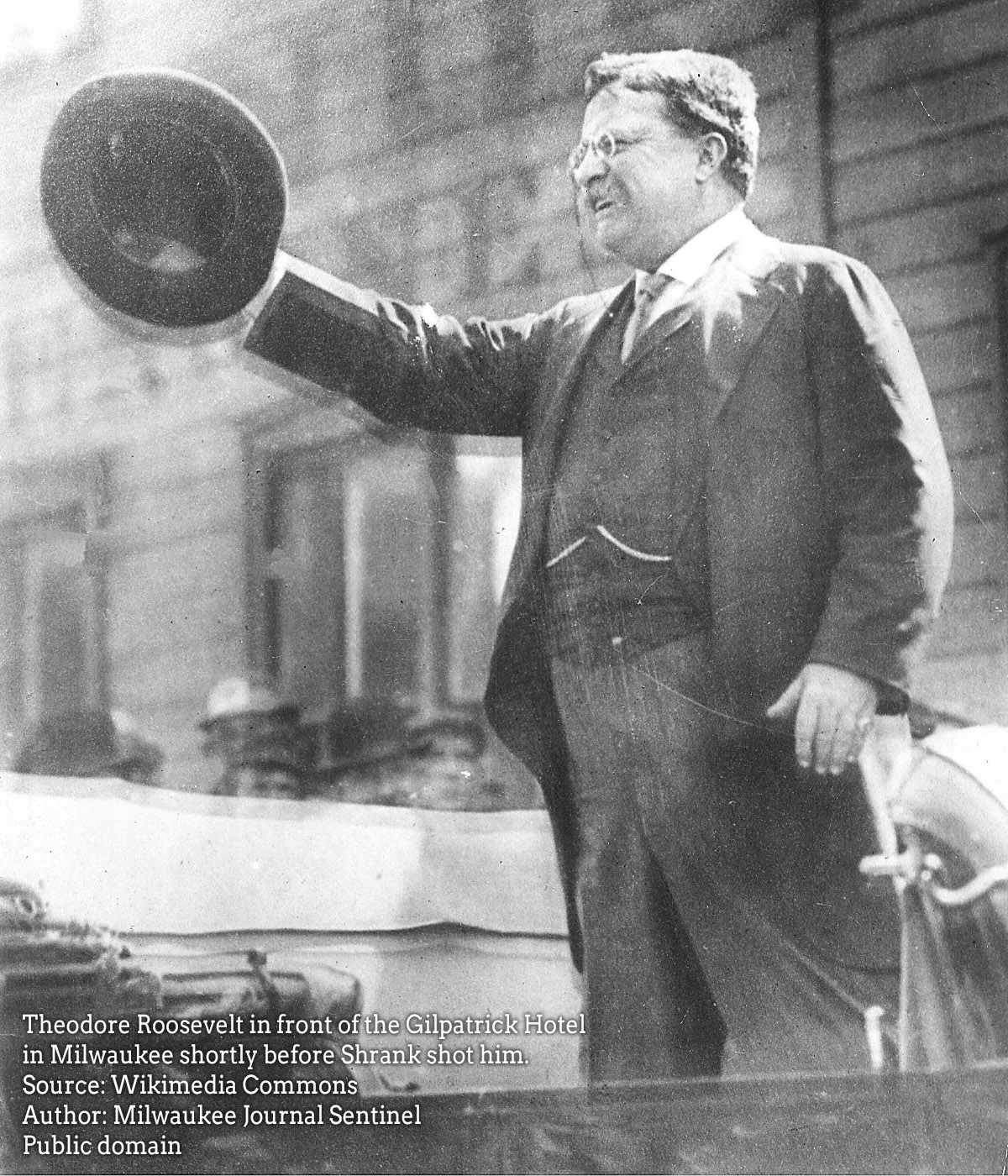
Milwaukee was also home to one of the most bizarre assassination attempts in history. On October 14, 1912, former President Theodore Roosevelt was in the city to deliver a campaign speech on his run for a third term in office. [11] Roosevelt was the Vice President under William McKinley but became President when McKinley was shot and killed in 1901 in Buffalo, New York, by Leon Czolgosz. Reflecting the turbulence of the era, Czolgosz was a professed Anarchist. [12]
Roosevelt’s two terms as President ended in 1909. In 1912, he was running as leader of the National Progressive Party, also known as the Bull Moose Party. When he walked outside of Milwaukee’s Hotel Gilpatrick, on North Third and West Kilbourn (now Dr. Martin Luther King Jr. Dr.), he was shot at close range by John Schrank. Shrank was immediately apprehended. Shrank, who stated he was acting on orders from the ghost of President McKinley, was later committed to the Central State Hospital in Waupun (Oddsconsin 69) where he died in 1943. His body was donated to the medical school at Marquette University. [13]
After being shot, Roosevelt insisted on delivering the speech he had prepared. The bullet had apparently struck the folded, fifty-page speech manuscript he had in his pocket, saving his life. However, he had a broken rib and was bleeding. Roosevelt carried the bullet in his chest for the rest of his life, doctors believing it was too risky to extract. It was a permanent memento from his Wisconsin trip.
Roosevelt’s first words to the crowd who had gathered for his speech were, “Friends, I shall ask you to be as quiet as possible. I don't know whether you fully understand that I have just been shot; but it takes more than that to kill a Bull Moose.” [14]
There’s a plaque at the shooting site today, inside the lobby of the Hyatt hotel.
Sources and Notes
[1] Douglas O. Linder, The Trial of Charles Guiteau: An Account. Famous Trials. https://famous-trials.com/guiteau/2197-home
[2] National Park Service, The Execution of Charles Guiteau. https://www.nps.gov/articles/000/the-execution-of-charles-guiteau.htm
[3] Town of Grafton, History of the Town of Grafton. https://townofgraftonwi.gov/town-history/
[4] Britannica, Pullman Strike. https://www.britannica.com/event/Pullman-Strike
[5] The leader of the labor movement at Pullman was Eugene Debs, who in 1920 became possibly the only person to run for the presidency (for the Socialist Party) from prison. He had been incarcerated under the 1918 Sedition Act for criticizing the US’s involvement in the First World War.
[6] One of the byproducts of these violent acts was Red Gym at UW-Madison. The violence “caused a fear of class warfare to become widespread among upper and upper-middle class Americans. As a result, there was a surge of armory building beginning in the late 1870s. It was believed that armories would be necessary as places for troops to assemble and arm in order to quell mob violence that would be led by the so-called dangerous classes socialists, communists, and labor unionists.” National Register of Historic Places, University of Wisconsin Armory and Gymnasium. https://npgallery.nps.gov/GetAsset/52e5ea5c-9daa-4bf5-b6d4-48afbea5a282
[7] Ray Taylor, Labor Struggle and Violence in Industrial America: the 1910 LA Times Bombing. Teaching American History, 2024. https://teachingamericanhistory.org/violence-and-the-labor-struggle-in-industrializing-america-the-1910-la-times-bombing/
[8] United States Senate, Bomb Rocks Capitol. https://www.senate.gov/about/historic-buildings-spaces/capitol/bomb-explodes-1915.htm
[9] Digital History, Terrorism in Historical Perspective. https://www.digitalhistory.uh.edu/topic_display.cfm?tcid=94
[10] Milwaukee Police Department, November 24, 1917 Bombing. https://city.milwaukee.gov/police/About-MPD/Memorial-Page/1917-Bombing
[11] The 22nd Amendment to the US Constitution limiting presidents to two terms was not in place until 1951, after another Roosevelt (FDR) served four consecutive terms.
[12] Czolgosz was convicted of murder and executed in the electric chair at Auburn Prison in upstate New York (see Oddsconsin 68).
[13] Milwaukee Police Historical Society, Roosevelt Shooting. https://www.mphswi.org/HighProfileHistory/RooseveltShooting
[14] Theodore Roosevelt Association, It Takes More Than That to Kill a Bull Moose. https://www.theodoreroosevelt.org/content.aspx?page_id=22&club_id=991271&module_id=338394