Wisconsin began building its first state prison at the time it abolished capital punishment in 1853. The two events are causally linked. Without capital punishment, a prison became a necessity, since local jails were not designed for long-term confinement of criminals who would otherwise have been executed. After the 1851 hanging of John McCaffary, convicted of murdering his wife Bridget, no further executions were carried out under the authority of the state. Going forward, the state prison would house those convicted of violent crimes. (See Oddsconsin 55)
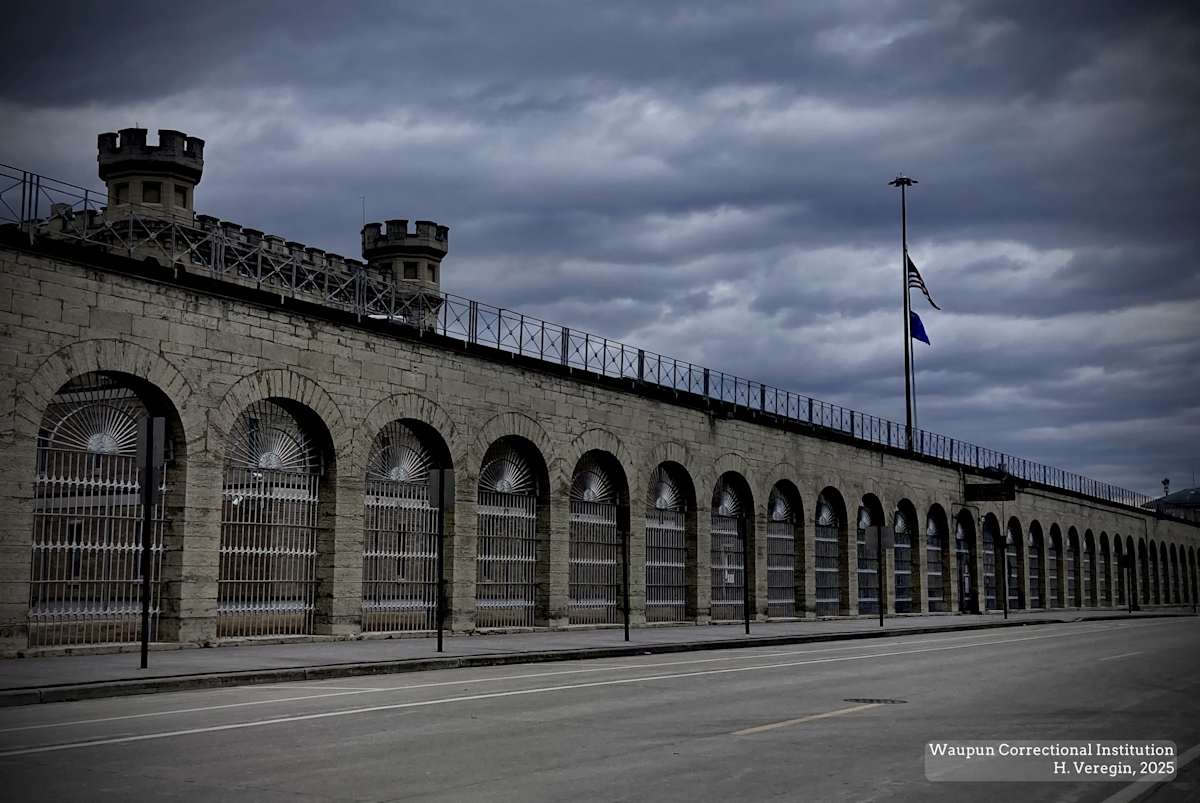
Wisconsin State Prison – or, as it is now known, Waupun Correctional Institution – is located in a residential district in the City of Waupun (Dodge County). The prison faces Madison Street, where the prison’s long front wall extends for hundreds of feet. High walls around the rest of the compound form a rectangular area that is almost forty acres in size.
The choice of Waupun as the location for the prison was a matter of heated debate in the middle of the nineteenth century. The other main contender was Madison, although Fort Winnebago – unused by the military since 1845 – was also briefly considered. In the 1851 legislative session, various bills were introduced advocating for one location or another. [1]
One of the drawbacks of Madison was the cost of acquiring property, proving that some things have not changed in almost two hundred years. It was estimated that a prison in Madison would cost over a million dollars, while only three thousand had been initially allocated. [1]
Eventually, a prison commission was formed to deal with site selection. In 1852, the commission submitted a report to the governor recommending Waupun. The city had everything thought necessary – an existing community, access to railroads, a source of water, and supplies of both lumber and limestone for building the prison itself. Construction of a temporary prison in Waupun began in late 1852. [1]
The decision was met with anger by some, who suggested corruption may have had a hand in the process. Why tempers ran so hot is hard to say. Perhaps there was genuine concern about choosing a location so far from Madison. Perhaps there were other motives. Nevertheless, and in part because the temporary prison was already under construction at Waupun, the decision was final and construction of the permanent facility soon began.
The oldest part of Wisconsin State Prison is the South Cell House, constructed in 1854-55. It connects to the prison’s Main Building, completed in 1858 to house administrative offices. The North Cell House, built in the 1860s, connects to the Main Building on its north side. [2] These three buildings – still in use today – form a long façade facing Madison Street. [3]
Over the decades, numerous modifications and additions have been made to the prison, including a kitchen (1894), additional cell houses (1906-14), a dining room attached to the kitchen (1913-14), a hospital (1940s), bath houses (1950s), a chapel (1960s), a solitary confinement facility (1960s) and various workshops and industrial outbuildings on the west side of the prison complex (through the 1950s). The latter were built to provide work for prisoners. [2] The prison also housed female prisoners (in a separate building) until 1933, when they were moved to the Wisconsin Industrial Home for Women in Taycheedah. [4]
Guard towers punctuate the tall wall that surrounds the prison complex. The original prison wall, twenty-four feet high and buried to a depth of eight feet under the ground, was built in 1858-61. The ornate front wall on Madison Street dates to the 1850s. [4] This wall is eighteen feet high and consists of a multitude of stone arches and pillars with iron gates. [2]
Early photos and views capture the appearance of the prison in ways that words cannot:
1865 elevated view of Wisconsin State Prison
1915 aerial view of Wisconsin State Prison
Exterior view of Waupun State Prison
The crenelated parapets of the Main Building are reminiscent of something out of a Dickens novel. It looks every bit the Victorian-era building that it is. However, the design of the prison was actually quite progressive for its time. It was modeled on the so-called Auburn style, in which prisoners were assigned to their own cells rather than dungeons, underground chambers or multi-prisoner cells.
The Auburn system arose at the same time and with some of the same motives that lay behind asylums, workhouses and poor houses. They were inspired by progressive, humanitarian influences. These institutions sought not just to incarcerate but to correct and mold inmates through honest work and moral instruction. These goals were met with varying levels of success in different locations.
The Auburn system was based on the design of Auburn Prison in the Finger Lakes region of upstate New York. Opened in 1818, the prison’s defining feature was its tiers of cells stacked on top of each other and overlooking an open gallery. Access to the cells was via metal stairs and catwalks, interspersed with locked metal doors. Wisconsin State Prison followed the Auburn design, as seen in this 1910 photo.
Auburn was also the model for New York’s infamous Sing Sing Prison (aka “The Big House”) [5], the setting of almost every 1930s prison film. The prison interior, with its tiers of cells, is an iconic look. You can almost imagine Edward G. Robinson sneaking up behind a prison guard with a gun carved out of a bar of soap. [6]
Auburn Prison also has the distinction of being the first prison to use the electric chair as a means of execution. (Unlike Wisconsin, New York had not banned capital punishment.) Like the Auburn style itself, the electric chair was thought to be more humanitarian than hanging. But its initial use in 1890 on convicted killer William Kemmler was a shocking display of inhumanity. [7]
Today, Waupun Correctional Institution is a maximum-security facility. Officially, it houses over 800 inmates, all male, almost 90 percent of whom were convicted of a violent crime. [8] Life in the prison was obviously never very pleasant, but its age and antiquated design must add an extra layer of misery and despair. (See this account for an insider’s perspective.)
Want Oddsconsin delivered to you inbox every week? Subscribe here!
Sources and Notes
[1] Daniel Belczak, Blood for Blood Must Fall. PhD Dissertation, Department of History, Case Western Reserve University, 2021.
[2] National Register of Historic Places, Wisconsin State Prison Historic District, 1991. https://npgallery.nps.gov/AssetDetail/NRIS/91001994
[3] It’s hard not to notice the same symmetry in the three oldest buildings on the UW-Madison campus – South and North Hall, both originally dormitories, and Bascom Hall, the original administrative center of the university, which sits between the two dormitories.
[4] Department of Corrections, Waupun Correctional Institution. https://doc.wi.gov/Pages/OffenderInformation/AdultInstitutions/WaupunCorrectionalInstitution.aspx
[5] Sing Sing Prison Museum, History of Sing Sing Prison. https://www.singsingprisonmuseum.org/singsinghistory.html
[6] This scene apparently never actually occurred in a 1930s prison film. However, the final scene of 1938’s Angels with Dirty Faces, where Rocky Sullivan (played by James Cagney) walks to the Death House, was filmed at Sing Sing.
[7] See this description of the execution. The electric chair was adopted following a series of public events conducted by Thomas Edison. Edison was a proponent of DC (direct current) while his nemesis, Nikola Tesla, advocated for AC (alternating current). (Ironically, the Tesla automobile runs on DC.) In the late nineteenth century, Edison electrocuted dogs, calves and horses in public exhibitions to show the danger of Tesla’s AC. The New York correctional system was impressed with what they saw. There’s another Wisconsin connection here, in Appleton’s Vulcan Street Electric Plant. Opened in 1882, it was one of the first commercial hydroelectric plants to utilize Edison’s DC generators. (See Oddsconsin 13.)
[8] Department of Corrections, Waupun Correctional Institution Fact Sheet. https://doc.wi.gov/DataResearch/DataAndReports/WCIInstitutionalFactSheet.pdf