Wisconsin was one of the first states to abolish capital punishment. In 1853, the legislature passed a law stipulating that “for the crime of murder in the first degree, the penalty shall be imprisonment in the state prison, during the life of the person so convicted; and the punishment of death, for such offence, is hereby abolished.” [1]
The state prison had been established at Waupun only two years earlier, with the first permanent building completed in 1854. [2] The creation of the state prison was a necessary first step to abolishing the death penalty, since local jails were not secure enough and could not provide the resources needed for long-term incarceration.
Before Wisconsin achieved statehood in 1848, several executions were carried out under the authority of the territorial government. These were murder cases that all involved seemingly minor disputes – an argument over a borrowed boat that was not returned (1838), a disagreement about the order in which guests would dance at a party (1842) and a squabble over the location of a fenceline (1846).
The only execution ever carried out under the authority of the state government after 1848 was that of John McCaffary, an Irish immigrant, who was convicted of murdering his wife Bridget. McCaffary was hanged in Kenosha in 1851. The story was widely debated in newspapers at the time, with proponents of capital punishment sparring with abolitionists who were morally opposed to the practice. [3]
But almost ten years before McCaffary, on February 11, 1842, another killing took place with much different results. The event was witnessed by dozens of people, but the perpetrator, James Vineyard, was acquitted of the crime and went on to live a successful life as a public figure. The contrast between the treatments of Vineyard and McCaffary is, in part, what led to the abolition of capital punishment in Wisconsin.
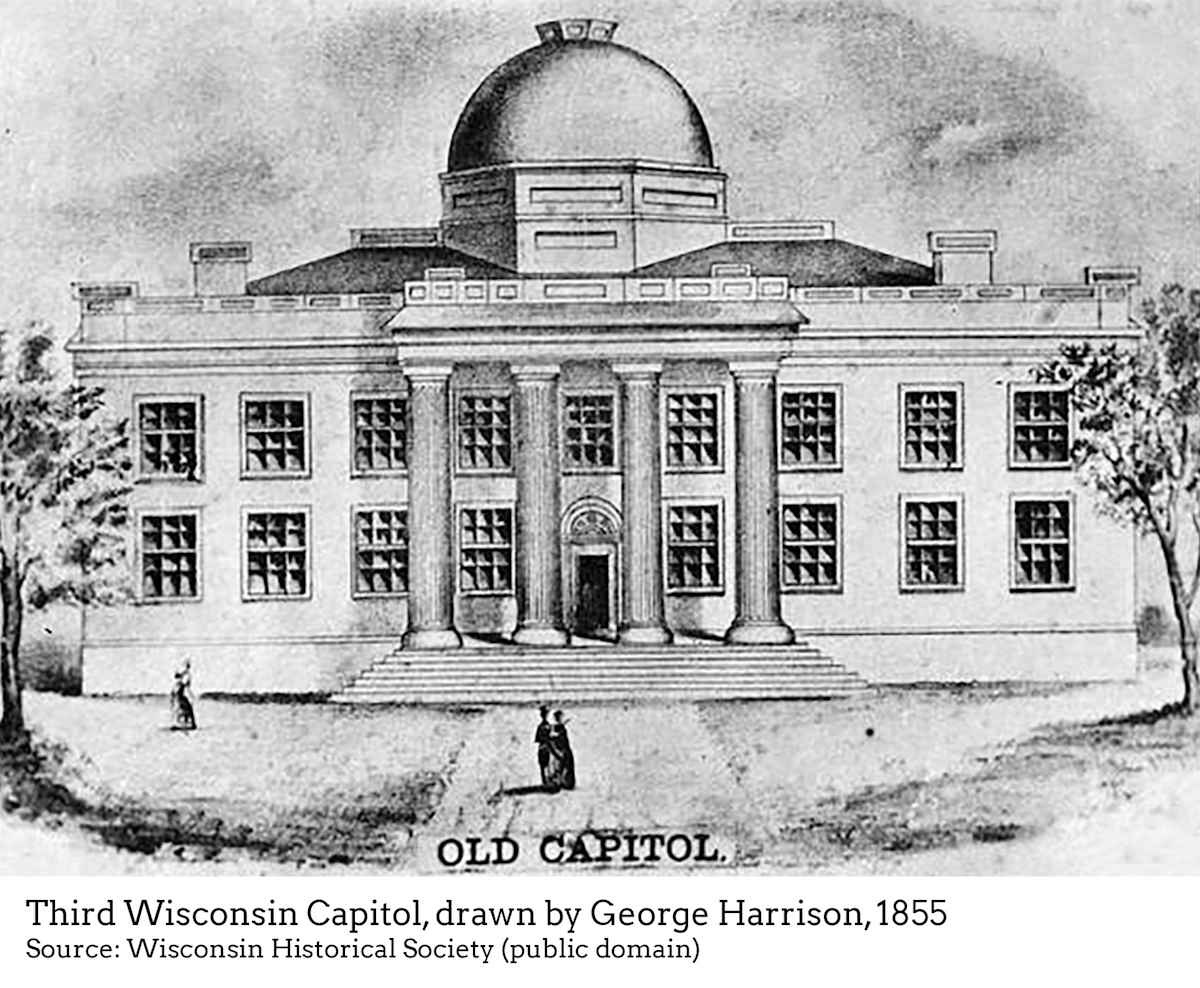
What makes the Vineyard case even more remarkable is that Vineyard and the victim – Charles Arndt – were both members of the Wisconsin Territorial Council and the killing took place in the Capitol in Madison.
The Territorial Council was in session when Vineyard and Arndt entered into a heated debate about the appointment of one Enos Baker as Grant County Sheriff. Arndt approved of the appointment and Vineyard did not. At one point, Vineyard apparently made disparaging remarks about Arndt’s character.
Historian Milo Quaif explains what happened next. When the council adjourned after the vote,
Arndt thereupon approached Vineyard and demanded to know if the latter had meant to impute falsehood to him in his remarks. Vineyard answered that he had, whereupon Arndt struck him in the face; whether with open or clenched hand is uncertain. Vineyard reeled or drew back a pace and instantly producing a pistol, shot his opponent through the breast. The stricken man fell into the arms of William S. Dering, who held him until he died without uttering a word, perhaps five minutes later. [4]
The shooting was witnessed by many council members, including Arndt’s father, a prominent judge, who was also a member of the Territorial Council.
Stranger still is the fact that Arndt and Vineyard were friends. Vineyard had boarded with the Arndt family in Green Bay and, as Quaif notes,
on the very morning of the killing, the two men were observed in the lobby of the Council Chamber, their arms thrown about each other's shoulders in affectionate attitude, engaged in familiar discourse. [4]
Charles Cotesworth Pinckney Arndt was only thirty at the time of his death. Born in Wilkes-Barre, Pennsylvania, he was elected to the Territorial Council in 1839. James Russell Vineyard (sometimes spelled Vinyard) was born in Frankfort, Kentucky, and was elected to the council in 1838.
After shooting Arndt, Vineyard retired to his room in the nearby American Hotel, where he was arrested and taken to Dane County Jail. He was expelled from the Territorial Council the next day, after attempting to resign. A short time later, he was released on $20,000 bail. At this point, the story becomes even stranger.
For the conclusion to the story, tune in next week for Oddsconsin 56.
Want Oddsconsin delivered right to your inbox? Subscribe here.
Sources and Notes
[1] Wisconsin Legislature, General Acts Passed by the Legislature of Wisconsin. https://docs.legis.wisconsin.gov/1853/related/acts/103.pdf
[2] Wisconsin Department of Corrections, Department History. https://doc.wi.gov/Pages/AboutDOC/DepartmentHistory.aspx
[3] Daniel Belczak, Blood for Blood Must Fall: Capital Punishment, Imprisonment, and Criminal Law Reform in Antebellum Wisconsin. PhD Dissertation, Department of History, Case Western Reserve University, 2021.
[4] Milo M. Quaife, Wisconsin’s Saddest Tragedy, The Wisconsin Magazine of History, Vol. 5, 1921-1922, pp. 264-83.