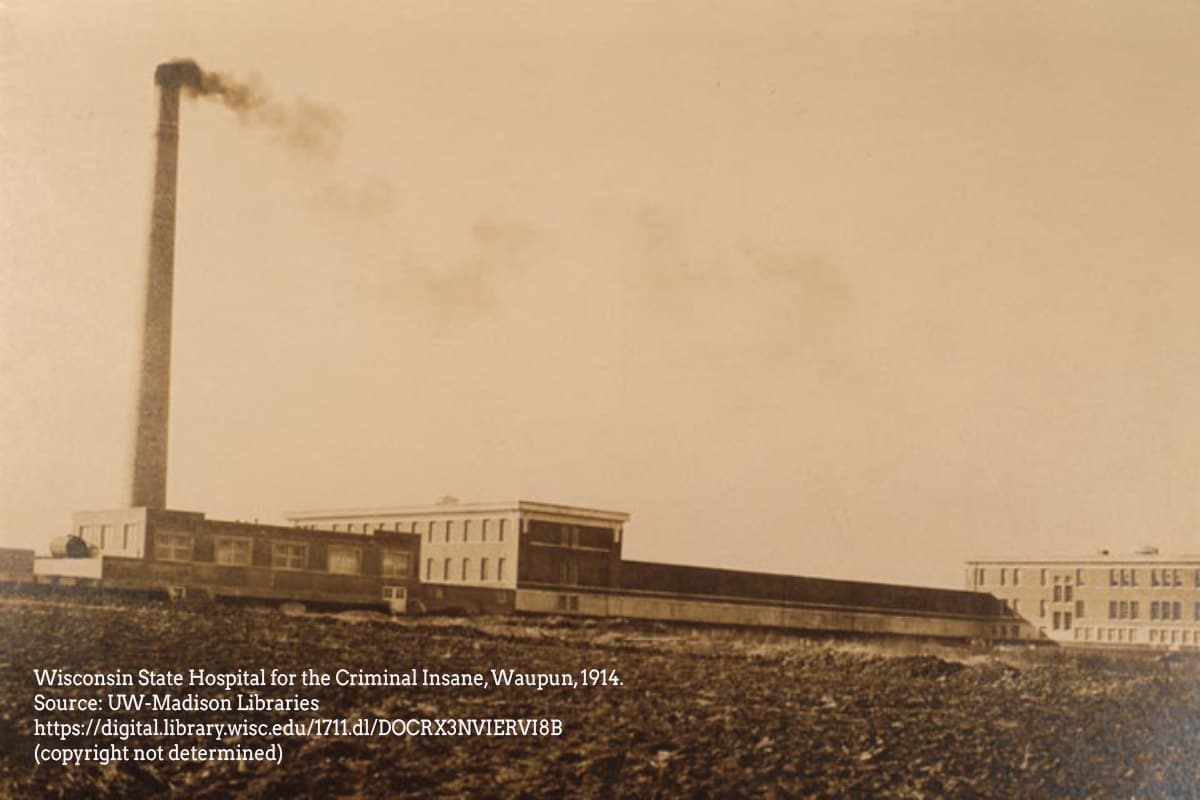
As we saw last week in Oddsconsin 68, the City of Waupun (Dodge County) is home to Wisconsin’s first state prison, established in the 1850s. Now known as Waupun Correctional Institution, it is a maximum security facility, one of six in the state. Just south of the prison and also in Waupun is Dodge Correctional Institution, another maximum-security prison, which began its life as the State Hospital for the Criminal Insane. It remains the only hospital in Wisconsin designed exclusively for the criminally or violently mentally ill. [1]
Construction of the State Hospital for the Criminal Insane began in 1914. Prior to statehood, townships generally cared for the poor and mentally ill in poorhouses and asylums. Counties began constructing mental asylums in the 1880s after the state passed legislation providing funds for construction costs and patient care. By 1896, twenty-three county asylums had been built. [2] Some examples are discussed in Oddsconsin 2 and Oddsconsin 9.
In 1860, the state built its own asylum – Wisconsin Hospital for the Insane – on the shores of Lake Mendota north of Madison. The building survived for a century, but was demolished in the 1960s. The area is now the campus of the Mendota Mental Health Institute (Oddsconsin 1). A second state asylum was constructed in Winnebago in 1873. This facility is now known as the Winnebago Mental Health Institute.
The State Hospital for the Criminal Insane in Waupun was built specifically to house the mentally ill who were violent or had committed serious crimes – individuals who were unwelcome in prisons or county asylums. Mental health advocates argued that these individuals needed a special type of facility, one that dealt with them as mental patients but also recognized their potentially violent tendencies.
In 1909, the legislature appropriated funds for such a facility. Waupun was selected as the location, where it was initially placed under the control of nearby Wisconsin State Prison. [1] The design of the new hospital was modular, having a central corridor with attached wings to provide a means for future expansion. Construction began in 1914 and the first patients were admitted that same year. It was a male-only facility.
Following psychiatric theories of the time, the hospital was designed to feel as unhospital-like as possible. Walls were painted in pastel colors and the grounds were carefully landscaped. The wall surrounding the hospital was dug into a deep moat to be unobtrusive, yet still unscalable. [1]
Additional wings were added through the 1930s. Eventually the facility had an administrative wing, a kitchen and dining room, a dairy, an ice house, a barn, a chicken coup, a root cellar, a machine shed, a smoke house, a pig pen, a garage, a warehouse and a machine and carpenter shop. [1] Patients were often put to work as part of their therapy. In 1917, the name of the facility was changed to Central State Hospital to reduce the stigma of labeling inmates as “insane.”
From the start, the hospital faced chronic overcrowding, with some patients sleeping in basement dormitories or hallways. [1] Funding was always insufficient and the patient-to-doctor ratio was in the hundreds. Treatments were primitive, often involving restraint, sedation, hydrotherapy (warm baths), insulin shock therapy (doses of insulin to induce hypoglycemia), electric shock therapy (popularized in the First World War, when it was called torpillage, a French word meaning “torpedoed”) and even lobotomies (surgery to sever connections in the brain’s prefrontal cortex).
By the 1970s, the consensus was that the hospital was failing at its mission of treating its patients and had evolved into simply another penal institution. At the same time, due to administrative changes, the hospital became the intake center for mandatory screening and evaluation of individuals convicted of a sex crime. In 1977, the legislature authorized funds to convert the hospital into an adult correctional facility and the next year, the first two inmates were transferred there from Waupun Correctional Institution. [3]
By the 1980s, the facility had become an intake center for the Department of Corrections and was renamed Dodge Correctional Institution (DCI). Today, the primary purpose of DCI is to manage first-stage processing of adult male inmates entering state custody, including health screenings, mental health checks and custody evaluations. [4] From DCI, prisoners are sent to one of Wisconsin’s other correctional institutions.
DCI is a male-only facility, but performed intake on women prisoners from 1996 to 2004, when female intake was transferred to Taycheedah Correctional Institution. [3]
Despite the construction of new wings, overcrowding is still a problem at DCI. According to Department of Corrections statistics, DCI has a capacity of 1,165 but a population of over 1,800. [5] Twenty percent of the inmates are sex offenders and about half have been convicted of a violent crime. For almost half of the inmates, it’s their first time being incarcerated. Almost 6,500 prisoners are processed through the facility each year.
It’s difficult to get a good view of DCI from the ground. It’s on a large piece of land, the buildings are only one and two stories in height and there’s a metal security fence around the compound with guard towers at the corners. Air photos show that the original inner wall and moat are still in existence well within the perimeter of the metal fence.
Infamous inmates of DCI include serial killer Jeffrey Dahmer (in 1991, before being transferred to Columbia Correctional Institution in Portage, where he was beaten to death by another inmate), Ed Gein (in the 1950s, later transferred to Mendota Mental Health Institute where he died in 1984) and John Schrank, who shot then former President Teddy Roosevelt in Milwaukee in 1912 when Roosevelt was giving a speech. After Schrank was apprehended, Roosevelt completed his speech even though the bullet fired from Schrank’s pistol had broken one of his ribs. [6]
Sources
[1] National Register of Historic Places, Central State Hospital Historic District. https://npgallery.nps.gov/AssetDetail/NRIS/91001395
[2] James E. Heg, Wisconsin County Asylums for the Chronic Insane. Madison: Democrat Printing Company, 1896. https://digirepo.nlm.nih.gov/ext/dw/101189292/PDF/101189292.pdf
[3] Department of Corrections, Dodge Correctional Institution. https://doc.wi.gov/Pages/OffenderInformation/AdultInstitutions/DodgeCorrectionalInstitution.aspx
[4] Wisconsin Inmate Locator, Dodge Correctional Institution Inmate. https://wisconsinprison.org/dodge-correctional-institution-inmate/
[5] Department of Corrections, Dodge Correctional Institution FY 2025 Annual Report. https://www.wistatedocuments.org/digital/collection/p267601coll4/id/35832/rec/1
[6] Theodore Roosevelt Association, It Takes More Than That To Kill A Bull Moose. https://www.theodoreroosevelt.org/content.aspx?page_id=22&club_id=991271&module_id=338394