You can't make an omelet without breaking eggs … when you operate in an overbuilt metropolis, you have to hack your way with a meat axe.
- Robert Moses, mid-century planner
This is Part 2 of a two-part series on the Wisconsin Industrial School for Girls. Read Part 1 here.
State funding for the Industrial School for Girls in Milwaukee was always haphazard. Food, clothing and supplies were paid by each girl’s home county. The state made small appropriations for building maintenance, care of the grounds and other services. But the bulk of the funding came from private donors, while volunteers like Mary Blanchard Lynde operated the facility. [1]
The situation did not fundamentally change when responsibility for the school was moved to the State Board of Control – a successor to the State Board of Charities and Reform – in 1917. Some of the school’s buildings, which had been built in the cheapest possible manner due to a lack of funds, needed repair. [2] But again the state balked, arguing that the buildings were too old and dilapidated to warrant further investment. It took over a decade for the legislature to finally arrive at a solution – a new school for girls just north of Oregon (Dane County). In a special legislative session in 1928, the state allocated $400,000 to the Board of Control to build the new facility. But even this fell short, given that the Board of Control had estimated the cost at $1,200,000. [2]
Still, construction of the new school soon began. Unlike the Milwaukee school, it was situated in a rural, wooded area with ten cottage-like dormitories scattered on an expansive campus. The dormitories were two stories high and constructed of stone for durability and fire safety. Each had its own kitchen, laundry, dining room, living room with a fireplace, porch and patio, matrons’ rooms and visitor’s room. Each resident had a private bedroom, with each cottage holding about twenty-one girls. The campus also contained a school building with classrooms, administrative offices, a gymnasium with a stage, a music room, a domestic science room, a beauty culture lab, a sewing room and living quarters for staff. [2][3]
The Wisconsin Historical Society has a small collection of photographs of the school buildings. [4] The campus is attractive in its own way, but interior shots show that the bedrooms were very small and spare, with a single bed, a desk, a night table, a narrow window and exposed pipes along the walls.
The Oregon school was praised by the Board of Control as a model institution. Unlike the Milwaukee school, there was ample room for a garden to grow vegetables, while the hilly landscape provided opportunities for picnics, hikes and sledding. The cottage layout was thought to provide a home-like atmosphere and the private bedrooms contributed to personal autonomy and individuality.
Unfortunately, funding from the state continued to be a problem. The dormitories were finished in 1932 but sat unoccupied for nearly a decade when the state did not appropriate more money to complete the campus. [5] Through the efforts of the Board of Control, funds were finally allocated in 1939 and the campus was completed in 1941.
After all that, the Oregon facility served as a school for girls for only a few decades. In 1976, it was converted to a minimum-security adult correctional facility, which it remains today. Known as Oakhill Correctional Institution, it holds over eight hundred male prisoners. [6]
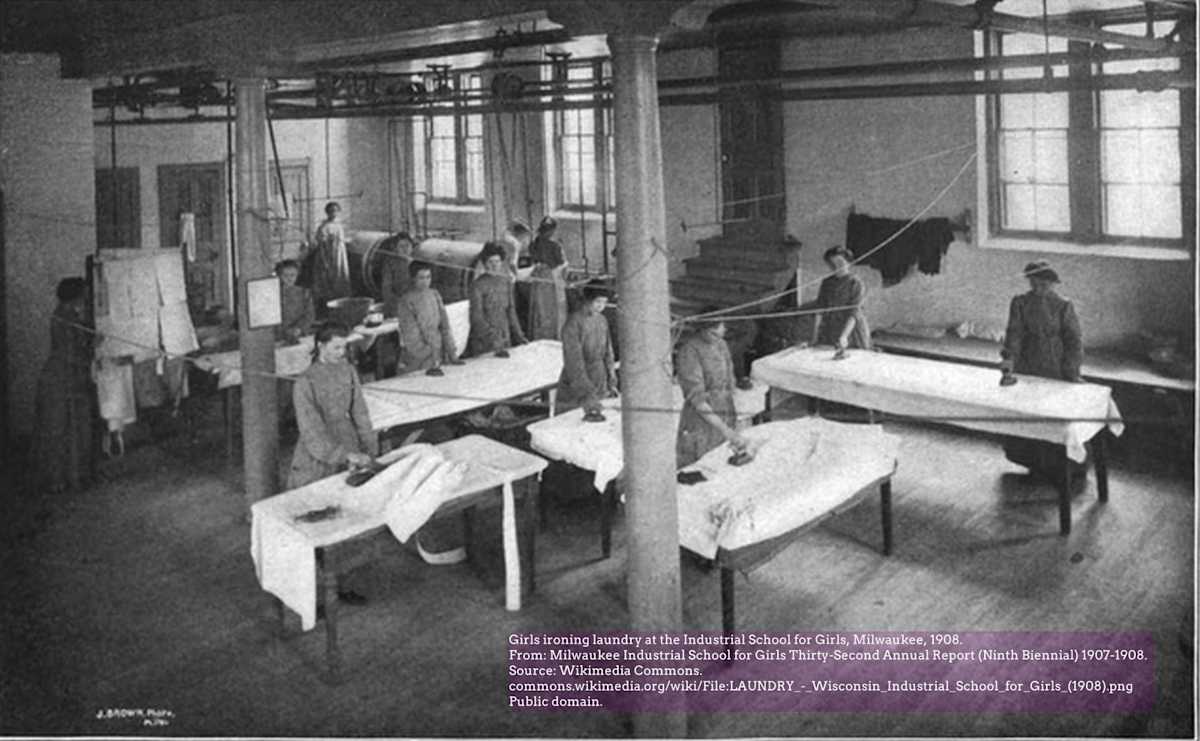
Back in Milwaukee, with the transfer of ninety-four girls to Oregon in 1941, the Industrial School for Girls was turned over to the Division of Public Assistance, which used the facility to provide services to the blind. Abandoned in 1965, the buildings which originally housed the Wisconsin Industrial School for Girls were then destroyed. [2]
These two industrial schools – the first in Milwaukee and the second in Oregon – are the only state facilities in Wisconsin constructed exclusively for juvenile girls. [2][7] The design of the school buildings and campuses reflect the ideas and ideals of the reform and progressive movements in the state from the mid-nineteenth century to the beginning of the twentieth. In this period, the social welfare programs of the Franklin D. Roosevelt administration in the 1930s had not yet been enacted, and the state’s poorest citizens had few options available when a crisis occurred. The establishment and development of the Industrial School for Girls was a direct response to this situation, first by a concerned group of Milwaukee women – the Ladies Benevolent Society – and then, somewhat reluctantly it seems, by the state.
Given the significance of the Milwaukee school in the state’s history, why was it not preserved and adapted to a new use? We will never know. The mid-century urban renewal movement was unrelenting and brutal in its attack on historic buildings. The architects and planners of the period viewed them with disdain, seeing them as not only inefficient and obsolete, but fundamentally incompatible with modern urban life. The Robert Moses quotation at the head of this post encapsulates the philosophy. Like many other historic buildings, the Milwaukee school was probably allowed to deteriorate to such an extent that the only option was to tear it down.
It’s the same sad story repeated over and over in Wisconsin and around the country. The parcel of land once home to the Wisconsin Industrial School for Girls is now occupied by Parking Lot B for St. Mary’s Hospital and – for a touch of unintended irony – the Women’s Medical Center. The school is now known only through a few old black and white photographs. The efforts of the women of Milwaukee who established the school and the experiences of the school’s residents are lost to time.
Sources
[1] Cynthia Sommer, An Evident Need – Citizens Responded, Murray Hill Neighborhood Association. https://murrayhillna.org/aboutus/neighborhood-history/milwaukee-industrial-school-for-girls/
[2] National Register of Historic Places, Wisconsin Industrial School for Girls. https://npgallery.nps.gov/NRHP/GetAsset/NRHP/91001391_text
[3] Society of Architectural Historians, Oakhill Correctional Institution (Wisconsin Industrial School for Girls). https://sah-archipedia.org/buildings/WI-01-DA57
[4] Wisconsin Historical Society, 5212 CTH M. https://wisconsinhistory.org/record/national-register/NR1193
[5] Asylum Projects, Wisconsin Industrial School for Girls. https://www.asylumprojects.org/index.php?title=Wisconsin_Industrial_School_for_Girls
[6] Wisconsin Department of Corrections, Oakhill Correctional Institution. https://doc.wi.gov/Pages/OffenderInformation/AdultInstitutions/OakhillCorrectionalInstitution.aspx
[7] Today the Department of Corrections operates Lincoln Hills School and Copper Lake School in Irma (Lincoln County) as a juvenile correctional facility for boys and girls. https://doc.wi.gov/Pages/AboutDOC/JuvenileCorrections/LincolnHillsCopperLake.aspx