Success in life is founded upon attention to the small things rather than to the large things.
- Booker T. Washington
Wisconsin has a lot of round barns. Dale Travis, well known for his website on round barns and covered bridges, lists 96 of them. There are examples from almost every county.
According to Travis’s statistics, Wisconsin leads the nation in the total number of round barns. Indiana and Iowa both have 90, Illinois and Ohio have 63, Minnesota has 51 and Missouri has 43, but other states don’t even come close. Of the 757 barns cataloged by Travis across the country, Wisconsin accounts for almost 13 percent. [1]
Round barns – also known as centric barns — were built primarily between 1880 and 1920. Since many round barns have collapsed or been torn down, no one really knows how many were in existence when the round barn craze was at its peak.
In 2017, the Wisconsin Historical Society submitted a Multiple Property Nomination for the National Register of Historic Places (required reading for round barn enthusiasts!) that gives some statistics. [2]
- As many as 215 round barns were constructed in Wisconsin.
- Estimates for neighboring states are 170 in Minnesota, 170 in Iowa, 155 in Illinois, 56 in Ohio and 49 in Nebraska.
- Indiana may have had as many as 225 round barns.
- In Wisconsin, 111 round barns are known to be still standing (as of 2017), more than any other state.
Round barns are a Midwestern phenomenon. There are more round barns in the Midwest than in any other region of the country. What accounts for this fact?
The round barn was an innovation linked to the rise of the modern dairy industry and progressive farming methods. The design was championed by agricultural colleges and experiment stations, including at the University of Wisconsin. Round barns used space more efficiently than rectangular barns, had better ventilation and temperature control, and took advantage of modern – and lower cost – construction methods. Their open design also provided unobstructed interior access for dairying operations. [2]
Most important, round barns promised to reduce farm labor by centralizing feeding operations. The ground floor of the barn was the stable for the dairy cows, while the upper story was the “mow story” or hay loft where hay was stored. Animal feed could be efficiently dispersed to the feeding floor on the lower level, rather than at individual stalls. [2] Higher efficiency meant larger herds and higher profits.
Efficiency was the name of the game. Round barns also accommodated modern feeding innovations like the silo for ensilage (preserved animal food). The ensilage process, developed at the University of Wisconsin by Franklin H. King, allowed feed to be available year-round. This in turn meant more efficient production of milk, cream, butter and cheese. [3]
Round barns are also linked to other agricultural innovations, some of which were also developed at the University of Wisconsin, such as Stephen Babcock’s butterfat test for milk – which allowed standardization of pricing – and new methods for cheese curing. [4]
In short, round barns were part of a scientific revolution in agricultural methods during the Progressive Era. They are not simply a novel architectural design, but a reflection of the evolution in agricultural practices and technology in the state. [3]
Then there’s the question of round barn size. Some barn sizes are tabulated on Dale Travis’s website. For round barns built before about 1920, most are in the range of 40-80 feet in diameter, although a few are over 100 feet. [5]
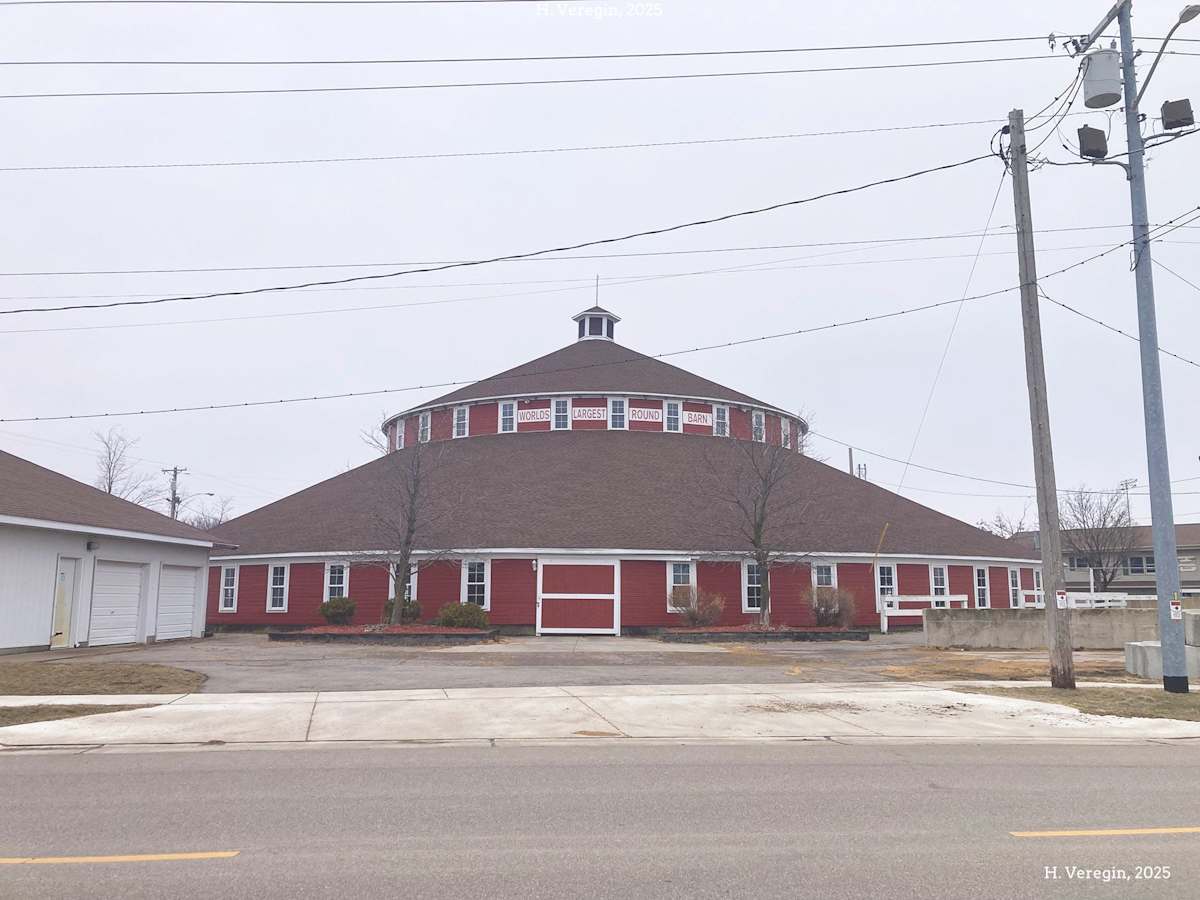
Then there’s the 150-foot round barn in Marshfield. This barn is called “The Biggest Round Barn in the World” on numerous websites – Central Wisconsin State Fair, Visit Marshfield, Travel Wisconsin, Roadside America and many others.
In theory, it would be easy to prove it is not the world’s largest round barn. All you would need is a single example of a larger barn. But who would go to the trouble to find one? The National Register Nomination for the Marshfield barn is non-committal on this question, stating only that the barn is “known in Marshfield as the World's Largest Round Barn.” [6]
One undisputed fact, however, is that the Marshfield Round Barn was never a working dairy barn. It was built in 1915-16 as a show barn for the county fair and continues to be used in that capacity to the present day. Other counties also have large round show barns on their fairgrounds, including Pierce County (130 feet), Marathon County (93 feet) and Langlade County. [7][8][9]
According to Travis’s website, the largest extant round barn (as of 2009, when it was last verified) that actually served as a functioning dairy barn is in Barron County. [10] Built in 1914 and made of concrete blocks, the barn is 128 feet in diameter, about 85 percent of the size of the Marshfield barn.
We’ll probably never be able to verify whether the Marshfield Round Barn is the largest in the world, but its size is still impressive. It’s 70 feet tall, 150 feet in diameter, has a circumference of 471 feet and a footprint of almost 18,000 square feet. [6] You could fit six or seven homes in that much space.
If you can’t find the time to visit the barn in person, you can take a virtual tour on the Central Wisconsin State Fair website. [11]
Round barns went out of fashion after about 1920. It’s hard to pin this on one factor. More conservative farmers never adopted the design, viewing rectangular barns as more adaptive and versatile. [2] Changes in dairy technology also negated some of the barn’s efficiencies. The historic round dairy barns that stand in Wisconsin today were built over a century ago, and like other agricultural buildings, they are quickly disappearing from the landscape due to decay and deliberate destruction.
Sources
[1] Dale J. Travis, Summary by State. https://dalejtravis.com/whatsnew/summary.htm
[2] National Register of Historic Places, Wisconsin Centric Barns, 1876-1921. https://npgallery.nps.gov/GetAsset/a34f8ae3-e4fc-40d8-a25c-65c0e17ca7b3
[3] National Register of Historic Places, Nashold 20-Sided Barn. https://npgallery.nps.gov/GetAsset/353e6649-9634-4e34-9312-fc0300c73f2c
[4] H. Veregin, Oddsconsin 34 – Cheese Curing and Strange Fraternity Rituals! https://howard-veregin.com/blog/oddsconsin-34-cheese-curing-and-strange-fraternity-rituals-nbsp-this-is
[5] Dale J. Travis, Wisconsin Round Barn & Other Round Structures List. https://www.dalejtravis.com/rblist/rbwi.htm
[6] National Register of Historic Places, Central Wisconsin State Fair Round Barn. https://npgallery.nps.gov/NRHP/GetAsset/0bd66912-36fa-4e01-9592-93f42422c724/
[7] Dale J. Travis, Pierce County fairgrounds barn. https://www.dalejtravis.com/barn/wisconsn/htm/wi04803.htm
[8] Dale J. Travis, Judging Pavilion in Marathon County fairgrounds. https://www.dalejtravis.com/barn/wisconsn/htm/wi04803.htm
[9] Dale J. Travis, Langlade County fairgrounds barn. https://www.dalejtravis.com/barn/wisconsn/htm/wi03401.htm
[10] Dale J. Travis, Barn in Dallas Township, Barron County. https://www.dalejtravis.com/barn/wisconsn/htm/wi00302.htm
[11] Central Wisconsin State Fair. https://www.centralwisconsinstatefair.com/p/other/worlds-largest-round-barn