
All we want are the facts, ma'am.
- Sgt. Joe Friday, Dragnet
The facts are sometimes hard to find when it comes to the origins of Wisconsin county names. This is especially true for names of Native American origin, where scholars never seem to agree on the interpretation. But even names that come from French trappers and traders have been obscured by history. The only county names whose origins are certain are those named after presidents, governors and other officials, where the historical record is clear.
A full explanation of Wisconsin county name origins would take multiple Oddsconsin posts, so I have presented the barest of facts. Readers can consult the sources I used – or other sources they are aware of – for more details.
Each county below is followed by its date of formation and a brief explanation of the origin of its name. Note that many counties, especially in the north, have had their boundaries redrawn numerous times over the years.
To tabulate your score for the Reader Challenge, add up the correct answers in your table (download it here if you did not do so last week) and compare it to the table of answers below (here’s a link to download this table). Scoring instructions are on the sheet.
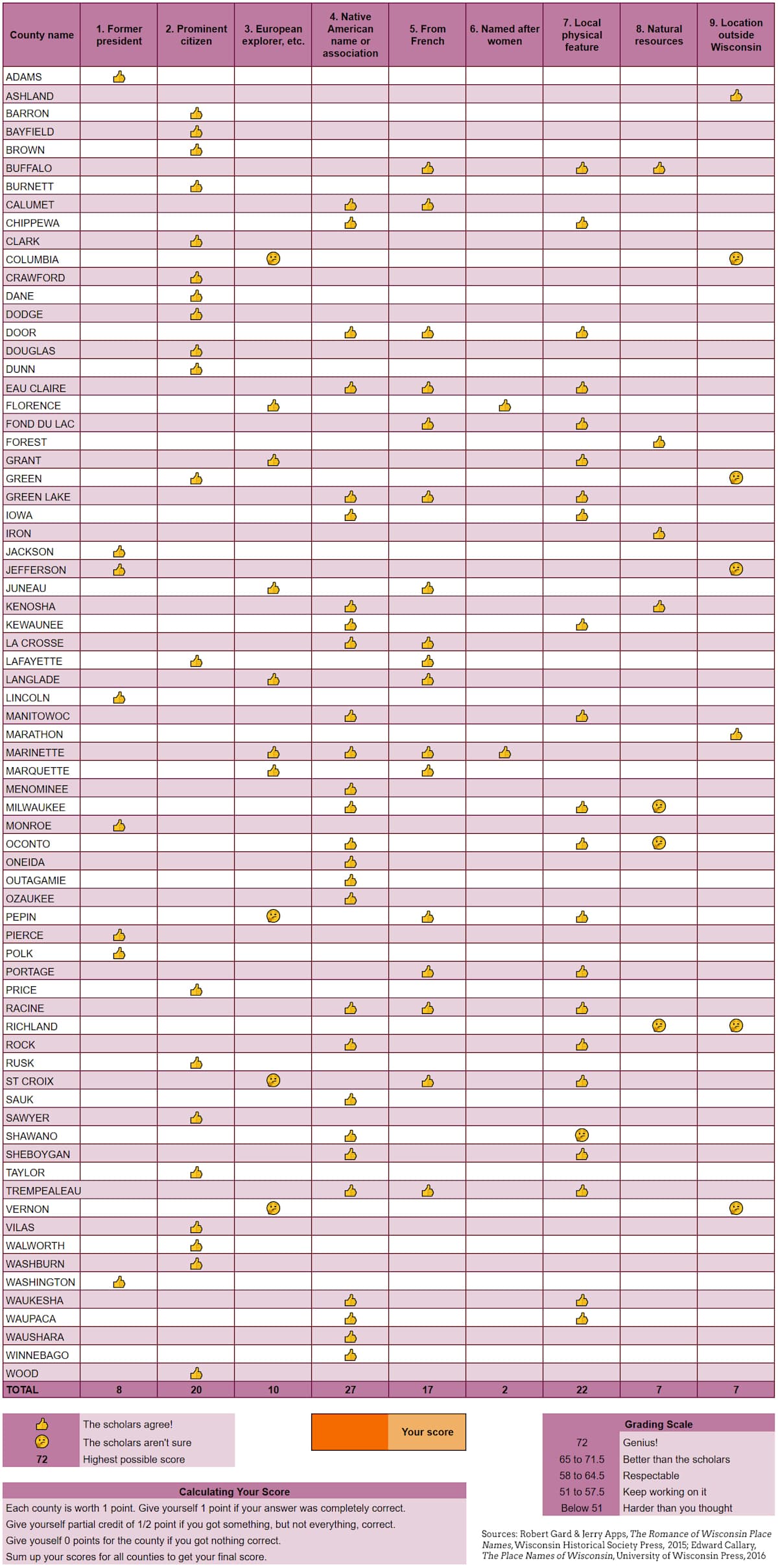
The map that accompanies this post shows how the sources of county names vary across the state. Some categories were merged to simplify the map. There are some obvious patterns present, some of which may invite more questions than answers.
Adams (1848) For John Quincy Adams, sixth US President (1825-29) or his father, John Adams, second US President (1797-1801).
Ashland (1860) After Henry Clay’s estate in Lexington, Kentucky. Clay served in the US Congress and Senate in the early nineteenth century.
Barron (1859) Originally named Dallas County, but renamed Barron in 1869 for Henry Danforth Barron, postmaster, judge, member of the State Assembly, state senator and a regent of the University of Wisconsin.
Bayfield (1845) Originally named La Pointe County, but renamed Bayfield in 1866 for Henry W. Bayfield, an admiral in the British Royal Navy who surveyed the Lake Superior shoreline in the 1820s.
Brown (1818). For General Jacob Jennings Brown, who fought against the British in the War of 1812.
Buffalo (1853) After the Buffalo River, known to French explorers as Riviére des Boeufs (River of Oxen or River of Beef). The name refers to the presence of buffalo (bison) in the area when European explorers first arrived.
Burnett (1856) For Thomas Pendleton Burnett, lawyer, Indian Agent, and member of the Wisconsin Territorial Legislature and Wisconsin Constitutional Convention.
Calumet (1836) Apparently a French word for peace pipe.
Chippewa (1845) After the Chippewa River, in turn named for the Chippewa (Ojibwe) Tribe.
Clark (1853) For George Rogers Clark, a Revolutionary War figure on the western frontier.
Columbia (1846) For Christopher Columbus or the Columbia River in Oregon.
Crawford (1818) After Fort Crawford, built in 1816 at Prairie du Chien, which was named for William Harris Crawford, US senator (Georgia) and cabinet secretary under Presidents James Madison and James Monroe.
Dane (1836) For Nathan Dane, architect of the Northwest Ordinance of 1787, which created the Northwest Territory out of which Wisconsin was formed.
Dodge (1836) For Henry Dodge, first Governor of Wisconsin Territory and military leader who played a prominent role in the Black Hawk War of 1832.
Door (1851) After Death’s Door, the dangerous passage between Washington Island and the tip of the Door County peninsula. The name has both Native American and French associations. (See Oddsconsin 44.)
Douglas (1854) For Stephen A. Douglas, US senator (Illinois) who lost to Abraham Lincoln in the 1860 presidential race.
Dunn (1854) For Charles Dunn, first Chief Justice of Wisconsin Territory.
Eau Claire (1856) After the Eau Claire River, French for clear water, itself probably a translation from Ojibwe.
Florence (1882) For Florence Hulst, wife of Nelson Hulst, one of the first to notice the deposits of iron ore in the area.
Fond du Lac (1836) French for foot of the lake (Lake Winnebago).
Forest (1885) After the forests that covered the area.
Grant (1837) After the Grant River, which was apparently named after a European trader and trapper.
Green (1837) Possibly for Nathanael Greene, Revolutionary War figure, or for Greene County, Pennsylvania (which is also named for Nathanael Greene).
Green Lake (1858) From the French Lac Vert or Lac du Verde, a translation of the Ho-Chunk name for the lake.
Iowa (1829) After the Iowa River, itself named after the Iowa Tribe.
Iron (1893) For the abundance of iron ore in the area.
Jackson (1853) For Andrew Jackson, seventh US President (1829-37).
Jefferson (1836) For Thomas Jefferson, third US President (1801-09) or for Jefferson County, New York (also named after Thomas Jefferson).
Juneau (1857) For Solomon Juneau, a French-Canadian trader living in the area.
Kenosha (1850) From the Ojibwe word for pike (the fish) found in creeks in the area.
Kewaunee (1852) After the Kewaunee River, from the Algonquian name. May refer to the name of a Potawatomi individual variously translated as prairie chicken, prairie hen or a river crossing.
La Crosse (1851) Apparently named by French traders and trappers after the sport of lacrosse played by the Ho-Chunk people. The French evidently saw a similarity between the hooked lacrosse stick and the cross carried by a bishop.
Lafayette (1846) For the Marquis de Lafayette, a French nobleman who served in the American Revolutionary War.
Langlade (1879) For Charles de Langlade, who established a trading post at Green Bay in the eighteenth century and participated in the French and Indian War.
Lincoln (1874) For Abraham Lincoln, sixteenth US President (1860-65).
Manitowoc (1836) After the Manitowoc River and probably derived from an Algonquian word related to a spirit or deity.
Marathon (1850) Thought to refer to a battlefield in ancient Greece where the Athenians defeated the Persians in 490 BCE.
Marinette (1879) For Marinette Chevalier, a métisse woman who settled in the area in the early nineteenth century. The name may be associated with Marie Antoinette, the French Queen beheaded in 1793.
Marquette (1836) For Father Jacques Marquette, Jesuit priest, missionary and explorer who was one of the first Europeans to explore the area in the seventeenth century.
Menominee (1961) Name given to the Menominee people by the Ojibwe, meaning people of the wild rice.
Milwaukee (1834) After the Milwaukee River, from a word that may be from Potawatomi, Ojibwe, Menominee, Algonquian or another language and meaning good land, gathering place, or possibly something else.
Monroe (1854) For James Monroe, fifth US President (1817-25).
Oconto (1851) After after the Oconto River, itself from a Menominee word for pike, pickerel, bass, paddle, red ground, ambush spot, or something else.
Oneida (1885) For the Oneida Nation, part of the Iroquois Confederation who relocated from New York state after the Revolutionary War.
Outagamie (1851) From the name given by the Ojibwe to the Fox Tribe, translated as people on the other shore.
Ozaukee (1853) From a name given by the Ojibwe to the Sauk Tribe, usually translated as people of river mouth.
Pepin (1858) After Lake Pepin, itself named as early as the seventeenth century after a French-Canadian settler family or possibly a French King.
Pierce (1853) For Franklin Pierce, fourteenth US President (1853-57).
Polk (1853) For James Polk, eleventh US President (1845-49).
Portage (1836) From the French referring to the overland trail between the Fox and Wisconsin Rivers, where canoes and cargo had to be carried overland.
Price (1879) For William T. Price, lumber baron, lawyer, member of the State Assembly, state senator and member of the US Congress.
Racine (1836) After the Root River, known in French as Rivière Racine, itself probably from a Potawatomi word for root.
Richland (1842) Possibly a reference to Richland County, Iowa, or indicative of the rich soil of the area.
Rock (1836) After the Rock River, an English translation of a Miami or Illinois name.
Rusk (1901) Originally named Gates County after a wealthy land speculator, but renamed in 1905 for Jeremiah McLain Rusk, a Civil War figure, Wisconsin Governor, member of the US Congress and cabinet secretary.
St. Croix (1840) After the St. Croix River, named by early French explorers and meaning “holy cross.” The name may refer to a rock formation that resembles a cross, a sign of a cross seen in the water by missionaries, the cross-like shape of the junction of the Mississippi and St. Croix Rivers, a French trader named St. Croix, or Fort St. Croix (built by the French in the 1680s).
Sauk (1840) From a name given by the Ojibwe to the Sauk Tribe, usually translated as people of river mouth. (See Ozaukee County).
Sawyer (1883) For Philetus Sawyer, a nineteenth-century lumber baron, businessman and member of the State Assembly, US Congress and US Senate.
Shawano (1853) Adaptation of a Menominee name for a lake in the area, or named after a Menominee individual.
Sheboygan (1836) After the Sheboygan River, from the Ojibwe or Menominee language. The meaning of the name is uncertain.
Taylor (1875) For William R. Taylor, Governor of Wisconsin when the county was formed.
Trempealeau (1854) English adaptation of French la montagne qui trempe à l’eau (the mountain that stands in water), itself a translation from the Ho-Chunk and referring to an island that rises out of Lake Pepin.
Vernon (1851) Originally named Bad Axe County but changed to Vernon in the 1860s for settler George Vernon Weeks, after Vernon County, New York, or for Mt. Vernon, George Washington’s estate in Virginia.
Vilas (1893) For William Freeman Vilas, a nineteenth century politician, lumber baron, Civil War officer, US Postmaster General, cabinet member, US senator and University of Wisconsin benefactor.
Walworth (1838) For Reuben Hyde Walworth, at the time Chancellor (Chief Justice) of New York state, abolitionist and member of the American Temperance Union.
Washburn (1883) Named for Cadwallader Colden Washburn, lawyer, Wisconsin Governor, member of congress and Civil War officer.
Washington (1836) For George Washington, first US President.
Waukesha (1846) Probably derived from a Potawatomi or Ojibwe name for Fox River.
Waupaca (1851) After the Waupaca River, likely a Potawatomi word that has been interpreted to mean many different things.
Waushara (1851) Adaptation of a Ho-Chunk word for fox or may refer to a Ho-Chunk individual.
Winnebago (1840) A name used by the Potawatomi or Ojibwe to refer to the Ho-Chunk people. Not used by the Ho-Chunk to refer to themselves.
Wood (1856) For Jospeh Wood, postmaster, coroner, clerk of court, judge, mayor, hotel proprietor, store owner and member of the State Assembly.
Sources
Robert Gard & Jerry Apps, The Romance of Wisconsin Place Names, Wisconsin Historical Society Press, 2015.
Edward Callary, The Place Names of Wisconsin, University of Wisconsin Press, 2016.