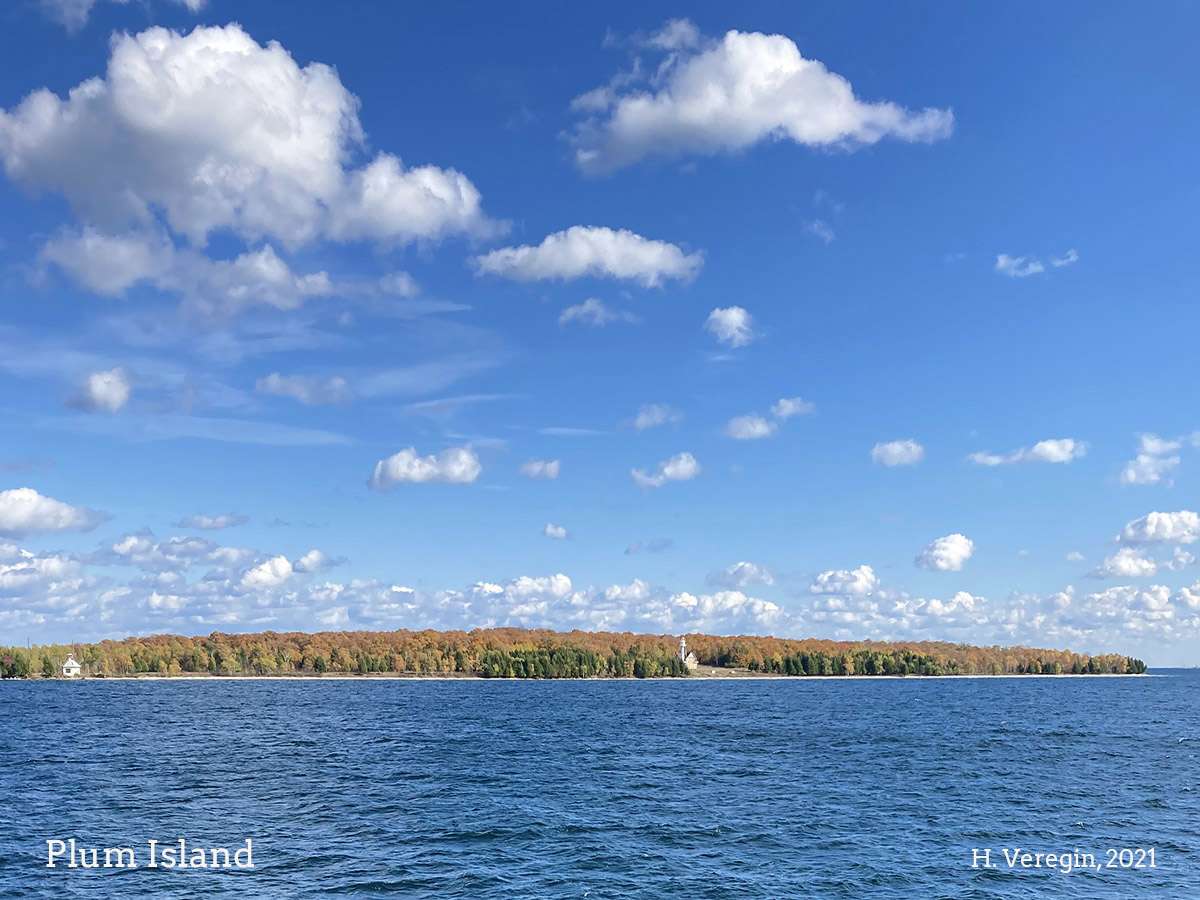
Door County evokes images of fall foliage, quaint villages, cherry orchards, sky-blue waters and sandy beaches. It’s Wisconsin’s playground. The name Door must be short for Doorway to Heaven. Or perhaps it’s from the French d’Or, meaning golden.
Not so fast. The county’s name actually comes from Death’s Door, the treacherous strait connecting Green Bay to Lake Michigan across the northern tip of the Door Peninsula. Countless ships have been wrecked in gales that forced them onto the strait’s submerged shoals and rocky beaches, taking their crews to their watery graves. Or so we are led to believe.
According to Edward Callary in The Place Names of Wisconsin, the first written reference to Death’s Door was by French missionary Emmanuel Crespel in the 1720s. [1] He referred to it as Cap a la Mort (Cape of the Dead), a name that was evidently already in use. Over time, French explorers and fur traders started calling it Porte des Morts (Door of the Dead).
Myths about Death’s Door have persisted for decades. One of these is that the name is associated with a battle between members of the Potawatomi and Ho-Chunk Nations, some of whom drowned in a storm in Death’s Door. The battle, which is supposed to have occurred before Europeans arrived, involved a series of vicious attacks and counter-attacks, burnings at-the-stake and acts of cannibalism. The story was popularized by Hjalmar R. Holand, originally from Norway, who published a two-volume history of Door County in 1917. [2]
Brennan Christianson, Collections Coordinator at the Door County Maritime Museum in Sturgeon Bay, thinks that Holand’s story doesn’t add up. Holand was writing about events that happened centuries earlier, did not know Native American languages or customs, and relied uncritically on non-authoritative sources. [3]
Other historians, including Conan Bryant Eaton in his book, Death’s Door, agree. [4] Eaton warns us to be skeptical of the story given the “re-telling, twisting, shaping, augmenting and embroidering” that has occurred over the centuries. Still, Christianson thinks there may be a grain of truth in the story, perhaps related to the loss of a large Native American trading mission heading from Wisconsin to points further east.
By the early 19th century, Death’s Door was already heavily used by European Americans as a commercial route for lumber, iron ore, wheat, sugar, salt and other commodities. What about these sailors? How many of them perished in the treacherous waters of Death’s Door? Based on the records that are available, the answer might be surprising.
The Wisconsin Shipwrecks website lists the known wrecks in Death’s Door dating from 1841 to 1928. [5] Some wrecks have not been found, but for those that have known coordinates, we know that there were ten at Pilot Island (on the eastern approach to Death’s Door), four south of Plum Island (considered the northern edge of Death’s Door), five in the vicinity of Northport, and another six in Hedgehog Harbor, west of Gills Rock.
For these 25 wrecks, the total number of deaths is zero. Death’s Door was more a killer of ships than a killer of ships’ crews. [6]
Most of the ships that sunk in Death’s Door during this period were wooden schooners, a type of sailing ship with multiple masts. Some of these schooners were very large and very expensive. The Fleetwing, a 135-foot-long schooner wrecked near Gills Rock in 1888, was built in Manitowoc in 1867 at a cost of $30,000. [7] This is equivalent to about $650,000 today. [8]
The disaster befalling the J. E. Gilmore and the A. P. Nichols is a colorful example illustrating the hazards of navigating Death’s Door. The Gilmore was a wooden schooner en route from Chicago to the upper peninsula of Michigan in October 1892. As it approached Death’s Door during an intense gale on October 17th, it was blown onto the reefs southeast of Pilot Island, right next to the wreck of the Forest, which sank the previous year in the same spot.
Despite the destruction of the Gilmore’s keel, the ship’s crew decided to stay on board, reasoning that the ship was safe enough and they had sufficient provisions to last for some time. After eleven days on the crippled vessel, all the while battling an increasingly intense series of storms, they were lucky enough to witness the wrecking of another schooner, the A. P. Nichols, on October 28th.
The Nichols was in more serious trouble than the Gilmore. It was the keeper of the Pilot Island lighthouse, Martin Knudson, who saved the Nichols crew. Knudson waded out to the ship and, one by one, rescued the crew members – including the female cook and the captain’s aged father – as they jumped into the shallow water. By October 29th, all sixteen crew members from both ships were safely inside the lighthouse and eventually made it back to Chicago when the storms abated a week later. [9]
Both the Gilmore and Nichols were abandoned on the reefs. The wreckage of the Nichols is still visible today beneath the waters of Pilot Island. [10]
A perilous adventure, but without fatality. Other Wisconsin waters have been much deadlier for ships’ crews and passengers. The biggest maritime disasters on Lake Michigan occurred offshore of places like Manitowoc, Port Washington, Milwaukee and Two Rivers. The causes of some of these tragic accidents might surprise you, but that’s for a future Oddsconsin post.
And then, of course, there’s the most famous wreck of all, the Edmund Fitzgerald on Lake Superior, now approaching its 50th anniversary.
Sources:
[1] Edward Callary, The Place Names of Wisconsin. University of Wisconsin Press, 2016.
[2] Steve Grutzmacher, Door County’s Original Historian: Hjalmar R. Holand. Door County Pulse, September 4th, 2015. https://doorcountypulse.com/door-countys-original-historian-hjalmar-r-holand/
[3] Myles Dannhausen Jr., Getting to the Bottom of Death’s Door. Door County Pulse January 11th, 2022. https://doorcountypulse.com/getting-to-the-bottom-of-deaths-door/
[4] Washington Island Chamber of Commerce, Death’s Door Legend. https://washingtonisland.com/deaths-door-legend/
[5] The website is a product of the Wisconsin Historical Society’s Maritime Preservation and Archaeology Program and the University of Wisconsin Sea Grant Institute. https://www.wisconsinshipwrecks.org/Vessel/UpprLakeMichigan?SearchString=&county=Door&nearestCity=
[6] This observation agrees with a statement elsewhere on the website, where it is noted that 24 sailing vessels were lost in Death's Door between 1837 and 1914, but no sailors lost their lives. https://www.wisconsinshipwrecks.org/learn/DeathsDoor
[7] Wisconsin Shipwrecks, Fleetwing (1867). https://www.wisconsinshipwrecks.org/Vessel/Details/201?region=UpprLakeMichigan
[8] According to https://www.in2013dollars.com
[9] Sturgeon Bay Republican, Nov. 10, 1892, p. 4.
[10] Wisconsin Shipwrecks, A.P. Nichols (1861). https://www.wisconsinshipwrecks.org/Vessel/Details/2?region=UpprLakeMichigan