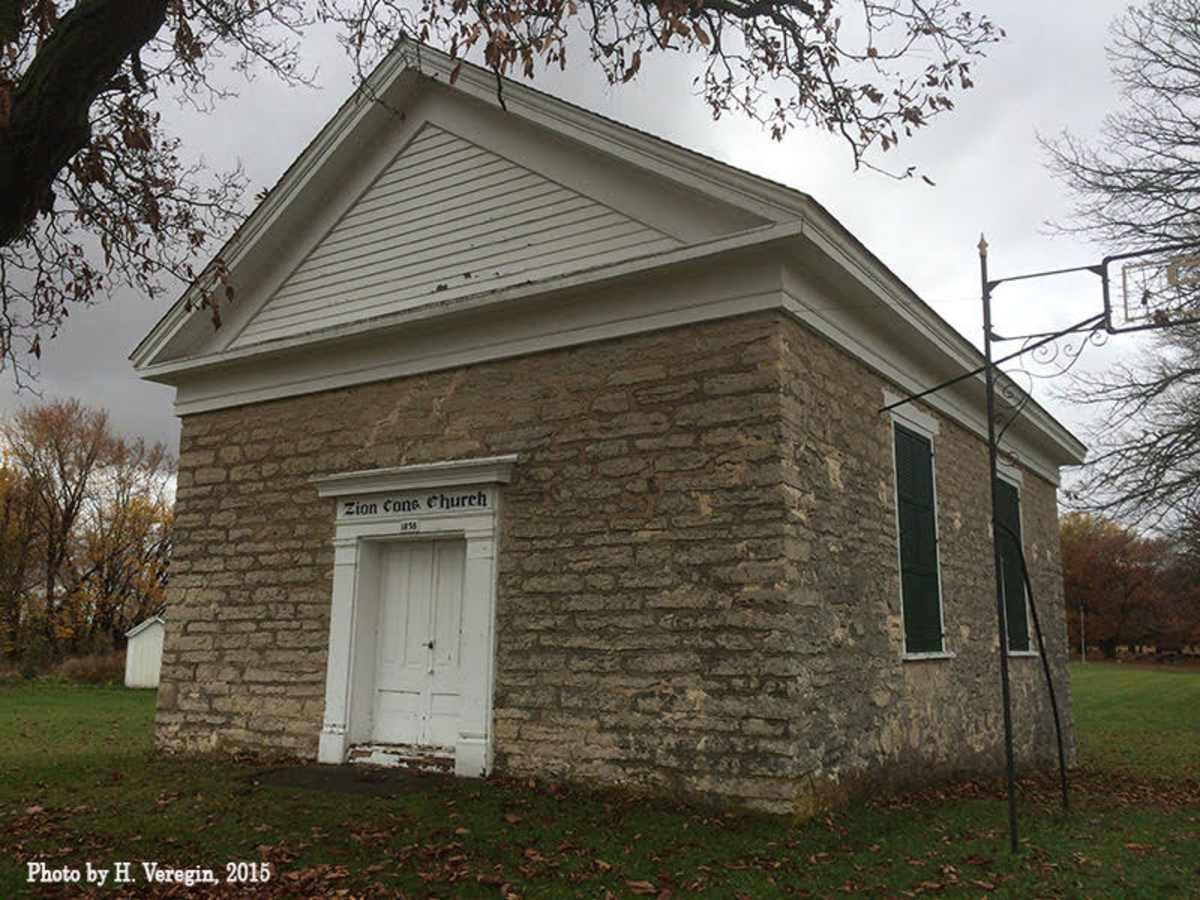
It’s a common occurrence in Wisconsin. You’re driving along a small country road, still miles from your destination, when around the next bend in the road you find a historic church standing alone next to a field of corn or a herd of dairy cattle. There are hundreds of rural churches in the state, many still in use and others closed and shuttered.
Zion Old Stone Church sits along Amity Road, a few miles north of Alto, an unincorporated community in the Town of Alto in Fond du Lac County. Fond du Lac is a French phrase meaning “foot of the lake” (Lake Winnebago). But in the nineteenth century, this part of the county was heavily settled by people from the Netherlands. In fact, the name Alto may be from the Dutch “halte” meaning a stop or resting place. [1]
The church, built in 1858, was originally called Zion Congregational Church. The congregation was organized in 1847, before Wisconsin was even a state. The church is small (42 x 30 feet) and built of rusticated limestone. In the Greek Revival style popular in the mid-nineteenth century, it features a pediment – a triangular gable formed above the cornice and frieze – over the main entranceway. Pilasters (rectangular columns) flank the recessed front double doors and support an elaborate entablature (horizontal molding) over the doors. There are only four windows, two on each side of the building, covered in dark shutters.
St. Augustine Church in New Diggings in Lafayette County (Oddsconsin 36) is another example of a historic church built in the Greek Revival style.
Zion Church is a simple structure, but significant enough to be listed in the National Register of Historic Places for its architecture. [2] It’s one of a handful of remaining pioneer-era churches in the Greek Revival style. The fact that it was built from limestone – probably local – is also significant, since there are no other examples of early limestone construction of this type in the Town of Alto.
The National Register nomination indicates that the interior of the church has been largely untouched, with no modern heating, electricity or plumbing. There are wood floors, original wood pews, an old stove and lectern, and iron holders on the walls for lamps. Beside the church is Oak Mound Cemetery, with a large wrought iron sign. It contains the graves of some of the church’s founders dating back to the 1860s. [2] Visitors should be aware that the church and cemetery are on property owned by the Netherlands Reformed Zion Church. The church and cemetery sign, however, are clearly visible from the public road.
Why is the church here? In more religious times, European immigrants established churches in the communities they settled in. Today, these churches speak of a time when rural residents were simultaneously more isolated but also more numerous. Rural depopulation and modern transportation make these churches seem out of place, but even one hundred years ago this was not the case.
In the nineteenth century, many of the Dutch settlers in the Town of Alto were “Seceders” – people who participated in the 1834 secession from the Dutch Reformed Church when it became the official state church of the Netherlands. Zion Church was apparently formed by families who were strongly opposed to efforts to reestablish a Dutch Reformed Church congregation in the area. [2]
The evolutionary linkages between Protestant denominations are amazingly complex but, with the risk of getting some important fact wrong, the story is as follows.
The Dutch Reformed Church was a protestant denomination that grew in Europe in the sixteenth and seventeenth centuries in the wake of Lutheranism. The main leader of the reform movement was John Calvin, a French/Swiss theologian. Other denominations that emerged at this time included the Presbyterian and Congregational Churches. What all of these churches had in common was a rejection of the authority of the Roman Catholic pope as a special emissary of God. Instead, these churches emphasized the teachings of the Bible and organized themselves into semi-autonomous congregations that established doctrine and managed affairs.
There are subtle differences between denominations. For example, both the Congregational and Presbyterian Churches rejected the hierarchical structure of the Catholic Church, but while the Presbyterian Church recognized hierarchical authority within congregational bodies (synods, or elected assemblies of church leaders or elders), the Congregational Church was based on the autonomy of each congregation. The Congregational Church, which evolved in England in the sixteenth century, is usually associated with the Puritans.
The Dutch Reformed Church followed a Presbyterian style of governance involving elected elders from each congregation. [3][4] But Zion Church was founded by “Seceders.” In the Netherlands, Seceders were those who objected to the transformation of the Dutch Reformed Church into the official state church in the early nineteenth century. As a result of this transformation, the Dutch king had ultimate authority over doctrine and church affairs. Seceders believed such matters should rest with the congregation instead. [5]
Due in part to this conflict, Seceders dominated the waves of Dutch immigration to the US in the nineteenth century. At a time when barely one percent of the Dutch population were Seceders, some 13,000 of them left the Netherlands between 1845 and 1880. Between 1846 and 1849, they comprised 65 percent of all Dutch emigrants. [6]
In the Midwest, large Dutch colonies formed in Michigan, Iowa and Wisconsin at this time. The Seceder movement led to the formation of the Christian Reformed Church of North America, which had its roots in Michigan in 1857. Seceders were wary of synods and elites, but tension grew between them and other Dutch settlers who favored integration with the Reformed Dutch Church, especially given the uncertainties of life in America.
The fact that Zion Church was founded as a Congregational Church, rather than under the Christian Reformed Church of North America, is a bit of a puzzle. It may have been due to the struggles of the Seceder movement in areas with scattered population, or it may have been due to dissatisfaction with the movement itself. Congregationalism offered the most democratic style of governance of all the denominations, and perhaps this was attractive to the founders of Zion Church.
Zion Church was only able to support a pastor until the 1880s, due to declining population and (possibly) cultural assimilation. By holding annual church services, the property has been able to retain its religious, tax-exempt status, which it holds to this day. [2]
Despite the short duration of European settlement in Wisconsin – especially compared to the thousands of years of Native American occupation of the area – European religion and cultural practices have left their mark on the state’s landscape. Zion Church is just one example.
Sources and Notes
[1] Edward Callary, Place Names of Wisconsin. University of Wisconsin Press, 2016.
[2] National Register of Historic Places, Zion Congregational Church. https://npgallery.nps.gov/NRHP/GetAsset/NRHP/05001579_text
[3] EBSCO, Dutch Reformed Church. https://www.ebsco.com/research-starters/religion-and-philosophy/dutch-reformed-church
[4] Reformed Church in America, History of the RCA. https://www.rca.org/about/history/
[5] The Standard Bearer, A Brief History of the Afscheiding (1), Vol. 84, Issue 2, 2008. https://sb.rfpa.org/a-brief-history-of-the-afscheiding-1/
[6] Robert P. Sweirenga, True Brothers: The Netherlands Origins of the Christian Reformed Church in North America. https://www.swierenga.com/Kampen_pap.html