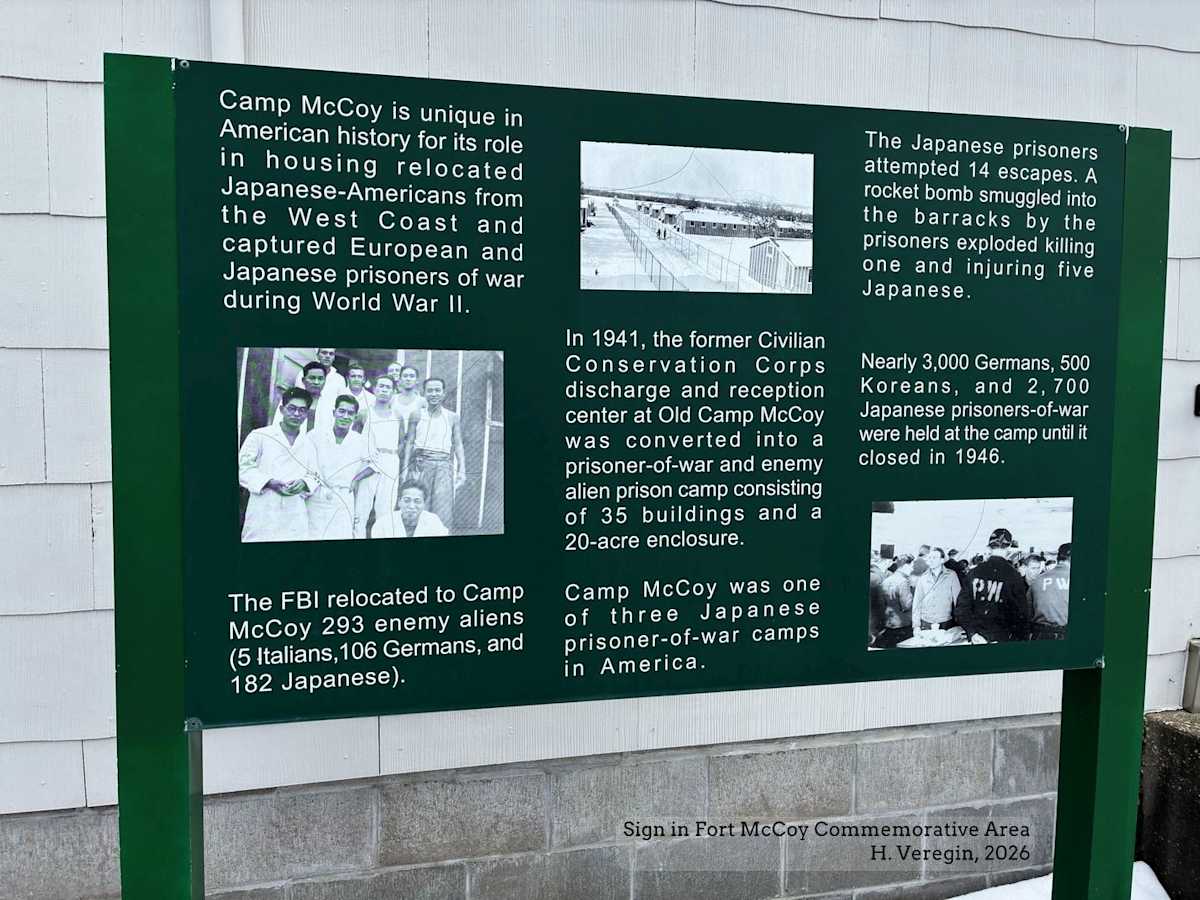
Before it housed a World War II Prisoner of War camp, Fort McCoy had a more notorious facility on site – an internment camp for “enemy aliens” deemed to be a threat to national security and incarcerated without due process.
The internment camp period in US history is well documented. In February 1942, President Franklin D. Roosevelt signed Executive Order 9066 that authorized the forcible removal of selected civilians from militarized zones on the west coast of the United States. Arrests and evacuations began a month later and were targeted almost exclusively at those of Japanese descent. That same month, Congress reified Roosevelt’s Executive Order by making its violation a punishable offense. [1]
Approximately 122,000 men, women and children – over one-half of whom were US citizens – were eventually forced into internment camps, most of which were located in remote areas of the country. [1] Incarceration brought not only loss of freedom, but also loss of homes, businesses, possessions, community stature and reputations. Nor was the US alone in its actions. There were similar internment camps in Canada, while in Mexico, the government moved quickly to evacuate people of Japanese heritage from restricted zones along the coasts and borders. [2, 3]
The precipitating event for internment was the Japanese attack on Pearl Harbor, Hawaii, on December 7, 1941. Following the Hawaii Governor’s declaration of martial rule, people deemed suspicious – perhaps due only to an off-hand comment overheard by a neighbor – were arrested and detained.
Fort McCoy was one of the first internment camps of the war, operating from January 1942 to May 1943. The first prisoners to arrive were mainly from Honolulu and the surrounding area, including 173 people of Japanese descent, 36 of German descent and two of Italian descent. Some were prominent citizens, including physicians and engineers, and others were Hawaiian business owners. Many were naturalized citizens who had been targeted for their ancestry and supposed ties to the enemy, and at least one was a US citizen by birth. By early 1942, the compound held approximately two hundred people. [4]
Ironically, Fort McCoy was also a base for Japanese-American infantry from Hawaii – the 100th Infantry Battalion – almost 1,500 of them. [5] They trained at Fort McCoy from the summer of 1942 until January of 1943, when the internment camp was still in use. One wonders what they made of it, or if they even knew.
The internment camp at Fort McCoy was housed in the old Civilian Conservation Corps (CCC) structures south of the railway, in Camp Robinson or “Old Fort McCoy.” The CCC buildings were surrounded by tall fences topped with barbed wire, sunken logs to prevent tunneling, a circuit of iron mesh and seven guard towers. [4]
Attempts by the prisoners to receive justice for the most part fell on deaf ears. Lawrence T. Kagawa, a US citizen (by birth) imprisoned at Fort McCoy, wrote to Samuel W. King, his Congressional Representative, in March 1942, appealing for some explanation of his supposed crimes. [6] And while some German prisoners were eventually released by the War Department, it appears those of Japanese descent were treated much differently. [4]
The paranoia that erupted in 1942, especially over Japanese-Americans, has the symptoms of a mass psychosis. Newspapers from the era report on purges of Japanese-Americans from state and city payrolls, raids on Japanese neighborhoods, arrests, mass evacuations and the removal of Japanese-American children from schools. The panic was spurred on by inflammatory comments from mayors, county boards, civil defense councils, military officials and even the California Attorney General (Earl Warren). Tellingly, some of the newspaper articles refer to the internment camps as “concentration camps.” [7]
By mid-1942, Fort McCoy was gearing up for a new role housing Prisoners of War (POWs). The internment camp transitioned to a temporary processing station to facilitate the transfer of detainees to permanent camps elsewhere in the country. The internment camp, whose population dropped to less than fifty when it closed in 1943, then became POW Compound A. (see Oddsconsin 63).
Signage in Fort McCoy’s Commemorative Area deflects blame for this shameful period in the country’s history, stating only that Fort McCoy had a role “in housing relocated Japanese-Americans from the West Coast.” Presumably, in the Army’s view, they were simply doing their job keeping the prisoners alive, not determining whether they should have been there in the first place.
In 1983, Congress estimated that, over the course of their confinement, the prisoners lost property worth $1.3 billion and income of $2.7 billion [1]. In 1988, the US government officially acknowledged the injustice and unconstitutionality of its actions and gave $20,000 to each person who was incarcerated.
It’s easy to judge from eighty years in the future, and America was at war, but the actions – despite their approval all the way up to the White House – clearly violated the prisoners’ civil rights, not to mention the US Constitution’s strictures against unwarranted search and seizure and the doctrines of probable cause and due process. There were no trials or evidence presented, prisoners could not appeal their detentions and most lost everything they owned.
Sources and Notes
[1] National Archives, Executive Order 9066: Resulting in Japanese-American Incarceration (1942). https://www.archives.gov/milestone-documents/executive-order-9066
[2] Legislative Assembly of British Columbia, 1939 to 1945 - World War II and the Japanese Internment. https://www.leg.bc.ca/learn/discover-your-legislature/1939-to-1945-world-war-ii-and-the-japanese-internment
[3] Mexico Speeds Shift of Coastal Japanese, New York Times, April 17, 1942, p. 13.
[4] Schmidt, A. R., C. L. Baxter & K. R. Schacht, Historic Context for the WWII Internment and Prisoner-of-War (POW) Compound at Fort McCoy, Wisconsin. The US Army Engineer Research and Development Center (ERDC), 2023. https://erdclibrary.on.worldcat.org/discovery
[5] Signage at Fort McCoy Commemorative Area.
[6] Wisconsin Historical Society, WWII Japanese Internment Camps. https://www.wisconsinhistory.org/pdfs/lessons/EDU-LessonPlans-JapaneseCamps-Kagawa.pdf
[7] See for example: West Coast Moves to Oust Japanese, New York Times, Jan. 29, 1942, p. 12; West Coast Widen Martial Law Call, New York Times, Feb. 12, 1942, p. 10; Coast Raids Trap 225 Nazis, Japanese, New York Times, April 14, 1942; Coast Raids Trap More Japanese, New York Times, April 28, 1942, p. 12.