It’s not widely known that Fort McCoy (Monroe County) served as a Prisoner of War (POW) camp in World War II. Soldiers from Japan, Germany, Italy, Poland and Korea were imprisoned here between 1942 and 1945, with the total number of POWs reaching almost 3,000. By some accounts, it was the largest Japanese POW camp in the country.
Before World War II, Fort McCoy was not as developed as it is today. The area came under government control in 1909, when the War Department purchased over 14,000 acres, including some land owned by Robert McCoy, a veteran of the Spanish-American War who advocated developing a military training facility in the area. The tract purchased by the War Department was cut in half by a railroad line, with the north half being called Camp Emory Upton and the south half Camp Robinson.
In the 1930s, Camp Robinson served mainly as a Civilian Conservation Corps (CCC) camp. The CCC was a depression-era work relief program for unemployed single men and was under the control of the US Army. Camp Robinson housed a supply depot and administrative outpost for CCC programs in rural Wisconsin. There were over thirty CCC buildings on site in a 20-acre enclosure.
New Army facilities were built at Fort McCoy soon after World War II began in late 1941, mostly in northern Camp Emory Upton. The site became a training base for infantry, artillery, railhead (deployment of equipment by rail), ordnance (supply and storage of ammunition), tank destroyer and engineer troops. In 1942, the Army built over two hundred new administrative facilities at Fort McCoy, plus eleven chapels, almost two hundred mess halls, a 1,800-bed hospital and a new cantonment area where soldiers lived and worked. A total of 1,500 buildings were constructed to house, train and support 35,000-40,000 soldiers. The base was also home to a Limited Service School to train soldiers with disabilities. Members of the Women’s Army Corps (WACs) served at Fort McCoy and there was an induction and basic training center for Army nurses.
The first POW at Fort McCoy was also the first POW captured by the US during World War II. Kazou Sakamaki – an ensign in the Japanese Navy – was captured shortly after the Japanese attack on Pearl Harbor, Hawaii, on December 7, 1941, when his mini-submarine was detected by a US patrol.
For the time being, however, the POW population at Fort McCoy remained small and comprised mainly German prisoners captured in Europe. The US began receiving German POWs from Great Britain in 1942, in an effort to relieve crowding and provide greater prisoner security. Sites were chosen at US military bases, while special camps were later built in the interior of the country.
At Fort McCoy, the POW compound was located in old CCC facilities in Camp Robinson south of the railroad, an area that came to be known as Old Fort McCoy. The CCC buildings were converted to barracks for the prisoners. Additional facilities included mess halls, kitchens, latrines, showers and recreation areas. The compound was surrounded by barbed wire and watch towers, where Military Police patrolled on foot with dogs.
As late as the summer of 1944, only about six hundred POWs were confined at Fort McCoy, about half of whom were German. They were located in “Compound A” – the first of four compounds eventually built for POWs. (To see what Compound A looks like today, enter these coordinates in the Google Maps search bar: 43.973485, -90.737217)
The situation changed dramatically when the War Department decided that Fort McCoy would be the main detention station for Japanese POWs captured in the Pacific war. By the summer of 1944, thousands of Japanese POWs began to flow in. Additional facilities were needed at Fort McCoy, and Lieutenant Colonel Horace Rogers, who oversaw the POW program, began to build them. The first of these made use of a cluster of former CCC and World War I-era buildings to the east of Compound A. This new compound, known as Compound C, held the influx of Japanese POWs. (To see what Compound C looks like today, enter these coordinates in the Google Maps search bar: 43.978990, -90.726830)
Eventually, about 2,500 Japanese POWs were incarcerated at Fort McCoy, by far the largest nationality of all prisoners on site. But more prisoners were to come. After the arrival of Korean POWs in late 1944, Rogers built a third compound, compound B, adjacent to Compound C. Here the POWs lived in tents, at least initially. (To see what Compound B looks like today, enter these coordinates in the Google Maps search bar: 43.979243, -90.723171) At about the same time, a fourth and final compound – Compound D – was built for Japanese officers.
With a population of about 300, German POWs were the largest nationality at Fort McCoy until the summer of 1944, when the influx of Japanese POWs began. Germans again became the majority in October 1945 when the War Department removed the Japanese POWs from Fort McCoy.
The exact number of POWs held at Fort McCoy is difficult to know for certain, due to incomplete records and the movement of prisoners to and from other camps in the country. Some estimates of the number of German POWs at Fort McCoy are as high as five thousand, but this seems improbable as the POW compounds were not large enough to hold that many prisoners at once.
If it’s strange to imagine a POW camp in the heart of Wisconsin, it’s even stranger to learn that at least thirty-eight branch camps were established across the state in twenty-five different counties. The branch camps were really agricultural labor camps, organized to help Wisconsin farmers deal with the labor shortage caused by the war. The POWs worked alongside local residents, picking and processing crops, tending to nurseries and dairies, or working in canning factories. For this, they were paid 80 cents per day. Japanese prisoners did not take part in these activities, as the majority of the workers were German. Oddsconsin 35 covers these branch camps in more detail.
Stranger still is the fact that some POWs never made it home alive from Wisconsin. There were fourteen POW deaths at Fort McCoy – eleven Japanese, two German and one Korean. Causes of death were: Tuberculosis, 7; Work accidents, 2; Suicide, 1; Accidental explosion, 1; Nephritis (inflammation of the kidneys), 1; Carcinoma, 1; and Coronary thrombosis (blood clot in the coronary artery), 1.
Archaeological research indicates that the deceased Japanese POWs were cremated at Camp McCoy or in Milwaukee, and were repatriated to Japan in the 1950s. On the other hand, the German and Korean POWs were buried at Camp McCoy in a small cemetery. After the war, their bodies were exhumed and reinterred at Camp Butler National Cemetery in Illinois.
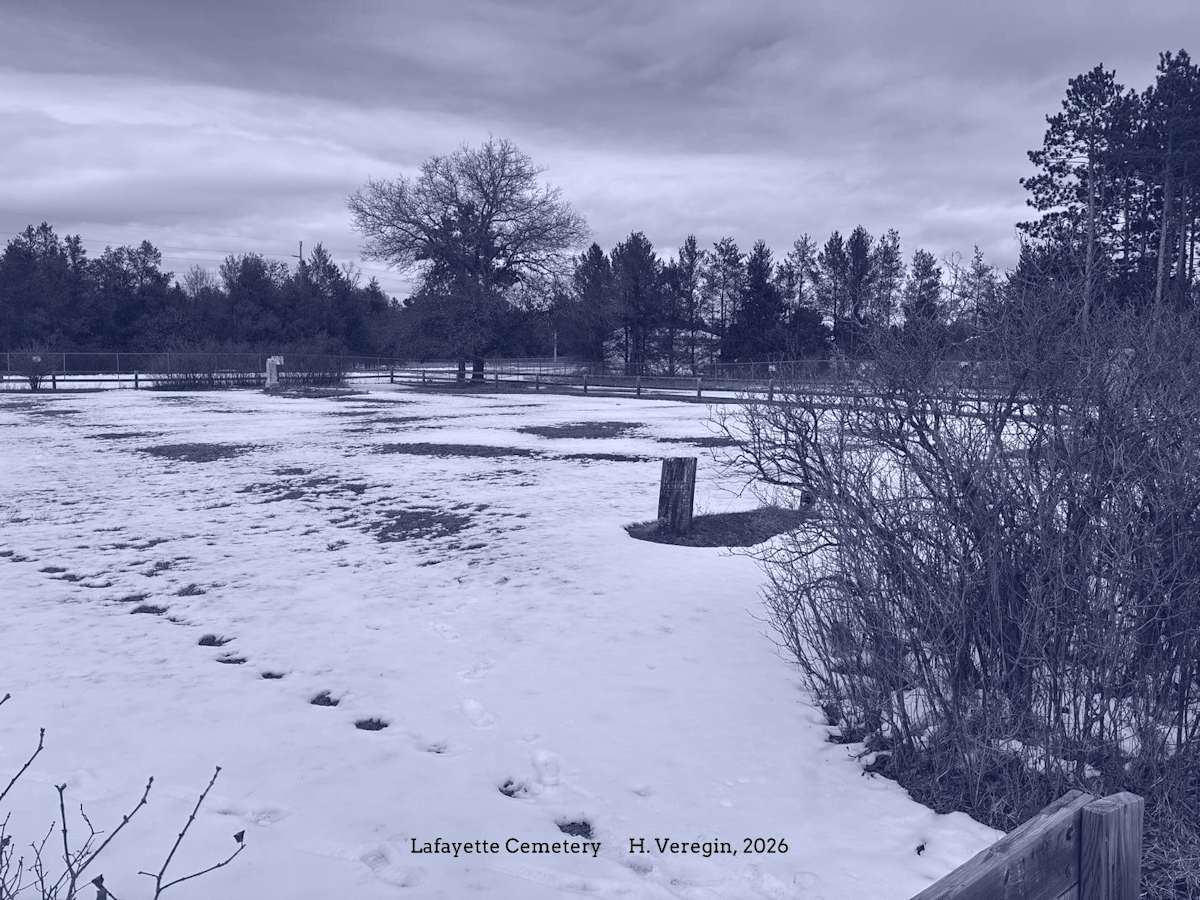
The POW cemetery is no longer in existence, but you can get close to it from Lafayette Cemetery, which is on the public side of the Fort McCoy gates. The POW cemetery was just to the northeast, on the other side of the chain link fence. It’s a somber place. Lafayette Cemetery has only a few gravestones. A recycling center is nearby and across the road there’s a sewage treatment plant.
Want Oddsconsin delivered right to your inbox? Subscribe here.
Sources
Army Historical Foundation, Fort McCoy - Wisconsin. https://armyhistory.org/fort-mccoy-wisconsin/
Cowley, Betty, Stalag Wisconsin, Badger Books, 2002.
Find a Grave, Lafayette Cemetery, Sparta, Wisconsin. https://www.findagrave.com/cemetery/2361774/lafayette-cemetery
Schmidt, A. R., C. L. Baxter & K. R. Schacht, Historic Context for the WWII Internment and Prisoner-of-War (POW) Compound at Fort McCoy, Wisconsin. The US Army Engineer Research and Development Center (ERDC), 2023. https://erdclibrary.on.worldcat.org/discovery
Signage at Fort McCoy Commemorative Area.