Last week, Oddsconsin 59 looked at the Milwaukee Falls Lime Company kiln ruins in Grafton. This week, we’ll take a quick tour of other lime kiln ruins in the state. Some of these are on public land, which means you can visit them yourself.
Lime production was once big business in Wisconsin. At the industry’s peak in 1911, the state had over fifty lime plants and was the third largest producer of lime in the US. [1] Lime kiln sites and ruins are scattered throughout the eastern part of the state, along the deposit of Dolomite (magnesium-rich limestone) that runs through Wisconsin from the Illinois border all the way to Door County.
Waukesha County was one of the earliest centers of lime production in Wisconsin. The first commercial lime kilns here were built in the 1840s. Some of these kilns have apparently not survived, such as the Nehs family kilns near Menomonee Falls, which operated from 1845 to 1891. [2] However, two of the original Garwin Mace kilns are preserved in Lime Kiln Park in Menomonee Falls. [3] These kilns, named after their builder, were constructed in 1890, about the same time as the kilns in Grafton. The operation didn’t last long. The kilns were active for only three years, failing to make a significant profit due to changing economic conditions and oversaturation of the market.
Several Waukesha County lime kilns were built near the Village of Sussex, including the Templeton Lime and Stone Company kilns, which operated from about 1849 to 1916, the Weaver kiln, which operated from 1853 to 1866 (the location is now an active limestone quarry) and the Wisconsin Lime and Stone Company kiln, which operated between 1891 and 1910.
Two kilns near Sussex are still standing in the southeast quarter of Section 23, Township 8 north, Range 19 east, close to a railroad bridge. The kilns are on private land, so Google maps might be as close as you can get. Thanks to Google’s 3D feature, you can see the kilns pretty clearly. [4]
The ruins of the Johnston Lime Kiln – built in 1870 – sit farther south, in the Town of Genesee, in the southwest quarter of Section 24, Township 6 north, Range 18 east, just north of Hwy 59. [5] This kiln is also on private land, but there’s a picture of it in the National Register of Historic Places Data Asset Management System. [6]
Five Hadfield kilns – built around 1873 – still stand in the City of Pewaukee just north of Waukesha, in the southeast quarter of Section 26, Township 7 north, Range 19 east. The kilns are on private land, and are obscured behind shrubs and trees, but are still visible on Google Maps in 3D. [7] The National Register of Historic Places Data Asset Management System has photographs of the kilns. [8]
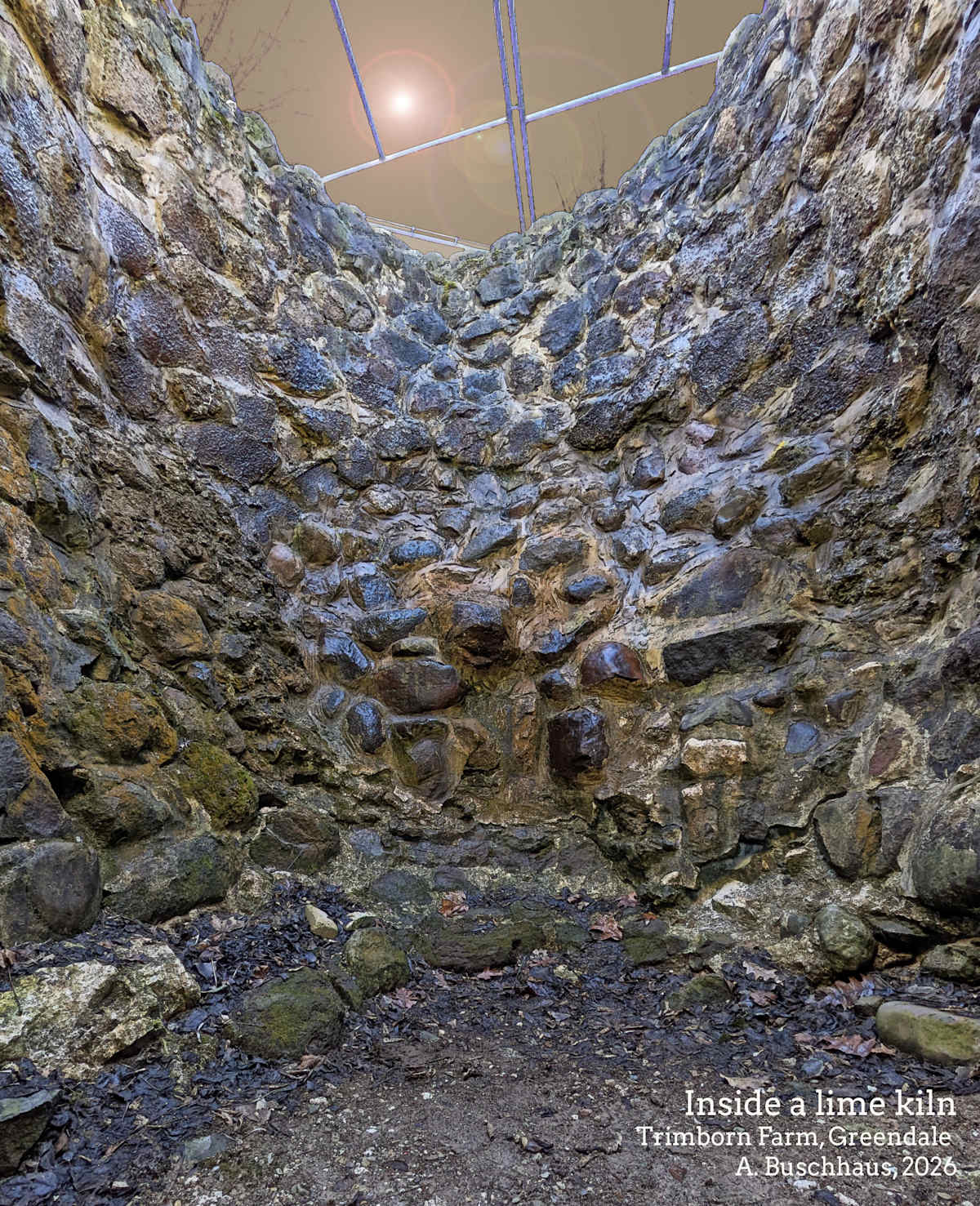
In Milwaukee County, Trimborn Farm in Greendale was a major lime production site from the 1850s to 1890s. Much of the lime produced here was used in building construction in Milwaukee, where one of the owners, Werner Trimborn, established a sales office. The Trimborn Farm site had a limestone quarry and six kilns, as well as worker bunkhouses. The plant was large, producing some 200 barrels of lime per day. [9]
The Trimborn Farm site (at 8881 W. Grange Ave., Greendale) is owned today by the Milwaukee County Historical Society and is part of the Milwaukee County Park system. [10] The remains of four kilns are at the south edge of the property under a wood awning. There is also an interpretive sign. [11] The kilns are open for exploration. The photograph for this blog post was taken inside one of the kilns.
Farther north, Ozaukee County is home to the partially preserved Milwaukee Falls Lime Company kilns in Grafton, discussed in Oddsconsin 59. Ozaukee County also has perhaps the only remaining pot kiln in the state, located in Harrington Beach State Park, near Belgium. The Park is owned and operated by the Wisconsin Department of Natural Resources. [12][13] A pot kiln is a small stone kiln in which limestone and wood were layered together and then burned. The lime that was produced was mixed with ashes from the burned wood. This was a local lime production operation, not a big company.
Sheboygan County has one of the best-preserved (and most unusual) lime kiln sites in the state. The Sheboygan Valley Land and Lime Company kilns are located at the intersection of Lime Kiln Road and County Road MM in the Town of Rhine. The site also contains a kiln shed, office building and a quarry. One thing that makes this location unique is that the lime complex has served as a private residence for decades, with a number of additions and alterations to the original structures. The National Register of Historic Places nomination is worth a look, just for the photographs alone. [14]
The site is privately owned, but viewable on Google Maps in 3D. [15] Note the narrow-gauge railway running along the tops of the kilns (which are 50 feet high) that delivered the rock to the kilns.
The Sheboygan Valley Land and Lime Company was established with the grand vision of not only producing lime but also clearing and draining the nearby marsh to create agricultural land. To facilitate this, the company harvested the marsh’s tamarack trees for kiln fuel. As many as 150 men worked in two lumber camps located at opposite ends of the marsh. [14]
These plans were short-lived. The kilns operated only until 1926, when changing economic conditions caused their closure. This seems to be a common theme. Most of the lime kilns we’ve looked at survived only a few decades, victims of an industry that seemed unable to cope with swings in the economy and the lime market.
We’ll wrap up our lime kiln tour next week with a visit to the kiln ruins in High Cliff State Park in Calumet County, which are quite spectacular.
Want to see more photographs of the Trimborn Farm lime kilns? Click here for a photo tour. Thanks go to A. Buschhaus, a friend from Milwaukee, for taking these photographs.
Want Oddsconsin delivered right to your inbox? Subscribe here.
Sources and Notes
[1] National Register of Historic Places, Milwaukee Falls Lime Company. https://npgallery.nps.gov/GetAsset/ba5077b1-2362-4090-bc4e-3730031e368e
[2] National Register of Historic Places, Garwin Mace Lime Kilns. https://npgallery.nps.gov/GetAsset/86dd3a9d-40a7-43e2-b0a0-a85aa3da6fb8
[3] Historical Marker Database, Menomonee River and Lower Falls.https://www.hmdb.org/m.asp?m=211234
[4] Enter these coordinates in the Google Maps search bar: 43.136667, -88.207191
[5] Enter these coordinates in the Google Maps search bar: 42.966169, -88.321513
[6] National Register of Historic Places, Johnston Lime Kiln. https://npgallery.nps.gov/AssetDetail/NRIS/82000723
[7] Enter these coordinates in the Google Maps search bar: 43.038744, -88.214788
[8] National Register of Historic Places, Hadfield Lime Kilns. https://npgallery.nps.gov/AssetDetail/NRIS/82000722
[9] National Register of Historic Places, Trimborn Farm. https://npgallery.nps.gov/GetAsset/6eabcdbd-356f-43d3-9139-b40edebd40ac
[10] Milwaukee County Parks, Trimborn Farm Map. https://county.milwaukee.gov/files/county/parks-department/Park-Maps/Trimborn.pdf
[11] Historical Marker Database, Wisconsin's Lime Industry.https://www.hmdb.org/m.asp?m=37508
[12] Wisconsin Department of Natural Resources, Harrington Beach State Park. https://dnr.wisconsin.gov/topic/parks/harringtonbeach
[13] Historical Marker Database, Pot Kiln. https://www.hmdb.org/m.asp?m=149608
[14] National Register of Historic Places, Sheboygan Valley Land and Lime Company. https://npgallery.nps.gov/GetAsset/f49ca47d-ba38-4fd1-af5f-d065ea16fd47
[15] Enter these coordinates in the Google Maps search bar: 43.854826, -88.028784