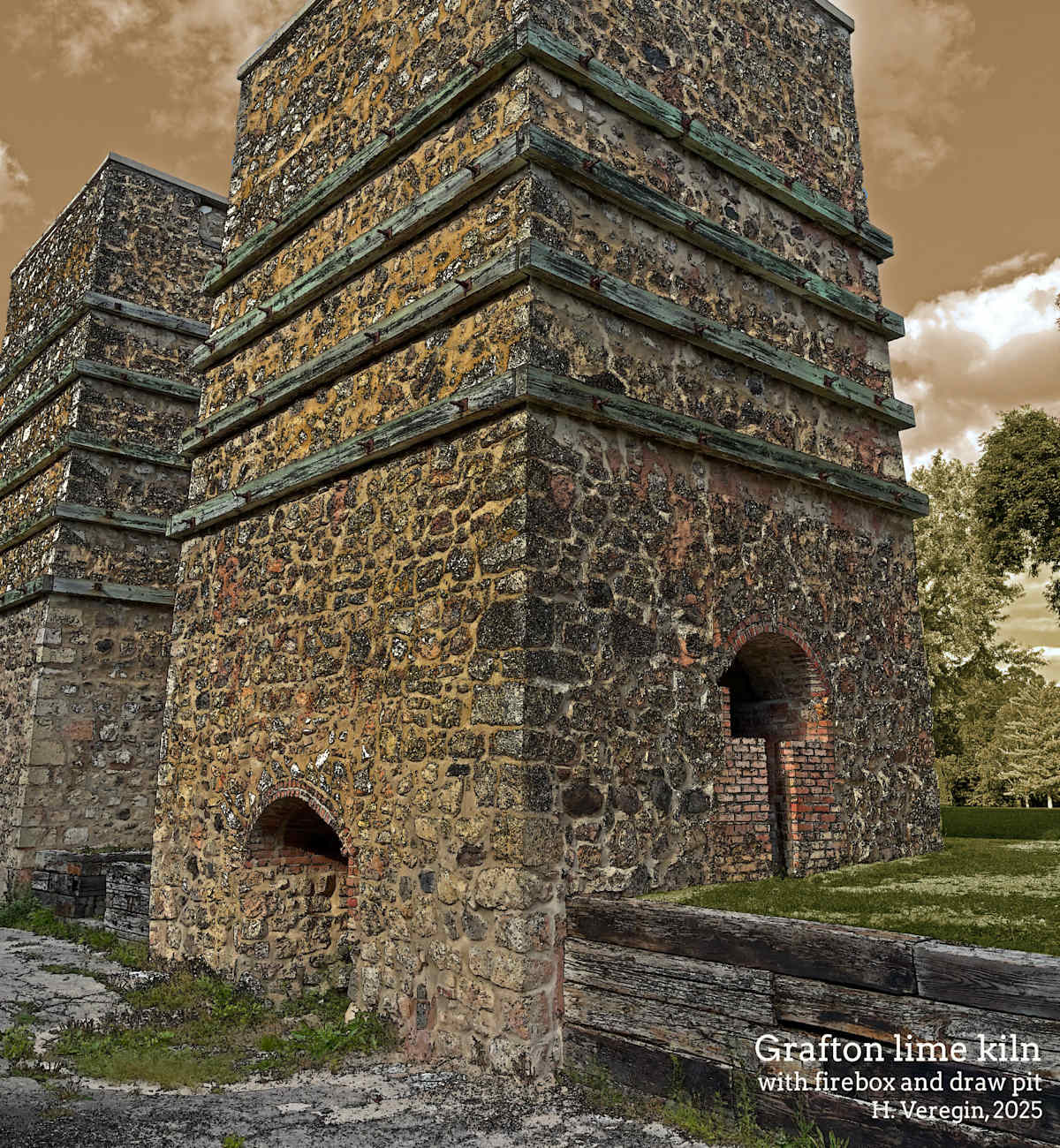
The lime kiln ruins in the Village of Grafton (Ozaukee County) are the footprints left behind by an industry that was once prevalent in eastern Wisconsin. Built in the 1890s by the Milwaukee Falls Lime Company, the kilns were in operation until 1926, but then rapidly fell into disrepair.
Three kilns remain of the original six. Several kilns collapsed in the 1940s and the village later used the site as a dump. In the 1970s, a local citizen group, the Lime Kiln Preservation Society, saved the three remaining kilns from demolition by the village and worked to stabilize them. The kilns are now within the Village of Grafton’s Lime Kiln Park, established in 1972, and are listed in the National Register of Historic Places. [1]
The kilns are rectangular in shape, twenty feet wide at the base and with a height of between twenty and thirty feet. They are made of irregular stone with squared stone quoins at the corners. Red brick lines the arched openings near the base. The kilns are reminiscent of defensive towers found along the outer walls of Medieval castles. But unlike castle towers, the kilns are hollow, like smokestacks, and their interior shafts are lined with heat-resistant brick.
The kilns produced lime by burning limestone, a sedimentary rock often used to construct masonry buildings. Limestone contains calcium carbonate, composed of calcium, carbon and oxygen. When limestone is heated to a high temperature (1,800 to 2,100 degrees Fahrenheit), two compounds are produced – carbon dioxide, which escapes as a gas, and calcium oxide, or lime. This process is known as calcination or calcining.
Fresh lime is sometimes called quick lime to distinguish it from slaked lime – lime that has absorbed water, either from the atmosphere or by deliberate introduction. Lime has a strong chemical affinity for water and can lose much of its usefulness if it absorbs too much. [2]
The Grafton kilns consumed limestone quarried on-site. Workers used dynamite and air hammers to break up the stone, which they loaded onto carts to transport it to the kilns. One of the quarries is still visible in Lime Kiln Park, but others have been filled in. A stone grinder crushed the stone into small pieces, which were then dumped into the kilns using an elevated tramway system, portions of which are still in existence.
Fireboxes near the base of each kiln burned cordwood to produce the heat needed for calcination. The kilns operated twenty-four hours per day throughout the year to maximize production. At its peak, the company employed fifty workers, who would have spent many grueling hours quarrying and loading the limestone, stoking the fires, shoveling the lime out of the kilns’ draw pits and packing it into barrels for transport. [3]
A dam across the Milwaukee River, built in 1893, provided power for the operation. The dam is partly preserved, but the various outbuildings – including a kiln shed, cooperage, stable, lime house and stone grinder – have disappeared. A railroad spur, now gone, once facilitated the transport of lime to market. [1]
At its peak, the plant produced as much as 100 tons of lime per day. [1] The main use of lime was as an ingredient in mortar and concrete. It was also used for whitewash (a sort of paint), leather tanning, glue manufacturing, soap making, glass making, iron smelting, paper production and soil conditioning. [2]
Wisconsin was once a major lime-producing state. Production centered on a deposit of dolomite (magnesium-rich limestone) running through the eastern part of the state as far north as Door County. The deposit continues north through the upper peninsula of Michigan, the islands of Lake Huron and then southern Ontario, until it reaches upstate New York, where it forms the escarpment over which Niagara Falls flows. The dolomite deposit – laid down as marine sediment over 400 million years ago – is rich in calcium carbonate from the shells of mollusks, snails, clams, and other marine animals. [2]
Wisconsin’s dolomite was a prized commodity in the days of the Grafton operation. The magnesium in the dolomite produced lime containing a high concentration of magnesium oxide. Mortar produced from such lime has improved strength, workability and durability, compared to regular lime. Dolomite is still used today in commercial lime production.
The demise of the Grafton lime plant in the 1920s is associated with changing economic conditions, competition from other producers and advances in the chemical composition of mortar and concrete. Visiting the Grafton site today, with the kilns silent, it’s a bit hard to imagine the activity and sounds that would have been present when the plant was in operation – the roaring wood fires, the thick smoke, the human activity and the noise of the carts, stone crusher, tramway and train cars. The site is quiet and serene. It’s sort of a cemetery, really, although not one for people.
Want Oddsconsin delivered right to your inbox? Subscribe here.
Sources and Notes
[1] National Register of Historic Places, Milwaukee Falls Lime Company. https://npgallery.nps.gov/GetAsset/ba5077b1-2362-4090-bc4e-3730031e368e
[2] W. S. Blatchley, 1903. The Lime Industry in Indiana (Report of the State Geologist). https://scholarworks.iu.edu/iuswrrest/api/core/bitstreams/8f838493-9c75-4a7c-8ffc-6e25c4cf2c51/content
[3] Carl Harms, 1991. History of Lime Kiln Park. https://www.villageofgraftonwi.gov/DocumentCenter/View/604/History-of-Lime-Kiln-Park