All the smartness, the spirited performance and the stalwart qualities so much admired in the famous Kissel Open Speedster may now be had for the first time in an enclosed car.
- Ad for 1924 Kissel Speedster
Wisconsin was a player in the early years of the automobile industry.
One of the big names was Nash Motors, which operated out of Racine and Kenosha from 1916 to 1937. During that period, it grew to acquire other automobile manufacturers like Jeffery Automobiles (Kenosha), Mitchell Motor Cars (Racine) and LaFayette Motors (Milwaukee). In 1937, Nash became a division of Nash-Kelvinator, a company that produced not just automobiles, but also refrigerators and helicopters.
In 1954, another merger occurred, this time with Detroit-based Hudson Motors to form AMC (American Motors Corporation). For a time, Nash and Hudson cars continued to be built in Kenosha. AMC then went on to introduce its classic car lines – including the Rambler, Pacer, Gremlin, Eagle and Jeep – before being purchased by Chrysler in 1987.
Your 2026 Jeep Grand Wagoneer has Wisconsin roots.
Southeast Wisconsin was the hub of early automobile activity in the state, with a number of smaller manufacturers operating out of plants in Milwaukee, Racine and Kenosha. Access to Lake Michigan was key to accessing shipping for materials and finished products. [1] Automobile plants also existed in Columbus and Janesville. But competition was tough and many of these companies only lasted a few years.
A more successful company was the Kissel Motor Car Company, which built cars in Hartford (Washington County) from 1906 until the Great Depression forced it into bankruptcy in 1931. Louis Kissel and his four sons, who founded the company, originally produced farm machinery and outboard engines, but moved into the expanding world of automobiles in 1906. The company developed a line they called the KisselKar, the “K” in Kar reflecting the German ancestry of the Kissel family. [2][3]
The first KisselKar was the 1907 Model C, which sold for $1,850 ($66,000 today). A five-passenger touring car weighing over a ton, it had a thirty-horsepower, four-cylinder engine and a three-speed transmission. [4] The Model C was everything you might imagine from a 1907 automobile. Open-topped with a fold-up roof hanging over the back end, it had upholstered upright seats, a prominent steering wheel sticking out of the floorboards, white tires on wagon-like wheels and a box of tools strapped to the running board.
The Model C, like other cars of its time, had the steering wheel on the right. The transition to today’s left-side drive occurred around 1913. [1] The Model C was a touring car, perfect for the open road. Other KisselKar models that followed it included a sumptuous sedan, a six-seater and the famous Gold Bug, an open-top two-seat speedster that could reach speeds of seventy miles per hour. [3] Amelia Earhart owned a Gold Bug as did many other celebrities, from Fatty Arbuckle to Al Jolson. [5][6] Earhart’s Gold Bug – which she drove cross-country from LA to Boston in 1924, is on display at the Forney Museum of Transportation in Denver, Colorado.
The ad for the 1924 Kissel Speedster at the top of this post was for an all-season vehicle. Unlike the Gold Bug, it was an enclosed car (it had a hard top), making it usable in the harsh Midwestern winter months. The 1924 Speedster was, however, still a stylish vehicle, with ebony black running gear, crimson wheels, a nickel-plated radiator and even an exterior golf bag holder. [7] Another Kissel innovation to accommodate winter travel was a detachable hardtop roof for touring cars, which the company patented in 1922.
Unlike Ford, Kissel was a luxury brand. The vehicles were advertised as “custom built.” Period KisselKar ads show how the vehicles were marketed toward “automobile connoisseurs.” The ads featured wealthy professionals, like doctors. Kessel attracted these individuals with features that included custom paint combinations, balloon tires, auxiliary seats, luxurious upholstery and engines powerful enough to “climb Mt. Wilson in high gear.” [7]
As early as 1910, Kissel also began producing commercial trucks (KisselKar Trucks). By 1912 they had introduced delivery trucks, ambulances, fire trucks, hotel buses and police paddy wagons (exactly the kind of vehicle you might see in a Keystone Cops film). To capitalize on demand during World War I, Kissel started producing four-wheel drive trucks for the US Army. [6] In the 1920s, after the war ended, the company expanded into small buses, hearses and taxicabs. [1][3][6]
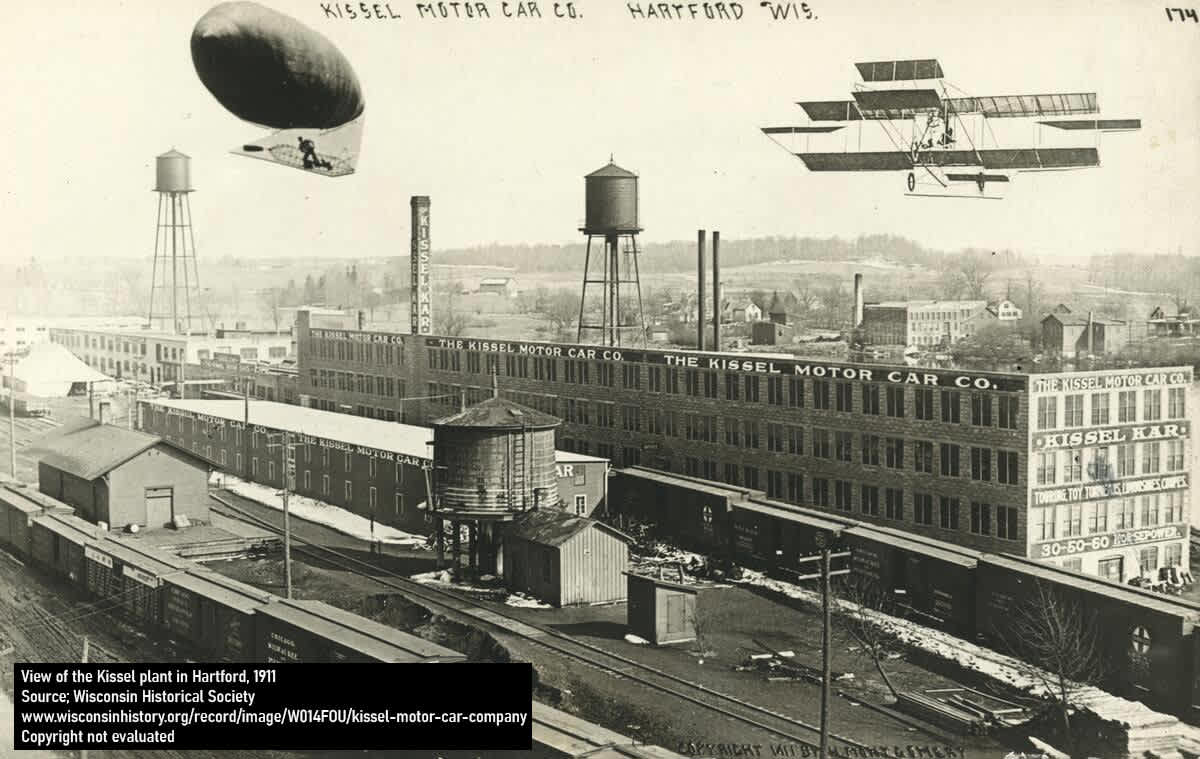
Kissel was able to produce these larger vehicles by expanding the size of its Hartford plant. By 1912, it had reached 300,000 square feet in size and the company employed over a thousand workers. In comparison, Hartford’s population at the time was only about three thousand. [1] Kissel’s production peaked at over 2,400 vehicles in 1920. Over its lifetime the company produced over 29,000 vehicles. [6]
The word “Kar” was dropped from the company’s branding in 1918, due to anti-German sentiment during World War I. [4] The radiator medallion saying “KisselKar – Every Inch a Car” was changed to simply “Kissel” with a figure of the Greek god Mercury. Later, Kissel was rebranded as White Eagle. [8]
The Kissel factory in Hartford no longer stands. After the company failed in 1931, the factory produced outboard motors. [8] A Wisconsin Historical Society marker is located at 43.31721N 88.37105W (on E Sumner St between Grand Ave and Steel Craft Dr). It’s just across the Rubicon River from the original factory site. [9] The building that now sits on the old Kissel site is operated by Steel Craft Corporation, which specializes in custom steel fabrication.
Several hundred Kissel cars and trucks have survived. Some are privately owned, but they also feature in automobile museums, including the Wisconsin Automotive Museum right in Hartford, which has a variety of Kissel cars and trucks on display. [1] [10] If you can’t make it to Hartford, you can check out the Kisselkar Klub online, which posts information from Kissel enthusiasts and dates of owner gatherings and meetups. [11] There are also informative videos you can watch from the comfort of your living room sofa. [1][8]
Kissel was not the only small automobile manufacturer that failed to survive the Great Depression. It was hard for these companies to compete with the likes of Ford and General Motors, which were producing hundreds of thousands of vehicles per year. But if things had turned out differently, perhaps southeast Wisconsin would still be a center of automobile production today.
Sources
[1] Dawn Bondus Mueller, Kissel, Wisconsin’s Luxury Automobile. https://www.pbs.org/video/university-place-kissel-wisconsins-luxury-automobile/
[2] Tower Heritage Center, Remembering the Kissel Car Company: The Rise of Wisconsin’s Early Automaker. https://www.thetowerheritagecenter.org/remembering-the-kissel-car-company-the-rise-of-wisconsins-early-automaker/
[3] Ronald Hausmann, Kissels and Classic Cars. https://kisselsandclassiccars.com/history-of-the-kissel-automobile/
[4] Lynn Kissel, The Kissel Motor Car, The Classic Car, Vol. 58, No. 4 (Winter 2010). https://web.archive.org/web/20190509011801/http://www.kisselkar.net/Articles/BriefHistory/KisselMotorCar2.pdf
[5] Ronald Sieber, Amelia Earhart and her Kissel Gold Bug Speedster. https://ronaldsieber.com/blog/2019/5/22/amelia-earhart-and-her-kissel-gold-bug-speedster
[6] Lynn Kissel & Doug Kissel, A Visual Essay on the Kissel Motor Car Company, Kisselkar Klub. https://kisselkar.net/wp-content/uploads/2023/02/KisselVisualEssay_2023-02-10.pdf
[7] Automotive History Preservation Society, KisselKar. https://autohistorypreservationsociety.org/kissel-documents/
[8] City of Hartford, History of the Kissel Motor Car Company. https://www.youtube.com/watch?v=BdJwm0_Vh0M
[9] Historic Marker Database, Kissel. https://www.hmdb.org/m.asp?m=30684
[10] Wisconsin Automotive Museum. https://wisconsinautomuseum.com/
[11] KisselKar Klub. https://kisselkar.net/