When I'm worried and I can't sleep
I count my blessings instead of sheep
- Irving Berlin, Count Your Blessings (Instead of Sheep)
Wisconsin once had a lot of woolen mills. Most were built after 1860 and some continued operations for a century. There were mills in Appleton [1][2], Baraboo [3], Beaver Dam [4], Chippewa Falls [5], Janesville [6], Monticello [7], Reedsburg [8], Waterford [9] and Waukesha [10]. And this is only a partial list. By 1871, there were fifty-four woolen mills in the state. [2]
These mills were located on the banks of creeks, rivers and canals, which supplied water power. They produced woolen fabrics, yarn, felt, flannels, mittens, blankets, socks, mackinaws (woolen jackets) and other products. Some mills were small but others were large complexes that included spaces for wool storage, washing, dying, machines for carding (aligning wool fibers), spinning (twisting carded fibers to create yarn) and knitting. Large looms were used to weave the yarn into fabric. Finishing rooms provided equipment to manufacture finished products.
These processes were mechanized from an early date. The wool industry was one of the earliest to adopt machines in production, as the processing of wool was otherwise a labor-intensive process. Europe was the technology leader. The Jacquard Loom, invented in France in 1801 by Joseph Marie Jacquard, was controlled by punch cards that presaged the arrival of the computer a century and a half later. [11]
Ada Lovelace, daughter of the poet Lord Byron and a skilled mathematician, was particularly impressed with Jacquard’s invention. She convinced her colleague Charles Babbage to adopt punch cards to control his Analytical Engine, which Babbage designed in 1837. While never fully completed, the Analytical Engine is usually credited as being the world’s first general-purpose computer.
The original impetus for Wisconsin’s wool industry was an “explosion” in the state’s sheep population in the 1840s. Sheep farming was profitable and farmers often raised sheep to supplement their incomes. Sheep were easy to maintain, reproduced rapidly and produced at least one product (wool) that was non-perishable. [2] It may seem hard to believe, but at its peak in 1880, Wisconsin was home to over one million sheep. Today, there are less than a hundred thousand. According to US Department of Agriculture historical data, Wisconsin produced 5.4 million pounds of wool in 1909, but only 286 thousand pounds in 2022. [12]
But the rapid increase in woolen mills in the 1860s had another cause: a shortage of southern cotton caused by the Civil War. Since cotton does not grow in Wisconsin, local farmers responded the only way they could, by increasing their production of wool and flax (used for producing linen). Wisconsin’s wool industry was born in the shadow of the Civil War, and it helped facilitate the state’s transition from a purely agricultural economy to one that included manufacturing. [13]
One of the best known historic woolen mills in Wisconsin is the Hilgen and Wittenberg Woolen Mill – later the Cedarburg Woolen Mill – in present-day Cedarburg (Ozaukee County). [14] The mill is a complex of limestone and wooden buildings, the oldest dating to 1864-65 and the latest to 1907. [13]
The mill was established by Frederick Hilgen and Diedrich Wittenberg. Hilgen was an entrepreneur in the area – then known as Cedar Creek Settlement – building the first grist mill there in 1845. Wittenberg was born in Germany and immigrated to the US in 1844. A teamster who worked for Hilgen, he worked on the construction of the woolen mill. In 1874, when the mill was incorporated into the Cedarburg Woolen Mill, Wittenberg was named the company’s president. [15]
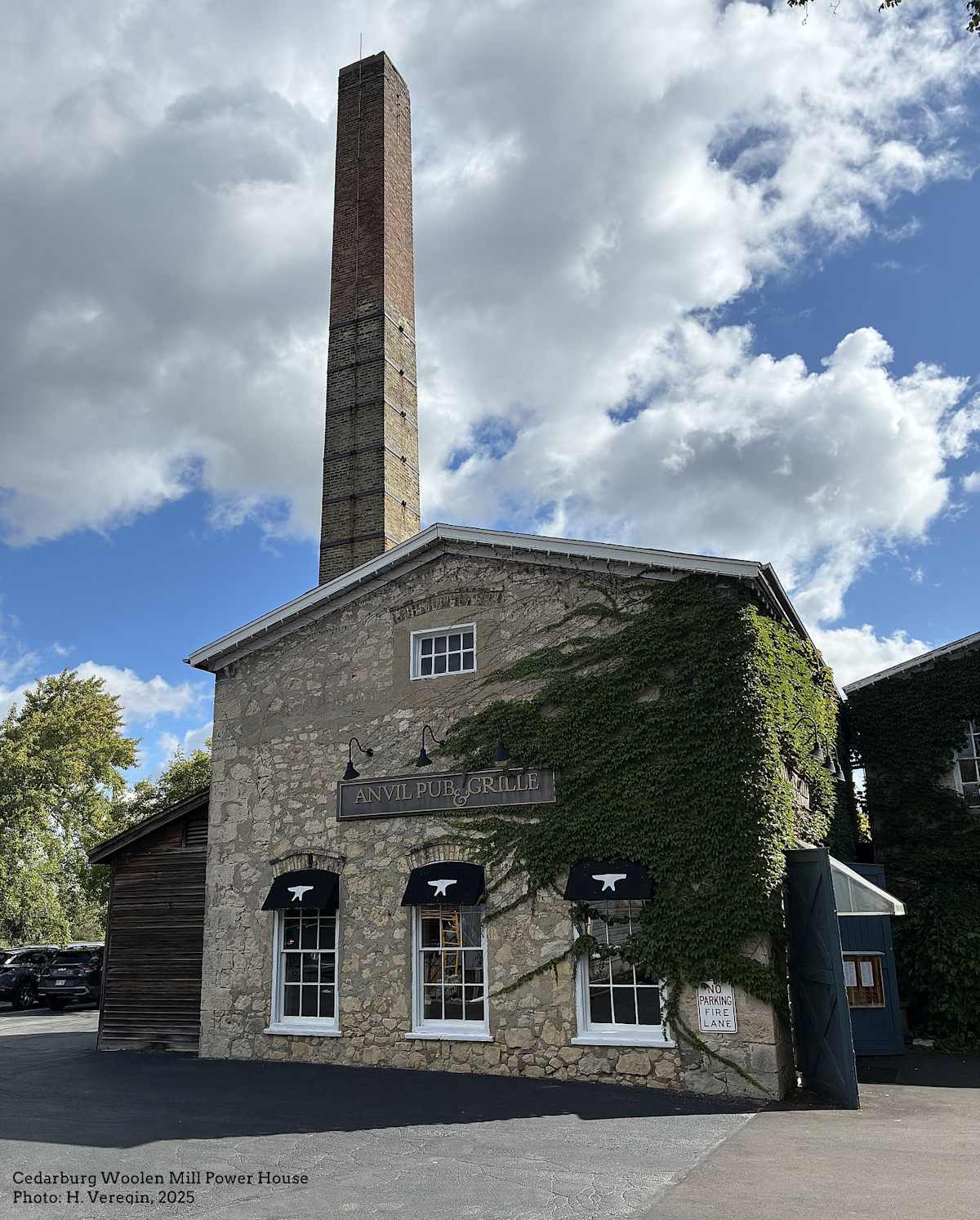
The Cedarburg mill complex grew over time to include not just the factory, but also warehouses, an office, a coach house, a store and shipping department, a bleaching house and a dye house connected to the factory basement by a tunnel. The photo at the head of this post is the powerhouse, built in 1896 to augment the mill’s water power (Cedar Creek) with steam engines. [13]
In 1897, a direct current generator was added to supply electricity to the factory and the homes of its owners. (See Oddsconsin 13 for a discussion of the battle between Thomas Edison and Nikola Tesla over direct versus alternating current. [16] The story includes the public electrocution of animals by Edison to demonstrate the dangers of alternating current!)
Business at the Cederburg Woolen Mill was so good that in 1880 the company built a branch factory in Grafton for the production of worsteds (fine, smooth yarn and the fabrics made from it). The end took almost a century to arrive, and the mill finally shut down in 1968. The reasons behind the decline of the US wool industry are complex. Factors include the introduction of cheap synthetic fibers like polyester, the rise of the state’s dairy industry at the expense of sheep and wool, and changes in domestic demand and international trade.
The Cederburg Woolen Mill complex is now home to specialty shops and restaurants called the Shops of Cedar Creek Settlement. Like other historic buildings, the mill was almost torn down, in this case to make way for a gas station. [15] It was saved by a sympathetic mayor and a local winemaker (now Cedar Creek Winery). By the early 1970s, the mill complex was an integral piece of Cedarburg’s historic downtown – which became a National Register Historic District in 1986 – that attracts tourists to the city. [17]
Although adapted to new uses, much of the old mill has been preserved. Wooden floors, rustic stone walls and exposed beams speak to the building’s history. A display on the main floor shows the tools of the trade when the mill was in operation. Cedar Creek still has a dam at the location. The mill is proof that Wisconsin has more to it than just cheese and beer. Wool was an early industry in the state and as such it helped “shepherd in” other types of manufacturing, including mineral products, paper, chemicals, transportation equipment and electronics – all of which are part of Wisconsin’s modern industrial landscape.
Sources
[1] Wisconsin Historical Society, 218 East South Island Street. https://www.wisconsinhistory.org/record/national-register/NR2496/redirect
[2] Historic Structures, JB Courtney Woolen Mills, Appleton Wisconsin. https://www.historic-structures.com/wi/appleton/courtney-woolen-mills/
[3] Sauk County Historical Society, Beginning in 1863 with a Millrace… https://saukcountyhistory.org/history-center
[4] Wisconsin Historical Society, Upper Woolen Mill Dam. https://wisconsinhistory.org/record/image/W013WD6/upper-woolen-mill-dam
[5] The Historical Marker Database, Woolen Mill. https://www.hmdb.org/m.asp?m=237868
[6] University of Wisconsin-Madison Libraries, Early woolen mill, Janesville. https://search.library.wisc.edu/digital/ADUTTNP5WSIKOM8R
[7] Welcome to Monticello, Wisconsin. Historic Monticello Woolen Mill. http://www.monticellowi.com/textilesSep00.htm
[8] City of Reedsburg, Woolen Mill / Baraboo River Mural. https://www.reedsburgwi.gov/index.asp?SEC=DFD59405-6470-4E56-87AD-43AB9F73E21F&DE=F903A79C-6F1F-4DFB-8D72-B1DD77AAD0CF
[9] Waterford Heritage Committee, The Mills of Watertown. https://historicalwaterfordwi.com/mill-sites/mill-site-no-2/
[10] Wisconsin Historical Society, 139 E North St. https://www.wisconsinhistory.org/record/property/HI88084
[11] National Museums of Scotland, The Jacquard loom: Innovation in textiles and computing. https://www.nms.ac.uk/discover-catalogue/the-jacquard-loom-innovation-in-textiles-and-computing
[12] United States Department of Agriculture, National Agricultural Statistics Service, Quick Stats. https://quickstats.nass.usda.gov/
[13] National Register of Historic Places, Hilgen and Wittenberg Woolen Mill. https://npgallery.nps.gov/NRHP/GetAsset/f2467651-84fc-4830-b851-35d856e68e9d
[14] Wisconsin Historical Society, Cedarburg Woolen Mills. https://www.wisconsinhistory.org/record/image/W013WK8/cedarburg-woolen-mills
[15] The Shops of Cedar Creek Settlement, History of the Wittenberg Woolen Mill. http://ww.cedarcreeksettlement.com/history.html
[16] H. Veregin, Oddsconsin #13 – The Vulcan Street Hydroelectric Plant. https://howard-veregin.com/blog/oddsconsin-13-the-vulcan-street-hydroelectric-plant-oddsconsin-where
[17] National Register of Historic Places, Washington Avenue Historic District. https://npgallery.nps.gov/NRHP/GetAsset/NRHP/86000218_text