A map, a map, my kingdom for a map!
– King Richard in William Shakespeare’s “Richard III”
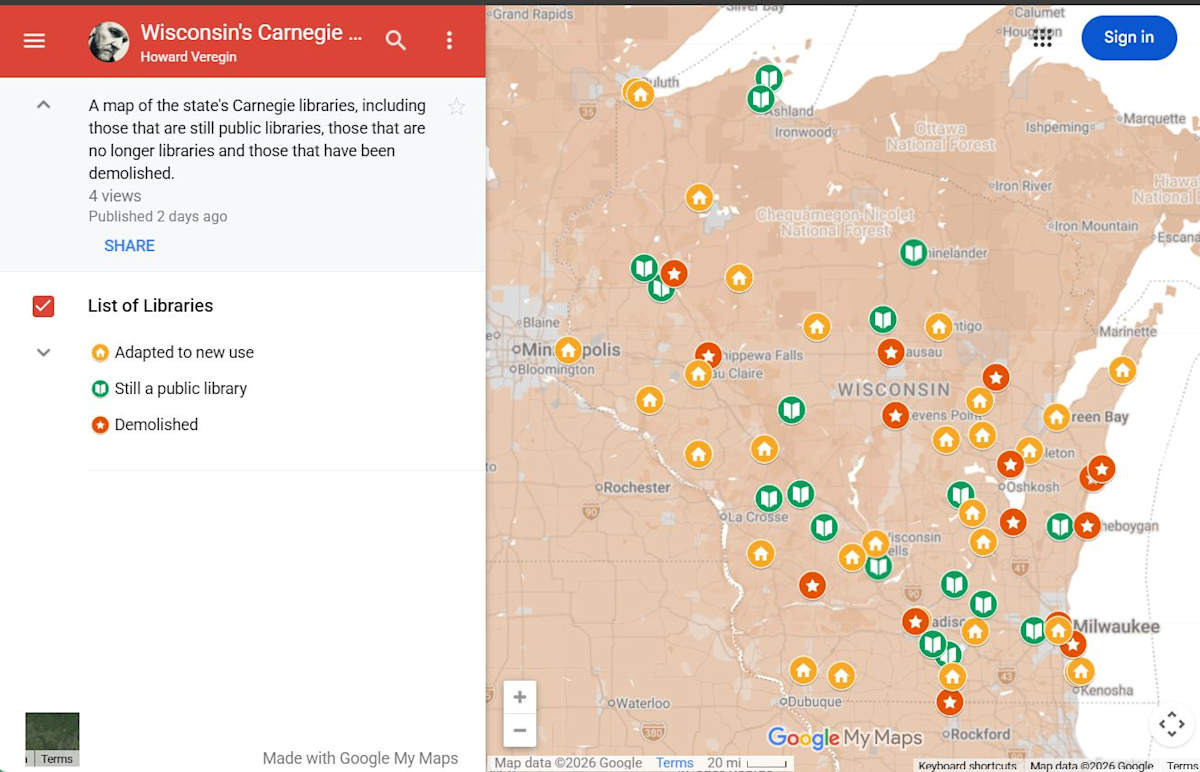
This week’s Oddsconsin post is this map.
Last week’s post looked at Wisconsin’s first Carnegie Library, built in Superior in 1902. This week, Oddsconsin maps out the other Carnegie libraries across the state. This includes libraries that are still libraries, libraries that are still standing but are no longer used as libraries, and libraries that have been demolished.
In the early years of the twentieth century, Andrew Carnegie – a wealthy Scottish-born industrialist – spent forty million dollars (equivalent to 1.35 billion dollars today) to construct 1,679 public libraries across the US. Wisconsin built sixty-three Carnegie Libraries in sixty communities. The first was Superior Main Library (1902) and the last was Superior’s East End Branch Library (1917). Along with Superior, the two other communities that built two libraries were Madison and Racine.
Of the sixty-three original Carnegie public libraries, eighteen are still public libraries. Some of these have been extensively renovated or expanded. Thirty former Carnegie libraries are now used for other purposes, including private homes, commercial buildings and museums. Fifteen libraries have unfortunately been demolished, usually because the city outgrew them and found it easier to build a new library than accommodate the old building into the new design.
The period of Carnegie library building in Wisconsin was short. Forty-seven Carnegie library grants were obtained in the decade from 1901 to 1910, and about two-thirds of Wisconsin’s libraries were constructed during this period. The average grant was about $16,500 (equivalent to over $500,000 today) and the total of all Wisconsin grants was just over $1,000,000 ($35,000,000 today).
The map is interactive. You can click on a map symbol to get more information about the library, including its address, current status, amount and date of the Carnegie award, and a building date where available. A link is also provided to the Columbia University Archive where Carnegie’s papers are held. These links take you to scanned versions of the original correspondence between Carnegie’s staff and the community requesting a grant.
A second link provides more information and sometimes photos of the library. These links are a bit random, since information is often only spotty.
A number of these libraries are also in the National Register of Historic Places, where more information is provided on the history and architecture of the library. But that’s a project for another day.
The information used to construct the map is all publicly available on the web. But be aware that many of the sites you find online have outdated information. This includes Wikipedia, one of the only sites to list all sixty-three libraries. In researching this post, I discovered numerous inaccuracies in online information – including two libraries that had apparently been demolished recently.
Since the map is a Google MyMap, you can also use it to get driving directions to each library. Start planning your statewide Carnegie library tour! In cases where a library is now privately owned, be wary of trespassing. And of course … things can change. If you do visit a library only to find it is no longer there or is now a private residence or office, let me know by sending me an email on this site.