I resolved, if ever wealth came to me, that it should be used to establish free libraries.
- Andrew Carnegie, 1889
Andrew Carnegie believed in the power of libraries. By the late 1800s, the Scottish-born industrialist had become one of the richest people in America thanks to the success of his business ventures – especially the Carnegie Steel Company. But wealth alone was not his goal. In The Gospel of Wealth – which Carnegie published in 1889 – he asserted that the rich are merely trustees of their wealth and are morally obligated to help those who cannot help themselves. He famously declared, “The man who dies thus rich dies disgraced.” [1]
But Carnegie did not believe in indiscriminate charity. His philanthropy was tied to his ideas of progress and self-improvement. A strong proponent of capitalism and a foe of socialism, he stated, “In bestowing charity, the main consideration should be to help those who will help themselves…. Neither the individual nor the race is improved by almsgiving.” [1] He advocated for the funding of universities, hospitals, medical colleges, churches, parks, meeting halls and “swimming baths.”
But Carnegie is best known for funding public libraries. His respect for books stemmed from an early age, as they provided him with the education he needed to move beyond his humble beginnings. By his death in 1919, he had donated forty million dollars (equivalent to 1.35 billion dollars today) to construct 1,679 public libraries across the US. Carnegie libraries were built in almost every state, plus Hawaii (not a state at the time), Puerto Rico and Washington, DC.
In 1911, Carnegie established the Carnegie Corporation of New York to manage his philanthropic activities. Communities requesting grants for libraries had to provide land and commit to sustained funding of the library and its collections. Over time, the rules became more stringent, with communities being required to document their commitment via local ordinances. [2] Carnegie was adamant about this, reflecting his views on indiscriminate charity. Simply providing a grant would have been “almsgiving.”
Beginning in 1902, Wisconsin built sixty-three Carnegie libraries in sixty communities. This represents about 3.8 percent of all Carnegie libraries built in the US. Given that Wisconsin’s population in 1900 (about 2 million) was 2.6 percent of the US population (about 76 million), the state built more libraries than would be expected based on its population – perhaps a reflection of Wisconsin’s progressive attitudes at the time. [3]
At least thirteen Wisconsin Carnegie libraries have since been demolished and of those that remain, about half are still in use as libraries. [3][4]
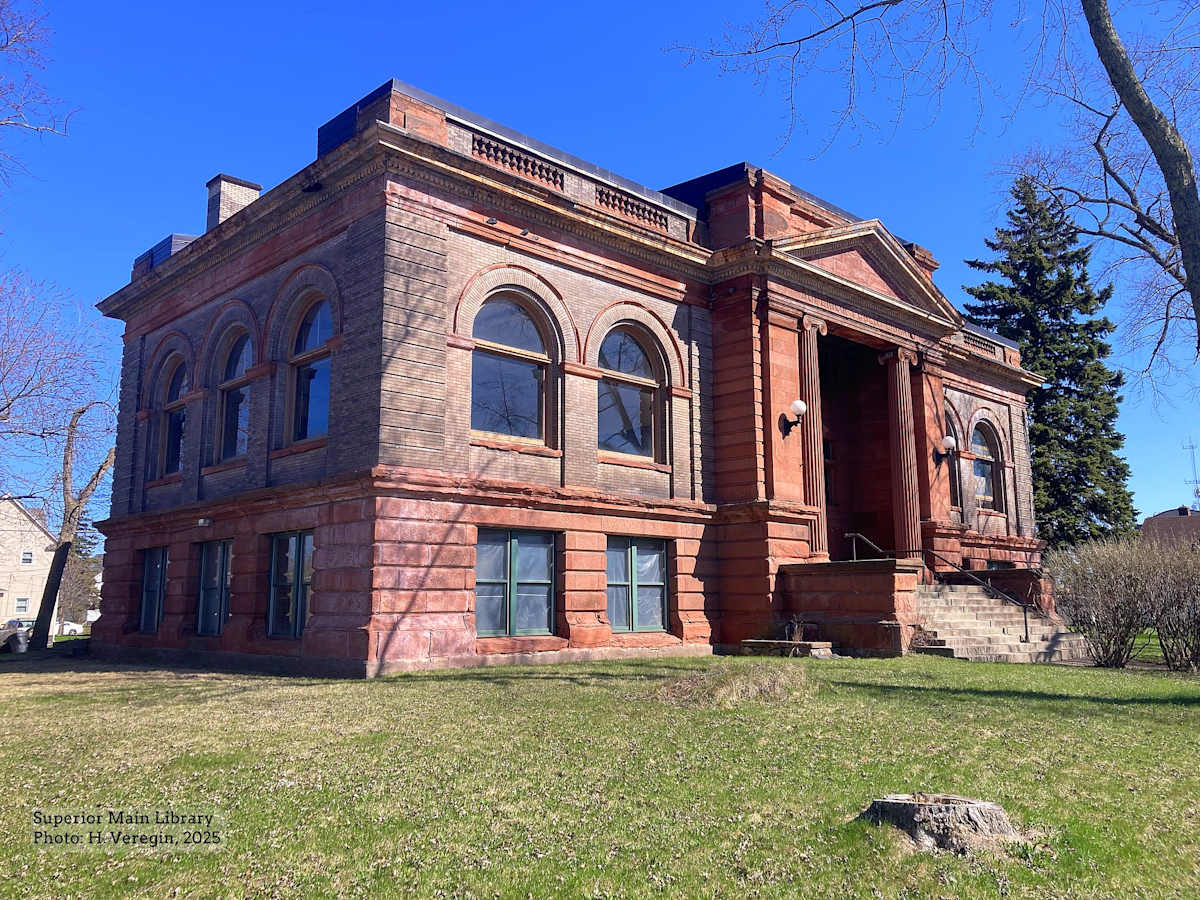
The City of Superior built two Carnegie libraries – the Main Library (1204 Hammond Ave) and the East End Branch Library (2306 East 5th St). Built in 1902, the Main Library has the distinction of being the first Carnegie library in Wisconsin. The East End Library, in contrast, was the last Carnegie library built in the state. [5] Why two libraries in Superior? In 1900, Superior was the second-largest city in Wisconsin with over 30,000 inhabitants – more than it has today.
Both of Superior’s Carnegie libraries still stand, but neither is used as a library today. The City of Superior vacated the Main Library in 1991 after moving to a new library (a remodeled grocery store) at 1530 Tower Ave. [6] City council apparently voted to demolish the Main Library, but after legal battles, declined to do so. Instead, the property went into private ownership. [5] In 2022 the city repurchased the building in hopes of attracting a developer. [7] The East End Library is privately owned and has been converted into a single-family home. It recently sold in September 2025.
While there were no precise requirements for the architectural design of Carnegie libraries, their interior layout was strongly influenced by professional librarians who served as Carnegie’s advisors. Carnegie’s personal secretary, James Bertram, was eventually given responsibility for making recommendations on library design proposals. His 1911 memo, Notes on the Erection of Library Buildings, states that the main floor should be used exclusively for the housing of books and the provision of comfortable reading areas, with lecture rooms, heating and “conveniences” located in the basement. [8] A one-story building with a basement was the preferred plan, but the design of library exteriors was to be left to the discretion of the community and architect, who were encouraged to “express their individuality.”
The Wisconsin Historical Society has a collection of interior and exterior photographs of Superior Main Library. [9] The interior reflects Bertram’s recommendations, showing rows of bookshelves, wooden tables and chairs for reading, and an open floorplan. The interior is airy and bright, with glass transoms above the doors and lighting fixtures suspended from the ceiling. An octagonal circulation desk stands at the center of the library, with bookshelves fanning out behind. [10]
The exterior images show a symmetrical Neoclassical building, made of brick and stone with a red tile roof. The entrance is up a set of stone stairs set between two stone columns, rising to a covered entrance pavilion topped by a Neoclassical pediment. The building exudes an air of stateliness, permanence and respectability.
Photos of the East Branch Library [11] show a more subdued building, its design often referred to as Georgian Revival. The brick building has a central entranceway between stone pilasters (columns set into a wall), a semi-circular fanlight over the entrance door and symmetrical large arched windows.
It’s unclear what will become of the Main Library, but hopefully it can be adapted to a new use, as have many other Carnegie libraries. Meanwhile, long after Andrew Carnegie’s death, the Carnegie Corporation of New York – now known as the Andrew Carnegie Foundation – continues to fund libraries. The latest solicitation for public library grants was in 2025. [12] If your community still needs a public library, this might be a good place to start!
Next week, we’ll map out the other Carnegie libraries in Wisconsin.
Want Oddsconsin delivered directly to your inbox? Subscribe here.
Sources
[1] Andrew Carnegie, 1889, The Gospel of Wealth. https://carnegie.org/publication/the-gospel-of-wealth/
[2] Carnegie Libraries of California, How do WE get a Carnegie Library? https://www.carnegie-libraries.org/lucy_cg.html
[3] Wisconsin Library Heritage Center, Carnegie Libraries. https://heritage.wisconsinlibraries.org/categories/listings/carnegie-libraries/
[4] The Library History Buff, Carnegie Libraries in Wisconsin. https://www.libraryhistorybuff.org/carnegie-libraries-wi.htm
[5] The Library History Buff, Carnegie Libraries in Superior Wisconsin. https://www.libraryhistorybuff.org/carnegie-libraries-superior.htm
[6] Superior Public Library, About Superior Public Library. https://superiorlibrary.org/about/about-spl/
[7] Colleen Leahy, Both of Superior’s Carnegie libraries are for sale, WPR, July 14, 2025. https://www.wpr.org/news/both-superior-carnegie-libraries-for-sale
[8] James Bertram, 1911, Notes on the Erection of Library Buildings, Carnegie Mellon University Digital Collections. https://digitalcollections.library.cmu.edu/node/85459?search_api_fulltext=Andrew%20
[9] Wisconsin Historical Society, Superior Library (search). https://www.wisconsinhistory.org/global-content/global-search/?keyword=superior%20library&fq=community%3ASuperior
[10] Wisconsin Historical Society, Superior Public Library. https://www.wisconsinhistory.org/record/image/W013COZ/superior-public-library
[11] Wisconsin Historical Society, 2306 E 5th St. https://www.wisconsinhistory.org/record/property/HI17309/2306-e-5th-st
[12] Andrew Carnegie Foundation, Call for Submissions: Grants to Support Public Libraries Nationwide. https://carnegie.org/article/call-for-submissions-grants-to-support-public-libraries-nationwide/