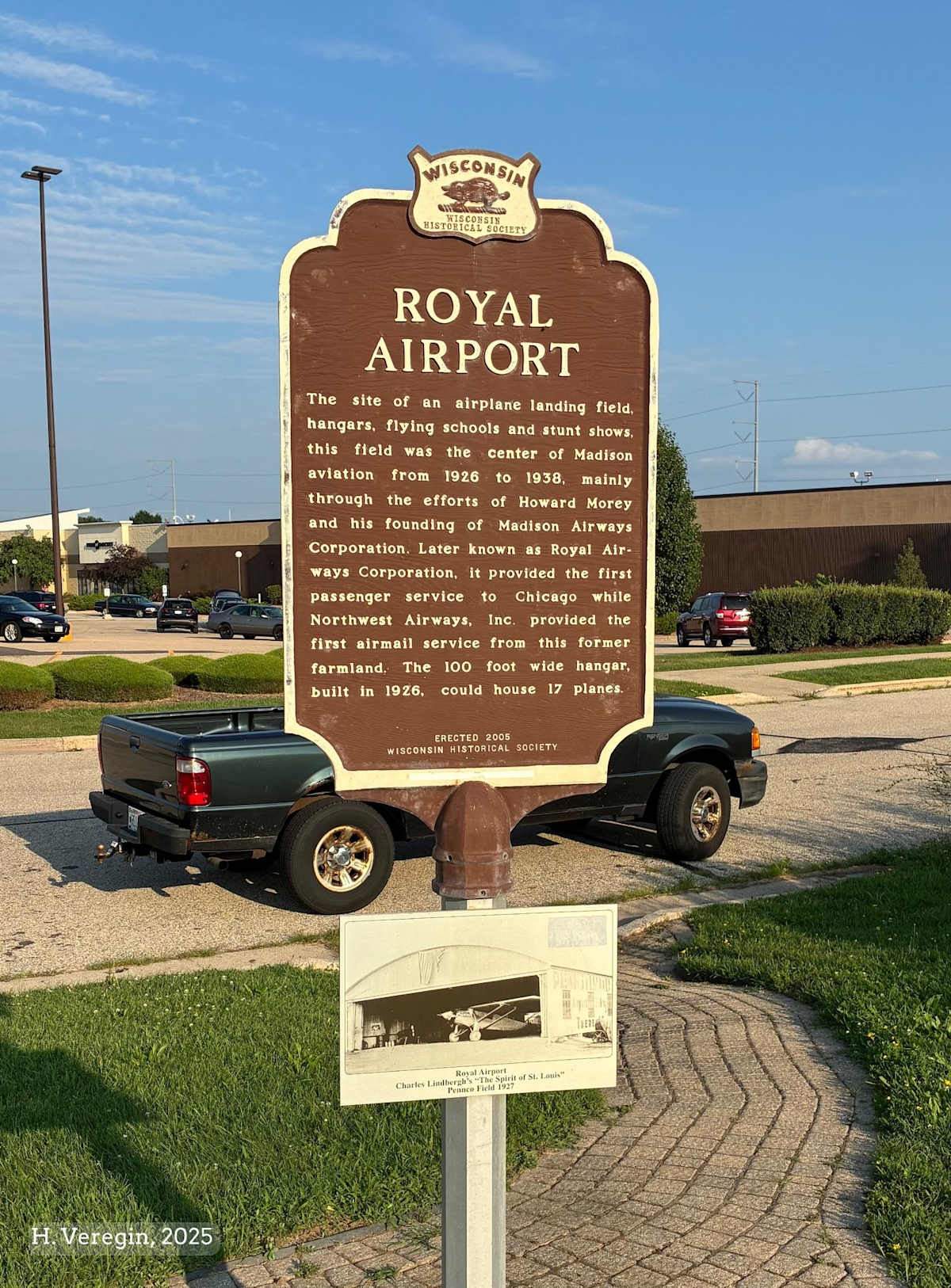
The historic marker is easy to miss. It sits adjacent to the South Towne Mall parking lot in Monona, in a small grassy area next to West Broadway. The marker, set by the Wisconsin Historical Society in 2005, has two sides. One side reads,
ROYAL AIRPORT
The site of an airplane landing field, hangars, flying schools and stunt shows, this field was the center of Madison aviation from 1926 to 1938, mainly through the efforts of Howard Morey and his founding of the Madison Airways Corporation. Later known as Royal Airways Corporation, it provided the first passenger service to Chicago while Northwest Airways, Inc., provided the first airmail service from this former farmland. The 100 foot wide hangar, built in 1926, could house 17 planes.
The other side of the marker reads,
CHARLES LINDBERGH
Royal Airport, then called Pennco Field, welcomed Charles Lindbergh and the “Spirit of St. Louis” in a triumphal visit to Madison in 1927, three months after his historic trans-Atlantic solo flight. He circled the field three times, and then banked into a perfect landing at exactly 2:00 PM. Lindbergh returned to Madison in 1928 to receive an honorary degree of Doctor of Laws. On each visit, Lindbergh strongly advocated for the commercial development of aviation in Madison.
Below the marker is a photograph of the Spirit of St. Louis (Lindbergh’s airplane) from the 1927 visit.
The airport is visible on historic air photos. A photo from June 27, 1937 (US Department of Agriculture, photo #5-439) [1] shows the airport’s narrow landing strip running north-south from West Broadway to the area that is now the Walmart Supercenter south of the Beltline. To the east of the airport are agricultural fields. Three airplanes, a main hangar and several smaller hangars are visible. Another, larger, airplane sits in front of a large building a few hundred feet to the northeast. A photo of the main hangar can be found in the collections of the Wisconsin Historical Society. [2]
Howard Morey – who, along with his business associates, formed Madison Airways and established the airport – was a barnstormer (stunt pilot) from Chicago. He sold Madison Airways to the Royal Rapid Transit Company in 1927, which renamed it Royal Airways and rechristened the airport as Royal Airport. Royal Airways provided daily passenger service to Chicago, but the company was short-lived, liquidating its assets in 1928. [3] For another decade, Royal Airport was home to a number of other airlines, including Northwest Airways, which grew to become Northwest Airlines before merging with Delta Air Lines in 2010.
Northwest originally carried airmail rather than passengers. A photograph of one of the letters making the inaugural Northwest Airways flight from Royal Airport to Minneapolis on November 22, 1927, is in the collection of the Wisconsin Historical Society. [4]
Airmail service in the US started in 1918 using open-cockpit cloth-and-wood biplanes (two wings) of World War I vintage. [5] By the 1930s, larger and more modern aircraft had been adopted. A photograph from the Wisconsin Historical Society collections shows a Northwest airmail airplane at Royal Airport in 1932. The single-engined metal monoplane (one wing) appears to be a Hamilton Metalplane H-45 or H-47, among the first all-metal aircraft in the US, covered with a distinctive corrugated aluminum skin. [6]
The Hamilton Metalplane Company was headquartered in Milwaukee. It was established by Seattle aviation pioneer Thomas Hamilton, who came east during World War I to direct the production of wooden airplane propellors for the US military, and then stayed on starting his own company. Hamilton’s company was eventually absorbed by Boeing.
Early passenger airplanes included both biplane and monoplane designs. The Curtiss Condor, for example, was a wooden and metal two-engined airplane that could carry up to fourteen passengers in a closed cabin. Glenn Curtiss, who formed the Curtiss Aeroplane Company in 1910, was responsible for several early successful aircraft designs, including the Curtiss Jenny, a one-engine wooden biplane developed for the US military during World War I. With surplus Jennys abundant after the war, it became a favorite of barnstormers in the 1920s. Curtiss is also known for his protracted legal battles with the Wright Brothers over patent rights.
The Ford Tri-Motor was another early passenger airplane. Like the Hamilton Metalplane, it was covered in corrugated aluminum, but as its name indicates, it had three engines. This was promoted as a safety feature (probably true!) and the Tri-Motor went on to become one of the most successful airplanes of the era. The Fokker F-10, another three-engined passenger airplane, is best known for the dubious distinction of carrying Notre Dame football coach Knute Rockne to his death in 1931.
It’s unlikely, given the small size of Royal Airport, that it could have accommodated the larger and more advanced passenger craft of the 1930s, like the Douglas DC-2 and DC-3.
Royal Airport was only a short-term solution to Madison’s passenger and airmail needs, as the site lacked room for expansion. [7] In 1927, the city purchased 290 acres of land on the northeast side of the city to establish Madison Municipal Airport, which would eventually become Dane County Regional Airport. [3] The city continued to lease Royal Airport until 1938, when the Municipal Airport was finally ready. [7] The airport opened with Howard Morey as manager, [3] highlighting the significant role Morey played in the evolution of the aviation industry in the city. Morey later also established what is now Middleton Municipal Airport after operation of Madison Municipal Airport was transferred to the US Army Air Corps (precursor to the Air Force) in 1942. [8][9]
And what of Charles Lindbergh, who made his triumphal visit to Madison in 1927? Lindbergh was actually not the first person to fly across the Atlantic. That record is held by British aviators John Alcock and Arthur Brown, who flew a wooden, World War I surplus two-engine Vickers Vimy biplane bomber from Newfoundland to Ireland in 1919, some eight years before Lindbergh.
Lindbergh’s accomplishment was doing the flight solo, flying from New York to Paris in May 1927 in 33 hours. He apparently survived on sandwiches and milk (one of his favorite beverages). Lindbergh became enormously famous for his feat and in the US he became a national hero. Raised in Minnesota, he attended the University of Wisconsin in the 1920s, but dropped out to become an early barnstormer and airmail pilot.
As to his honorary University of Wisconsin degree, records are unclear whether it was a Doctor of Laws or a Doctor of Letters. [10]
Later in life, Lindbergh became a controversial figure due to his stance over US involvement in World War II and his apparent sympathies with some of the policies of the National Socialist regime in Germany. But delving into that history would require its own blog posting.
Next time you’re at South Towne Mall, be sure to check out the marker and try to imagine the location as the historic center of Madison’s aviation industry.
Sources and Notes
[1] Wisconsin Historic Aerial Image Finder. https://maps.sco.wisc.edu/whaifinder
[2] Wisconsin Historical Society, Royal Airways Corporation Hangar. https://www.wisconsinhistory.org/record/image/W0144XV/royal-airways-corporation-hangar
[3] Dane County Regional Aiport, History of the Dane County Regional Airport. https://www.msnairport.com/about/facilities_maps/history
[4] Wisconsin Historical Society, Air Mail Begins. https://www.wisconsinhistory.org/record/image/W0133BU/air-mail-begins
[5] Smithsonian National Postal Museum, How Mail Made Commercial Aviation. https://postalmuseum.si.edu/research-article/airmail-to-airlines/how-mail-made-commercial-aviation
[6] Delta Mike Airfield, Hamilton Metalplane H-45 NC134E. https://cloverfield.org/airplanes/NC134E/index.php
[7] Blooming Grove Historical Society, Royal Airport. https://www.historicbloominggrove.org/royal-airport
[8] Wisconsin Historical Society, Middleton Airport and Morey Airplane Co. https://www.wisconsinhistory.org/record/image/W014A9D
[9] Wisconsin Aviation Hall of Fame, Howard A. Morey. https://www.wahf.org/hall-of-fame/howard-a-morey/
[10] University of Wisconsin-Madison Libraries, Mary Frank and Charles Lindbergh. https://search.library.wisc.edu/digital/APHQMRKAGDSWD287