“How many can we preserve for the Tricentennial in 2076? This would require a determined effort to keep them alive and well along with a willingness to allow a place for them in an environment rapidly filling with asphalt and concrete developments.”
-Walter Scott
By Matt Noone
Soon after Winston started kindergarten at Schenk Elementary in Madison, I arrived at school to collect him for our daily bike ride home. As I stood waiting, Winston came out of the building with his classmates in their orderly lines. I could tell immediately there was something different going on from his demeanor. He high-fived the teacher, ran up to me, attempting to knock me down, and then proudly told me, “Dada - you have to see this, you won’t believe this, but you have to see the acorns I found!” I was thrilled at the realization that Winston was seeing his world through the lens of a naturalist, forester and ecologist. “Take me to the acorns!” I said.
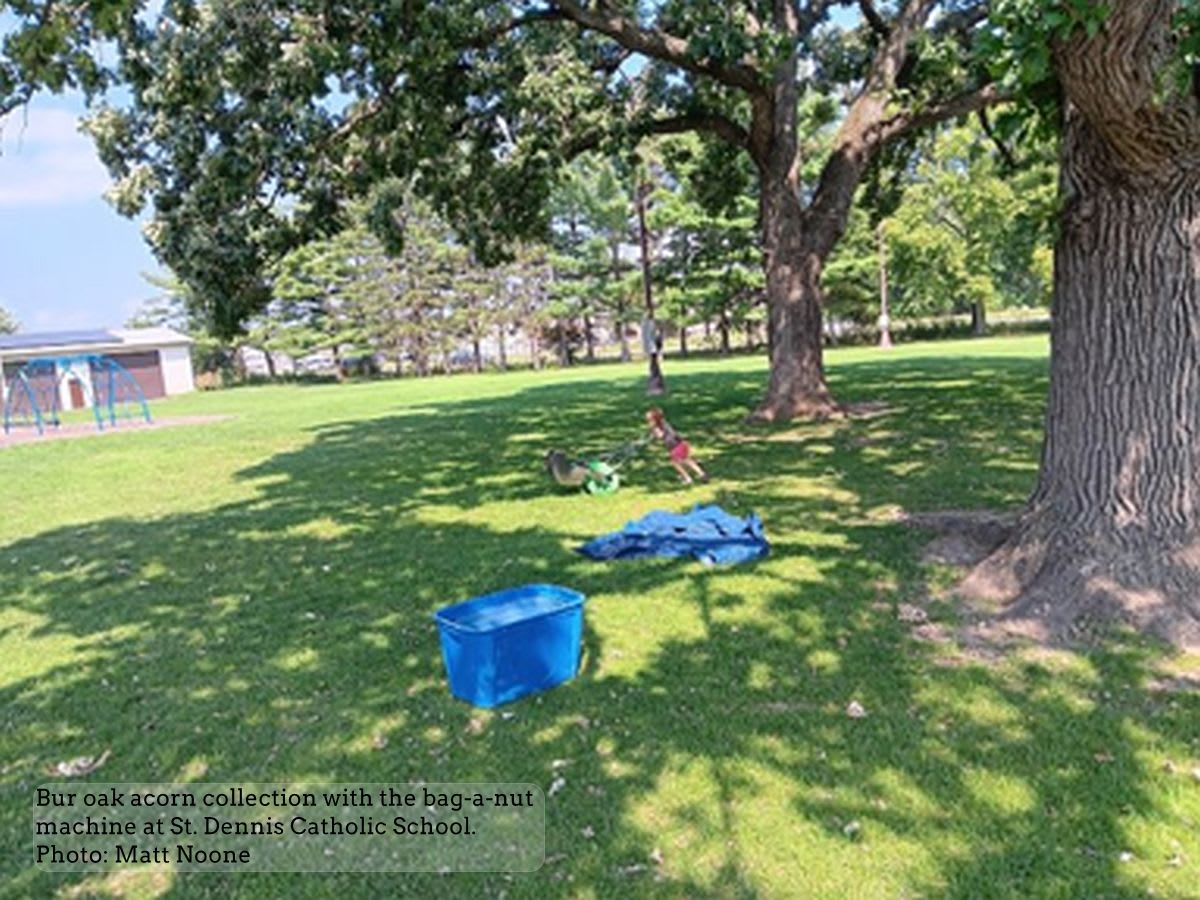
As he brought me to the acorn mast he found, I could see how proud of himself he was for being the one to locate the mast and for understanding its importance. Sure enough, this was the largest acorn crop I had ever seen from a single tree. There were so many acorns from this single two-hundred-year-old schoolground tree that you could hardly see the pavement. It was an incredible moment for two big tree hunters turned seed collectors. We biked back home to ready the car with our collection equipment, with the addition of a large broom and snow shovels. No seed collector was needed here: we swept up the acorns, shoveled them into garbage cans and reveled in our success. Winston’s discovery and effort would earn him a nice reward when we sold the acorns to the DNR.
For me, this was a validation as a father. Winston understood what we were doing, why we were doing it, and the purpose of trying to make a difference in this world. It was time to raise the stakes again to meet the occasion. I contacted Schenk Elementary’s principal and asked her if she was interested in growing heritage oak progeny at her school from acorns collected from the playground, involving as many kids as possible throughout the process. The idea was to modify the project into part of a school curriculum and create educational events for the kids. She thought it was a wonderful idea, the appropriate approvals were achieved, and our first tree nursery was established.
Now we just needed to learn how to grow trees – something I had been doing most of life, albeit with little success – and design a tree nursery. The tree nursery would provide necessary protection from the critters that want to stow away the acorns. The Dane County Tree Board provided the funds for the materials and construction of the tree nursery, and neighbors and Tree Board members assisted in its delivery to Schenck Elementary. Success was a must as my reputation at Winston’s school was now on the line. Nervousness about the acorn planting at Schenk was overwhelming: this was a new endeavor for me, and there were many unknowns.
When it comes to growing trees, many mistakes were made and many lessons were learned. Lessons are still being learned. By now I can say that we’ve established a successful model and team to implement tree growing educational curriculum in elementary, middle or high schools. We provide instructions for acorn collection, tree propagation, watering and maintenance. With funding assistance from the Tree Board or others, the school can successfully implement its own tree nursery. And even when setbacks occur, such as a failed crop, that too is a learning experience in plant biology and ecology.
The Tree Board has now established seven self-sufficient tree nurseries throughout Dane County: Schenk Elementary, Nuestro Mundo, Shabazz High School, Thoreau Elementary and Lafollette High School in Madison, Westside Elementary in Sun Prairie, and Severson Learning Center in the Village of Cambridge. Over four hundred kids have participated in this program, and currently over one thousand trees are growing in school nurseries in our region. Winston has been part of each new nursery establishment, empowering him to be the teacher rather than the student and encouraging me to keep moving forward with the project. His favorite job is to be in the tree nursery accepting the potted trees from students and strategically placing them inside. My hope is that some of the students who participate in the project are able to look at the landscape around them with a naturalist lens and see how the little acorn they planted may one day also become a living artifact.
Where this program goes from here is unknown, but that is part of the fun. As the partnerships involved in the project grow, so do the opportunities for Dane County’s tree canopy. How will schools distribute the trees? Will they be sold for fundraisers? Given to interested families? Planted on school grounds? Will the project inspire students to pursue environmental or forestry-related careers? Time will tell.
The takeaway here is to plant the acorn, expose our children to nature, nurture these little things and let them grow. It’s the little things in life that collectively make the greatest difference and impact in this world. A single teacher, a friend, a neighbor or maybe even a tree can change the trajectory of a child. Walter Scott planted the acorns for this project 50 years ago, Bruce Allison watered and cared for the trees, and countless others have since aided and influenced this effort. I’m grateful for all of these efforts. Our heritage oaks will only persist across our landscape through such efforts.
Acknowledgments: While it’s impossible to acknowledged all those involved with the project, I would like to thank all the students, teachers, principals, volunteers, DNR Urban Forestry staff, Tree Board Members, concerned citizens, Capital Area Regional Planning Commission staff, State Cartographer’s Office staff, David Mladenoff, the Big Tree Hunters around the world, and last but not least my son Winston.