“From the finest and best oaks wise persons will secure acorns for planting”
- Walter Scott
By Matt Noone
Though I’d been a Big Tree Hunter for many years, it was the enthusiasm of my then four-year-old son, Winston, that motivated me to pursue the Heritage Oak Project. The two of us spent the next few years measuring and mapping over two hundred of these trees. The opportunity to share my passion for forests and trees with my little boy was a highlight for me.
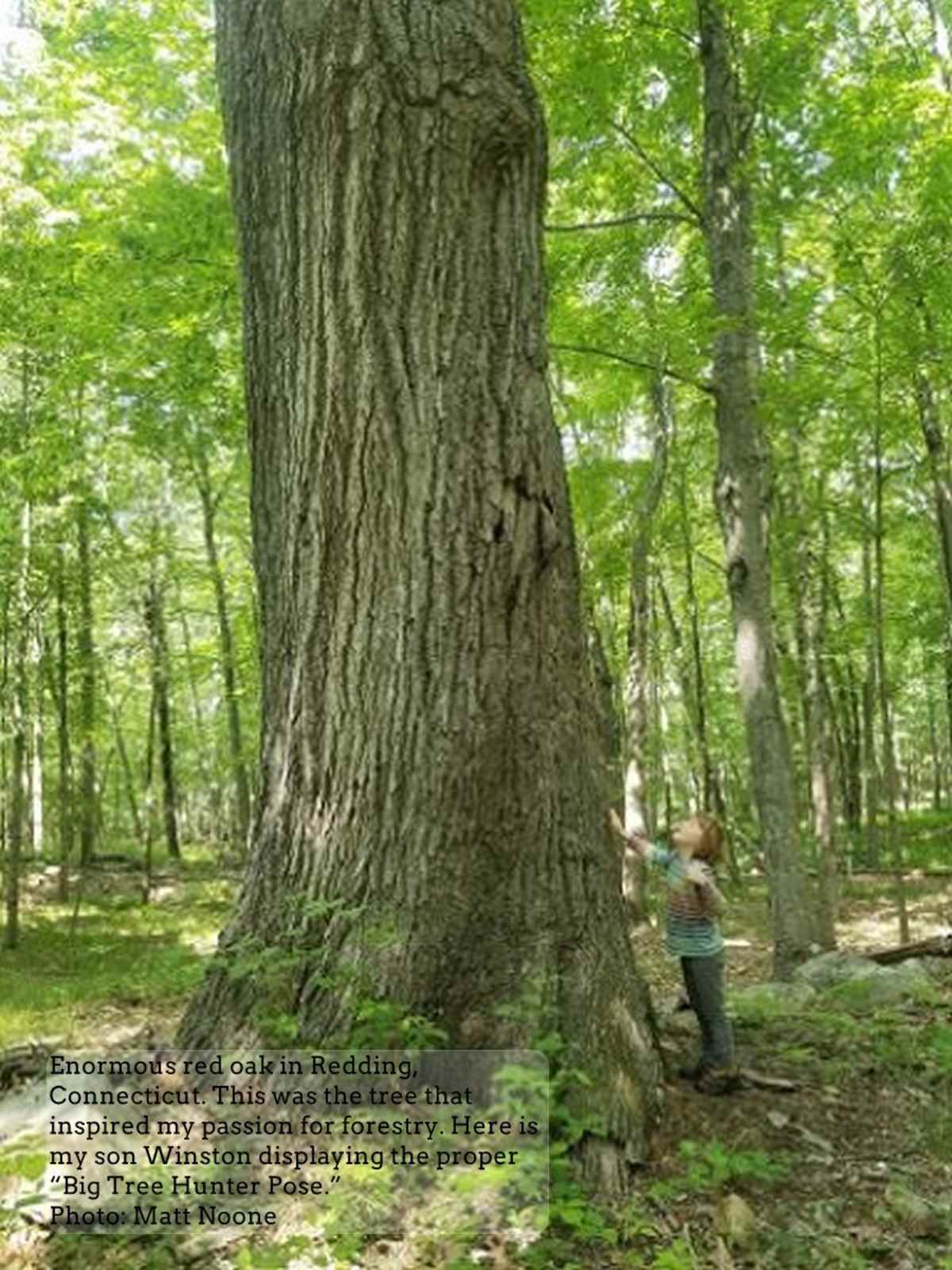
We discussed the different strategies that oaks have to persist in the landscape, and how all life forms develop niches to persist and replicate in this world. We visited many areas of Dane County we surely never would have otherwise. We learned how to measure trees properly, the difference between diameter and circumference, and how the magic number pi (π or 3.14), allows you to convert back or forth from either measurement. I taught him the proper “Big Tree Hunter Pose” I’d learned in Oregon. His delight in adding a new oak to the web map, verifying an existing oak in the inventory, or finding a new record diameter tree was a continual inspiration for me to see this project through.
There were times when I worried I was overdoing this big tree hunt with Winston, and his interest might fade. But his enthusiasm reinforced mine, and mine his. We both found ways to raise the stakes with the project, providing fuel to keep it going.
What began as an assessment of heritage oak trees around Madison that inspired countless people fifty years ago is now inspiring a new generation. The information compiled from these efforts has become a long-term study of observed growth rates of oak trees and quantification of their persistence in the landscape. A web of community involvement has been created to support the project and promote awareness of the benefits these trees provide us. Some measures are quantifiable while others are intangible. Through this project, countless collaborations have been established with researchers, K-12 schools, college students, nonprofits, arborists and tree enthusiasts resulting in a community involvement movement, all in an effort to protect and preserve the next generation’s legacy canopy.
By the end of 2024, the inventory of the oldest oaks in Dane County was completed and the weekly excursions and science lessons with my son Winston were also over. I hadn’t realized how monumental this experience would be for both of us as a learning and bonding experiment. I began wondering: What was next for us?
I learned from forestry friends that the Department of Natural Resources (DNR) has its own nurseries where they grow trees from seeds of “natural origin” for reforestation purposes. “Natural origin” means that the seeds come from trees that are too old to have been imported to the region by European American settlers, evidence that they are adapted to the local climatic and soil conditions. The DNR is dependent on local seed collectors for their nurseries. Once you gain a little experience in collecting you can make a little money and learn a lot more about growing oak trees from acorns. This was it, exactly what I was looking for - Winston and I would become seed collectors!
Oak trees have a significant mast (acorn crop) every 3-5 years. The trees can be synchronized across a region because they are all subject to the same predation and environmental changes. A widely accepted theory about this phenomenon is that an overabundant mast produced by all trees of one species at one time will overwhelm the predators that consume the seed, allowing more seeds to escape predation and become established grow trees. In the year following a large mast, few acorns will be produced, resulting in a predator population crash that further aids the trees.
We went all-in on this acorn collection endeavor. We kept a bag-a-nut (seed collector machine), binoculars (to spot potential significant acorn crops), tarps, garbage cans and a wagon in the car at all times. We were prepared to collect acorns from these heritage trees at any time.
It turns out collecting acorns, or seeds in general, takes more skill and patience than one might assume. Winston and I became expert acorn collectors. We learned which trees might have a decent mast worth collecting, and we knew there might only be one to two days to collect those acorns before they were eaten or stored away by the birds, chipmunks and squirrels. We knew how to clean the acorns and check them for viability, and how to protect them in our garage before they were transferred to the DNR nursery.
Through our preparation and persistence, Winston and I collected over 50,000 acorns from heritage oak trees, most of them from just five or six trees. These acorns were shipped off to be planted at the Wilson Nursery in Boscobel, Wisconsin, and then returned as young saplings to support reforestation throughout our region.
Over 2024 and 2025, the Capital Area Regional Planning Commission and the Dane County Tree Board have been distributing heritage oak saplings to non-profits, municipalities, schools, home ownership associations, parks and the public. The Tree Board’s mission is to provide leadership and guidance on county tree policy while promoting equitable and healthy tree canopy cover.
With help from Winston and the Tree Board I distributed trees and told our stories at various Earth Day and Arbor Day events. We have now given away over a thousand heritage oak saplings. Most have been planted in our region, though some have been planted in faraway places – our trees have ended up in twenty-three Wisconsin counties and at least twelve states. As much as I would consider this our success story, what happened next was what I consider my greatest achievement with this project and one of my proudest moments as a father.