For the next four weeks, Oddsconsin welcomes guest blogger Matt Noone, Senior Environmental Planner at the Capital Area Regional Planning Commission in Madison. In a four-part series, Matt will discuss how hunting for big trees with his son Winston led to four hundred kids growing one thousand heritage oak trees at schools across Dane County, Wisconsin.
As Matt says, "This is a story about connecting people to their natural world and historical context, and fostering care for remarkable places and living things."
By Matt Noone
When I was eleven years old, my family moved to Redding, Connecticut, a rural, wooded town crisscrossed with stone walls. The walls date to New England's colonial days when the forests were cleared to graze sheep. As farming faded, the forests returned.
I routinely roamed these forests with a dog, on a bike or on foot, exploring vernal pools (seasonal ponds), glacial erratics (boulders deposited by glaciers) and historic farm foundations. On one such excursion, I came across a single tree so enormous I couldn’t believe my eyes. I didn’t know the species – or the significance – but I knew it was an exceptional tree with a story to tell. Over the years, I venerated this tree and brought countless friends and family members to share its glory. The tree turned out to be one of the largest red oaks (Quercus rubra) in Connecticut. Only recently did I realize that finding that tree was the moment I became a big tree hunter.
My big-tree fixation continued at the University of Maine, where I began searching for the few remaining white pines demarcated with “The King's Broad Arrow” – an axe mark designating them as Royal British property for ship masts in the late 1600s. From there I migrated to the Pacific Northwest, where Wendel Wood’s “A Walking Guide to Oregon's Ancient Forest” became my bible and compass in life. I explored unique forests, finding the largest, oldest and tallest trees – oaks, maples, junipers, Douglas firs, Sitka spruce, laurels and more – across Oregon and Washington.
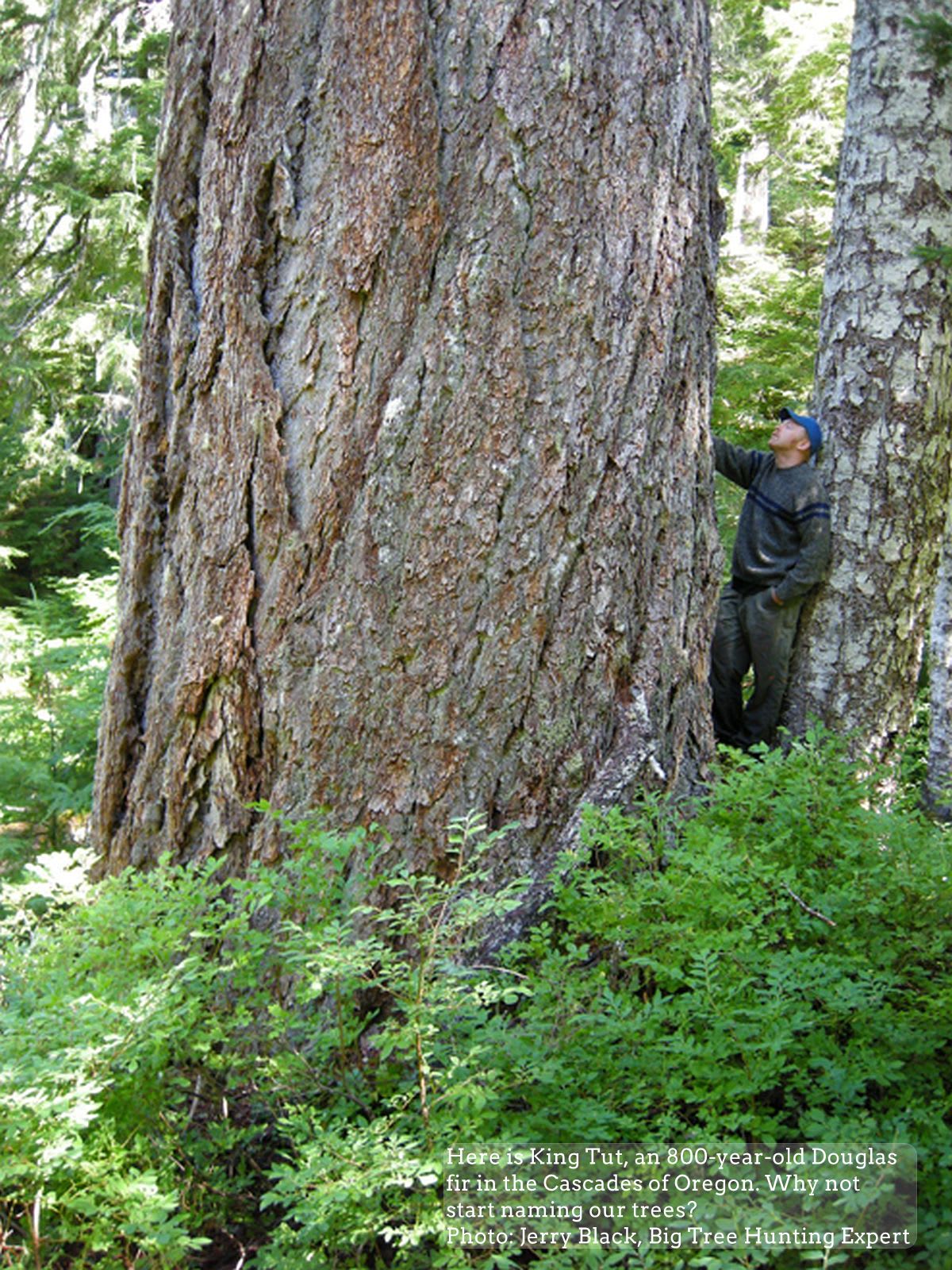
The search for King Tut was one of my most memorable big tree adventures in the Cascades of Oregon. King Tut was one of the largest Doug firs in the state, estimated to be eight hundred years old. The trail route is described as “rugged” and “not recommended,” but a tree with a name adds to the allure for us big tree hunters. The tree was named to bring awareness and respect for a unique old-growth forest area slated for logging.
Even with detailed background research, success in finding these giants in the wilderness of Oregon was always questionable. The path followed remote logging roads with washed-out bridges, no signage and no other people around to point the way. The notes I had to relocate King Tut – twenty years since the tree was first documented – were scarce. It was only after I found a decaying pencil by the trunk of the giant that I was sure this was the tree I had been searching for.
Fast forward to 2022. My big tree hunter persona was rejuvenated, this time in Dane County, Wisconsin. I was working for the Capital Area Regional Planning Commission and had a new partner in my adventures – my son Winston. Winston became an integral part of this story and provided the incentive to inspire the next generation in appreciating, respecting and understanding our landscape and place in this world.
This is a story about connecting people to their natural world and historical context, fostering care for remarkable places and living things and teaching the next generation to do the same. It is a type of story I believe is not shared or told enough, and it has come together with support from friends, fellow tree growers and big tree hunters, and my colleagues.