Many roadside attractions make exceptional claims – the biggest ball of twine in Minnesota, the oldest church in the US, the world’s largest muskie statue. Do you ever wonder if these claims are accurate? Karl Popper, the twentieth-century philosopher of science, wrestled with this type of question. For Popper, such claims would not have been assertions of fact, but propositions waiting to be falsified by counterexamples. Confirmation was impossible, since unknown counterexamples might exist.
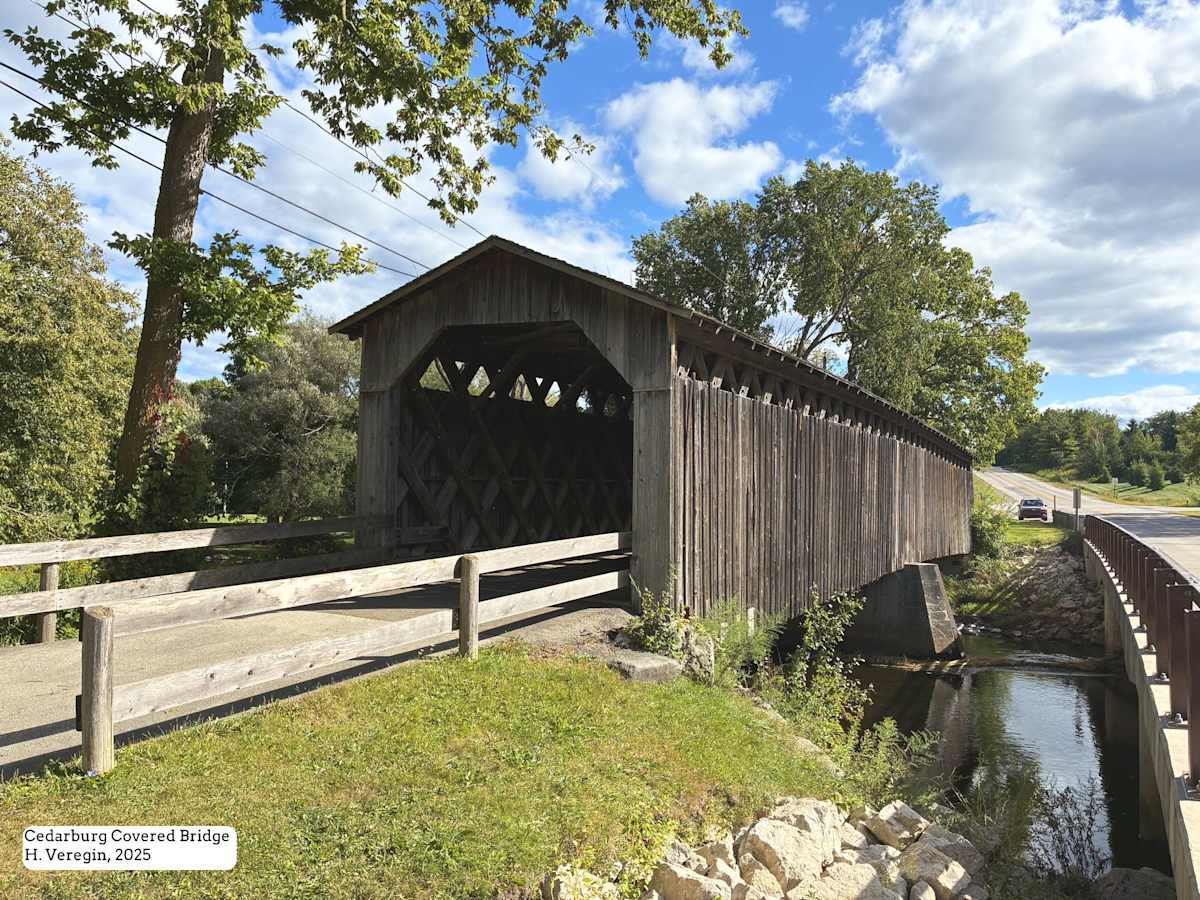
The Cedarburg Covered Bridge in rural Ozaukee County claims to be the last covered bridge in Wisconsin. The bridge crosses Cedar Creek a few miles north of Cedarburg. A plaque next to the bridge, erected in 1965 by the Ozaukee County Historical Society, is titled “Last Covered Bridge.” A plaque attached to the bridge in 1955 by the Port Washington Chapter of the Daughters of the American Revolution states that it is the “Last Covered Bridge in Wisconsin.”
Following Popper’s falsifiability principle, we must rate this claim as FALSE. There are plenty of other covered bridges in the state. There’s the Horton Covered Bridge in Amnicon Falls State Park (Douglas County), Stonefield Village Covered Bridge over Dewey Creek in Grant County, the Omaha Trail Covered Bridge near Elroy (Juneau County), Red Mill Covered Bridge in Waupaca County, Twin Park Covered Bridge over the East Twin River in Mishicot (Manitowoc County), Smith Rapids Covered Bridge (aka Chequamegon Covered Bridge) over the Flambeau River in Price County, Clarence Covered Bridge over Norwegian Creek in Brodhead (Green County), Springwater Volunteer Covered Bridge over the Pine River in Waushara County, and others! Dale J. Travis’s “Round Barns and Covered Bridges” website lists dozens of covered bridges in Wisconsin. [1]
Cedarburg Covered Bridge is not the last covered bridge in Wisconsin, but it’s probably the last traditional covered bridge. In other words, it appears to be the only covered bridge still in existence in Wisconsin that was built in the nineteenth century using nineteenth-century methods and materials. The word traditional is chosen here intentionally. As noted in An Introductory Guide to Covered Bridges, published by the National Society for the Preservation of Covered Bridges, the term historic should be avoided, since from a preservation standpoint, any structure over fifty years of age can be considered historic. [2] Some of the non-traditional covered bridges in the state have already passed this age.
Maybe this seems like an argument over semantics, but the distinction is important if we want to speak with accuracy about historic artifacts. Covered bridges were once quite common, but by the end of the nineteenth century, most had been replaced by steel truss bridges capable of handling heavier loads. Cedarburg Covered Bridge escaped the fate of its peers. Built in 1876, it was retired in 1962 when a modern bridge was built to replace it. Ozaukee County decided it was important to preserve the covered bridge and it now sits adjacent to its modern replacement, where it is used for pedestrian traffic and as a photo backdrop for weddings that take place in the nearby county park.
Cedarburg Covered Bridge has been listed in the National Register of Historic Places since 1973. [3] The Library of Congress has HABS (Historic American Buildings Survey) photographs of the bridge from the 1930s, when it was still in use, and more recent HAER (Historic American Engineering Record) documents, including line-drawings derived from laser-scanning technology. [4][5] The bridge is 120 feet long and supported on stone abutments on each side of the creek. A concrete center abutment was added in 1927 to handle heavier traffic.
The National Society for the Preservation of Covered Bridges categorizes bridges by the type of truss supporting them. In this context, a truss is a configuration of wooden components designed to support loads over long spans. The type of truss is essential to the design of the bridge. There are many types, each with its own arrangement of wooden braces, counter-braces, chords, tie-rods, stringers, posts and timbers.
Cedarburg Covered Bridge’s truss type is known as “Town” after architect Ithiel Town, who patented the design in 1820. The truss consists of layers of diagonal planks forming a tight lattice. The planks are held together with two-inch hardwood pegs called treenails, which are visible on the inside of the bridge. Town’s design was popular and used widely. He designed it to be “simple, permanent, and economical.” [2]
As to why covered bridges were covered in the first place … the internet has many theories. These include protecting travelers caught in the rain, calming animals who were frightened by rushing water, keeping snow off the bridge, providing extra support for heavy loads, improving the bridge’s appearance, and providing a place for sleeping tramps, dances, parties, town meetings, secret rendezvous, card games and rainy-day luncheons.
The real reason, according to the National Society for the Preservation of Covered Bridges, is to protect the bridge’s wooden structure. “Without protection from the weather, the wooden timbers supporting the bridge would decay more rapidly and eventually collapse.” [2]
For poor Karl Popper, there were no certain facts, only contingent propositions waiting to be disproven. He would probably have been skeptical about the uniqueness of Cedarburg Covered Bridge as the last traditional covered bridge in Wisconsin. After all, there might be another nineteenth-century example in some forgotten corner of the state, just waiting to be rediscovered. For the rest of us, it’s probably safe to assume that the bridge is indeed the last of its kind, offering us a unique glimpse of nineteenth century life in rural Wisconsin, before the automobile arrived to break its bucolic spell.
Sources
[1] Dale J. Travis, Round Barns and Covered Bridges. https://dalejtravis.com/
[2] National Society for the Preservation of Covered Bridges, An Introductory Guide to Covered Bridges. https://www.coveredbridgesociety.org/
[3] National Register of Historic Places, Covered Bridge. https://npgallery.nps.gov/AssetDetail/NRIS/73000092
[4] Library of Congress, Covered Bridge, Spanning Cedar Creek Vicinity, Cedarburg, Ozaukee County, WI. Historic American Buildings Survey (HABS) Documentation. https://www.loc.gov/item/wi0094/
[5] Library of Congress, Cedarburg Covered Bridge, Spanning Cedar Creek on a bypassed section of Covered Bridge Road, Cedarburg, Ozaukee County, WI. Historic American Engineering Record (HAER) Documentation. https://www.loc.gov/item/wi0814/