Looks like this town is finally going to die away
Leaving nothing but broken promises
Where there once were small town dreams
- The Cowboy Junkies, The Last Spike (1992)
It’s the mid-1800s. A small settlement emerges in rural Wisconsin. New residents build homes. Businesses – a blacksmith shop, a grocery store, a hotel – are established to serve the needs of travelers and local farm families. A post office begins operations in the general store. The population reaches a few hundred. Then, the railroad comes. But the route bypasses the settlement, and the railroad depot is built ten or fifteen miles away. Within a few decades, the settlement has disappeared. The buildings have collapsed. The residents have moved away. The businesses have reestablished themselves close to the railroad depot, where there are more customers.
It’s hard to say how many times this scenario played out in Wisconsin. Probably hundreds. When you consider the entire country, the number must be in the tens of thousands. The story might seem like a worn-out cliché, but it’s hard to overemphasize the importance of the railroad in the life and death of small-town America in the nineteenth century. Before trains, goods and people moved by coach or wagon along dirt or plank roads, or perhaps on a canal. The railroad changed all that by vastly increasing transportation efficiency. If you were not close to a railroad line, it was hard to compete with those who were.
The village of Dover, in Iowa County, is in many ways a typical example of a settlement left behind by the railroad. Established in the late 1840s, Dover seemed poised for prominence as the largest settlement in the Town of Arena. But when the railroad bypassed the community in 1856 – running its tracks through nearby Mazomanie instead – Dover was doomed.
Dover was established as the main settlement of the British Temperance Emigration Society, founded in Liverpool, England, in 1842. The goal of the society was to facilitate migration from England to Wisconsin, where immigrants would become land-owning farmers. The society was a joint stock company. Prospective immigrants paid a shilling each week to purchase a share. The funds thus collected were used by agents of the society to purchase land in Wisconsin. Each year, a lottery was held to choose which shareholders would migrate. Those who made the journey received an eighty-acre farm, with five acres already in production, and a log home. Settlers paid an annual rent to the society, the ultimate goal being that the settlers would become sole owners of their eighty acres.
The British Temperance Emigration Society was a “friendly society” whose mission was to assist those who wished to move to Wisconsin but did not have the resources to do so. Historians agree that the word “temperance” was used in the name because of the importance of that virtue in English Victorian society, and to demonstrate the good character of the society’s members.
Some search-engine AI summaries claim that the society aimed to create an alcohol-free community in America, reflecting their temperance ideology. This is AI rubbish. The word temperance at the time had a much broader meaning than simply avoidance of alcohol. The constitution of the society – twenty-eight articles in total – does not ban the use of alcohol by society members. It does stipulate that if a member – while doing business with society agents – is intoxicated, disorderly or abusive, swears or offers to fight the agent, he or she will be fined five shillings. (Article 21) Members could also be expelled for felony, blasphemy or promulgating “infidel principles.” (Article 13) However, nowhere in the constitution is the idea of an “alcohol-free community in America” mentioned.
Agents of the society first arrived in the Town of Arena in 1843 and began to purchase land at the Government Land Office in Mineral Point. The first English settlers arrived in 1844 – almost 150 people in total. Most traveled from Liverpool to Boston, Massachusetts, then through Buffalo, New York, and the Great Lakes to Milwaukee. The last part of the trip was overland. More settlers arrived in the following years – a total of almost seven hundred. By 1850, emigration from England had essentially ceased, due to financial and legal troubles with the society.
Dover was the main settlement in the area in the early 1850s. It was only six blocks in size, but was a center for commerce, religious activities and social events like dances. The population of Dover rose from 91 people in 1847, to 119 in 1850, to 215 in 1855. Local businesses included taverns, hotels, general stores, wagon shops, blacksmith shops and a shoemaker.
The population of Dover never grew above 215. In 1856, the Chicago, Milwaukee and St. Paul Railroad came through this part of the state, but it bypassed Dover and instead established a depot in Mazomanie, only a few miles away. By 1860, the population of Dover had dropped to 75. Most businesses had closed, a few of them moving to Mazomanie. By 1875, the settlement was essentially a ghost town.
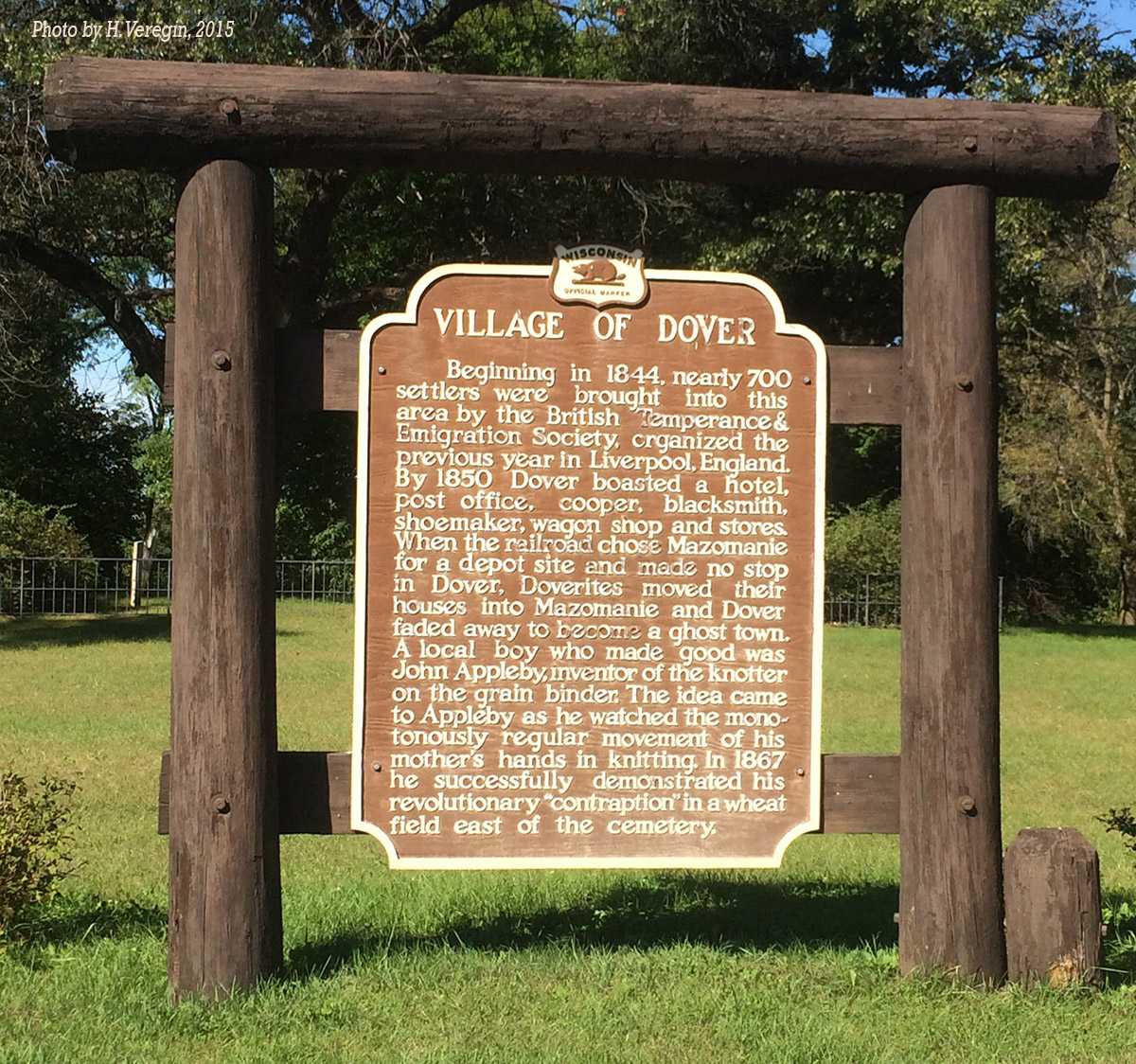
There’s nothing left of Dover today. A plaque, erected in 1953 by the Wisconsin Historical Society, sits just west of the Dane-Iowa county boundary on Highway 14, near the original site of Dover. The three-acre plot where the plaque sits also contains a small cemetery. The plot is owned by the Wisconsin Department of Natural Resources, but the surrounding parcels are private. There’s not much to see and it’s difficult to imagine Dover ever existing here.
Sources
William Kittle. (1900). History of the township and village of Mazomanie. Madison, WI: State Journal Print. Co.
Frank Wolf. (2010). Ghost Town Dover and the British Temperance Emigration Society. Mazomanie, WI: Frank Wolf.