And ain't it just like you and me
To be down here on the ground
Going down an old plank road
To the bar in a one-horse town
- The Deslondes, Old Plank Road (2024)
Before asphalt and concrete, roads were made of wood planks. Or, at least, some of them were.
In Wisconsin, plank roads flourished in the mid-1800s. They were an alternative to dirt roads, which were slow and hazardous. A particular problem with dirt roads was mud, which bogged down wagons and sometimes made roads unusable. Plank roads allowed people and goods to get to their destinations more quickly and with less effort.
The development of plank roads was primarily motivated by commercial interests. The roads were financed by private companies. Shares were sold to investors – including local residents – to raise funds for construction. Some communities issued bonds to finance plank roads. The legislature, which authorized charters for plank roads, provided no funding.
Initially, plank roads were profitable. Toll booths collected tariffs from travelers based on trip length and the number of horses (or other animals) pulling the load. Tolls generated substantial dividends for investors, some of whom also speculated on land along the routes. Taverns and inns in one-horse towns sprung up to capitalize on road traffic.
Commercial traffic on plank roads included wagons carrying loads of wheat, barley, fur, lime, lead and other products. Moving along at five miles per hour, they were the direct ancestors of today’s semitrailers flying down I-90. Like modern trucks, the wagons of old caused wear and tear on the roads, especially when carrying heavy loads. Plank roads were costly to maintain. Planks cracked or floated away in spring floods. Trees and brush had to be regularly cleared. And the planks only lasted a few years before they started to rot.
Plank roads were complex engineering projects, not just rows of wooden planks laid on the bare ground. The road’s path was first “grubbed” (cleared of trees, stumps and brush), then graded to a width of twenty feet or more. Stringers – long thick wooden beams – were laid out parallel to the roadbed to serve as the foundation for the planks forming the road surface.
Plank roads required a staggering volume of wood. Assuming planks were one foot wide, over five thousand would have been required for every mile of road. For a fifty-mile stretch, that works out to a quarter of a million planks. And that doesn’t include wood for the stringers and other wooden components.
In the 1850s, plank roads began popping up in Wisconsin’s eastern counties. Over a hundred charters were issued by the legislature, but not all roads were finished. An 1854 Wisconsin map by Increase Lapham shows plank roads running from Green Bay southwest to the boundary of Outagamie County; from Howard along the west bank of the Fox River almost to Appleton; from Manitowoc west to the boundary of Calumet County; from Sheboygan all the way to Fond du Lac; from Milwaukee to Watertown; from Milwaukee to Mukwonago; from Milwaukee to Cedarburg; from Muskego to Waterford; from Rochester to Delavan; from Racine to Rochester and Burlington; from Kenosha to points east; and from Racine to points north.
The Milwaukee-Watertown Road, built between 1848 and 1853, was one of the most heavily used plank roads in the state. And at almost sixty miles in length, it was perhaps the longest. It followed the old Territorial Road from Milwaukee to Wauwatosa, Brookfield (near Goerke’s Corners), Pewaukee, Ixonia and Watertown.
The road purportedly cost over $100,000 to construct, or almost $2,000 per mile. This is equivalent to about $4.5 million today. Actually, that doesn’t sound too bad. The estimated cost of the Wisconsin Department of Transportation’s 67-mile I-39/90/94 expansion between Madison and the Dells? About $3.8 billion. But that’s probably not a fair comparison.
Wisconsin’s transportation network is a palimpsest inscribed with ancient Native American trails, the wagon roads built on top of them, the plank roads that replaced the wagon roads, and the highways and freeways that followed the routes of the old plank roads. The Milwaukee-Watertown Plank Road became State Highway 16. The plank road from Manitowoc to Green Bay became US Highway 10. Part of State Highway 57 follows the old plank road from Milwaukee to Cedarburg.
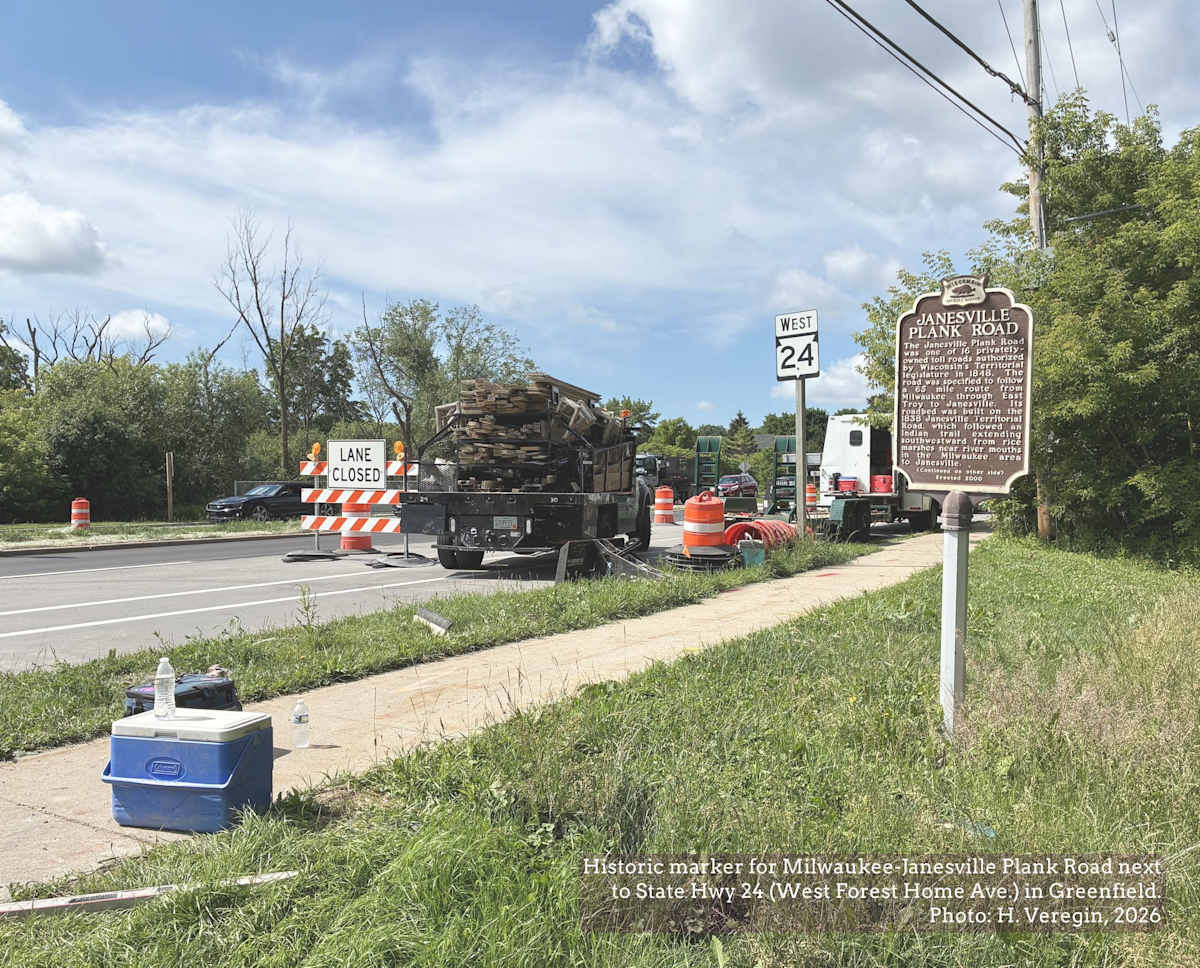
Not all plank roads were successful. The Janesville Plank Road from Milwaukee to Janesville, authorized in 1848, was to follow the Janesville Territorial Road, which itself followed an earlier Native American trail. Only twenty-four miles of the plank road were ever completed. What killed it is what killed the state’s other plank roads – the arrival of the railroad.
Railroad tracks quickly replaced planks as the most efficient way to transport people and goods. Trains demanded even more resources than plank roads – timber for railroad ties, iron for rails and locomotives, coal or wood for the boiler – but the economies of scale were undeniable. A team of horses could pull a wagon, but a locomotive could pull dozens of cars. By the 1860s, the state’s plank road system was in disrepair. Abandoned and decaying, roads were taken over by the state and turned into public highways. They would rise again in importance in another half-century, when the automobile arrived and the State Trunk Highway system was created.
Sources
Adam Azzalino, The Milwaukee Cedarburg Plank Road, Ozaukee County Historical Society, May 2016. https://ochs.co.ozaukee.wi.us/copy-of-a-bridge-to-history
Beth Dippel, History Uncovered: From Indian Trail through Plank Road - Hwy 23, Sheboygan Sun, Jan. 4, 2023. https://www.sheboygansun.com/history/history-uncovered-from-indian-trail-through-plank-road---hwy-23/article_dc21f35e-8c4d-11ed-8124-471d85af145e.html
Lane Kimble, WisDOT to Seek Federal Approval for Expanding 67 Miles of I-39/90/94, Wisconsin Transportation Builders Association, Aug 1, 2024. https://wtba.org/wisdot-to-seek-federal-approval-for-expanding-67-miles-of-i-39-90-94/
Manitowoc County Historical Society, Travel on the old Plank Road.https://www.manitowoccountyhistory.org/stories/plank-road
Dave McCormick, Early Toll Roads of Wisconsin, Northwest Quarterly, March 20, 2023. https://northwestchicagoland.northwestquarterly.com/2023/03/20/early-toll-roads-of-wisconsin/
Watertown Historical Society, Milwaukee-Watertown Plank Road. https://www.watertownhistory.org/articles/watertownplankroad.html