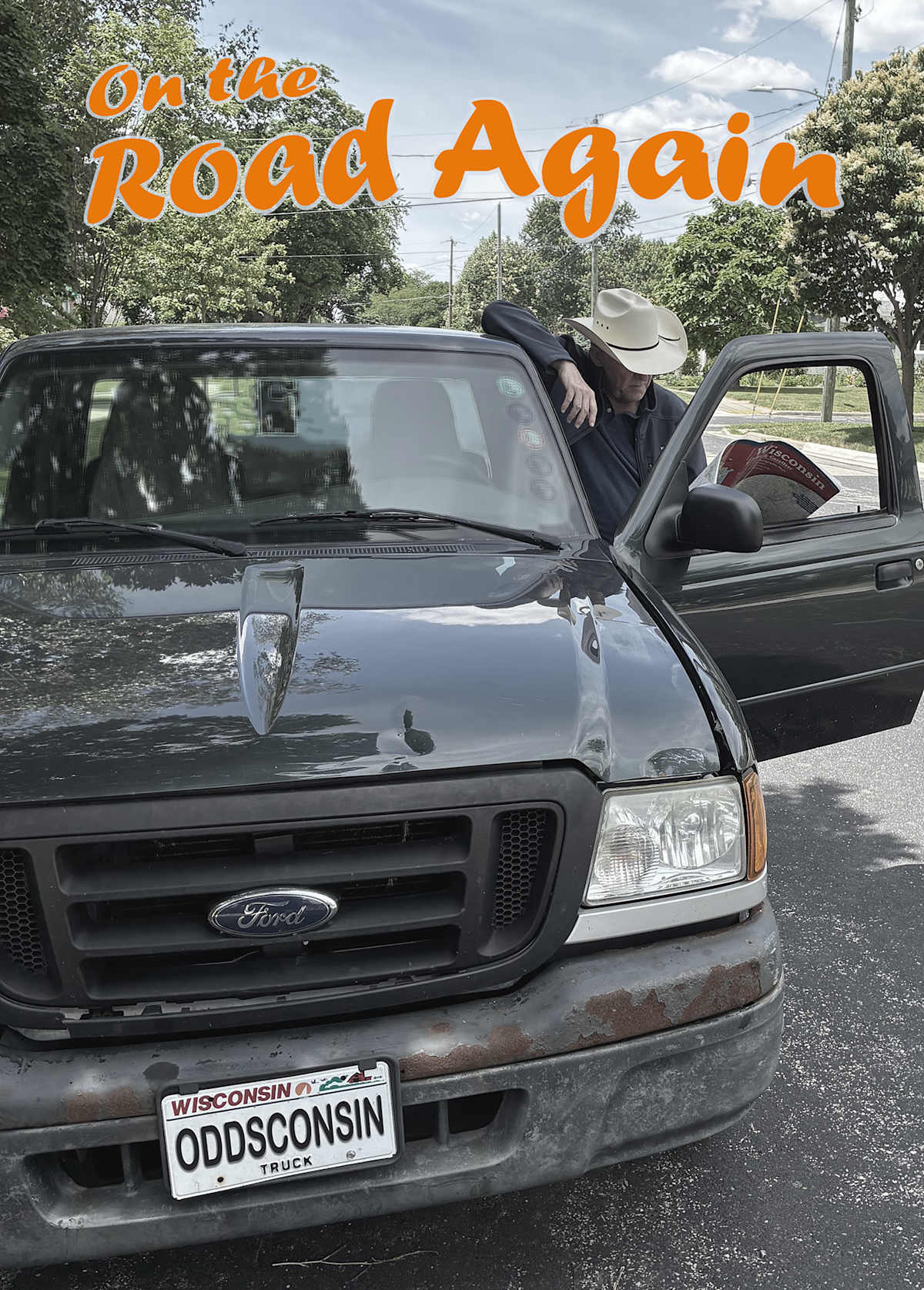
On the road again
Just can’t wait to get on the road again
- Willie Nelson
After spending the last six weeks in Science Hall at UW-Madison, it’s time for Oddsconsin to get back on the road. Since this blog started in January 2025, we’ve visited over fifty unique sites in about twenty-five counties. If you started at Oddsconsin 1 (Wisconsin Memorial Hospital) and drove to every other site in a continuous loop, you would have travelled about 8,360 miles. That’s equivalent to one-third of the way around the Equator. And we’re just getting started!
Those of you who drive long distances may have noticed how your mind can sometimes start to wander. You may find yourself pondering important questions: How long until the next Kwik Trip? How many revolutions are my tires making on this trip? How much time will I save if I speed up by ten miles per hour?
That last question has perplexed me for some time. Obviously, if you speed up ten miles per hour (10 mph) over your current speed, you will travel ten more miles for every hour of travel. But this isn’t really telling you how much time you’ll save, because a) miles per hour is a rate of travel not a measure of time and b) speeding up means that the travel time to your destination will be reduced, so while you may travel ten more miles in an hour, you will not be travelling for as many hours.
Let’s imagine you’re driving a leisurely 50 mph in the slow lane in your mom’s Subaru. How much time will you save if you increase your speed to 60 mph? What about 70 or 80?
It turns out there some basic mathematical rules at work here.
(a) Obviously, the faster you drive, the more time you’ll save (assuming you don’t have an accident or get pulled over for speeding).
(b) Equally obvious is that the longer your trip, the more time you will save if you drive at a higher speed.
(c) But surprisingly (perhaps) the time savings you realize for each increment in driving speed is greater at low speeds than at high speeds. To put it differently, increasing your speed from 50 to 60 mph has a bigger payoff than increasing your speed from 60 to 70 mph. This might sound like it contradicts point (a) above, but it doesn’t. Driving 70 mph will get you to your destination more quickly than 60 or 50, it’s just that the advantage of adding another 10 mph to your speed diminishes the faster you drive. Why? Because the faster you go, the less time you spend getting to your destination, so adding to your speed has less of an impact.
There’s a fairly easy calculation you can do to determine how much time you will save:
minutes saved = (60/mphl – 60/mphh) x miles
where mphl = your initial “low” speed in miles per hour, mphh is your planned “high” speed in miles per hour, and miles is the number of miles to your destination. The values 60/mphl and 60/mphh are measuring the number of minutes it takes to travel a mile (i.e., minutes per mile).
For example, on a 30-mile trip, driving 60 mph rather than 50 mph will save you 6.0 minutes. But adding another 10 mph to get to 70 mph will only save you an additional 4.29 minutes. Cranking it up to 80 mph will only net you an additional 3.21 minutes. The incremental time savings continue to taper off the faster you go.
The table below shows the time savings for speeds between 20 and 120 mph. Results are tabulated for a standard 100-mile trip. The Savings (minutes) column can be scaled by the actual length of your trip to get the actual savings in time. For example, for a 200-mile trip, double the values in the Savings (minutes) column.
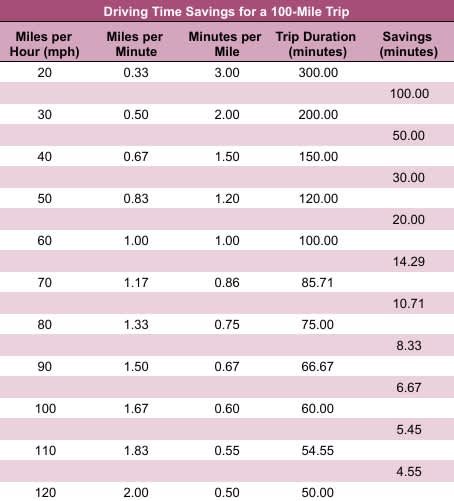
The table is based on speed increments of 10 mph. If you increase your speed from, say, 50 mph to 70 mph, be sure to add the time savings for 50-60 mph and for 60-70 mph.
I’m actually trying (perhaps unsuccessfully!) to advocate for slower driving speeds. Obviously, driving time is a factor if you are making the 400-mile trip between Racine and Superior, when even a modest increase from 60 mph to 65 mph will save you over 30 minutes. But what about short trips? My commute to work is about 13 miles. Driving 70 mph rather than 60 mph would save me less than 2 minutes.
Our culture’s obsession with driving time is evident in everything from Google Maps (which defaults to the fastest route) to the behavior of the many drivers who fly past those of us in the slow lane, regardless of weather conditions, traffic levels or posted speed limits. Slowing down occasionally wouldn’t hurt, especially if you’re only going to gain a minute or two on your trip.
I’m not just a slow driver, but also a backroads driver. I enjoy driving the most when there are no other vehicles in sight. I find the untraveled backroads the most interesting. That's where the really unique sites hide out. I don’t think anyone is going to find the soul of Wisconsin – assuming it exists – on the Interstate…