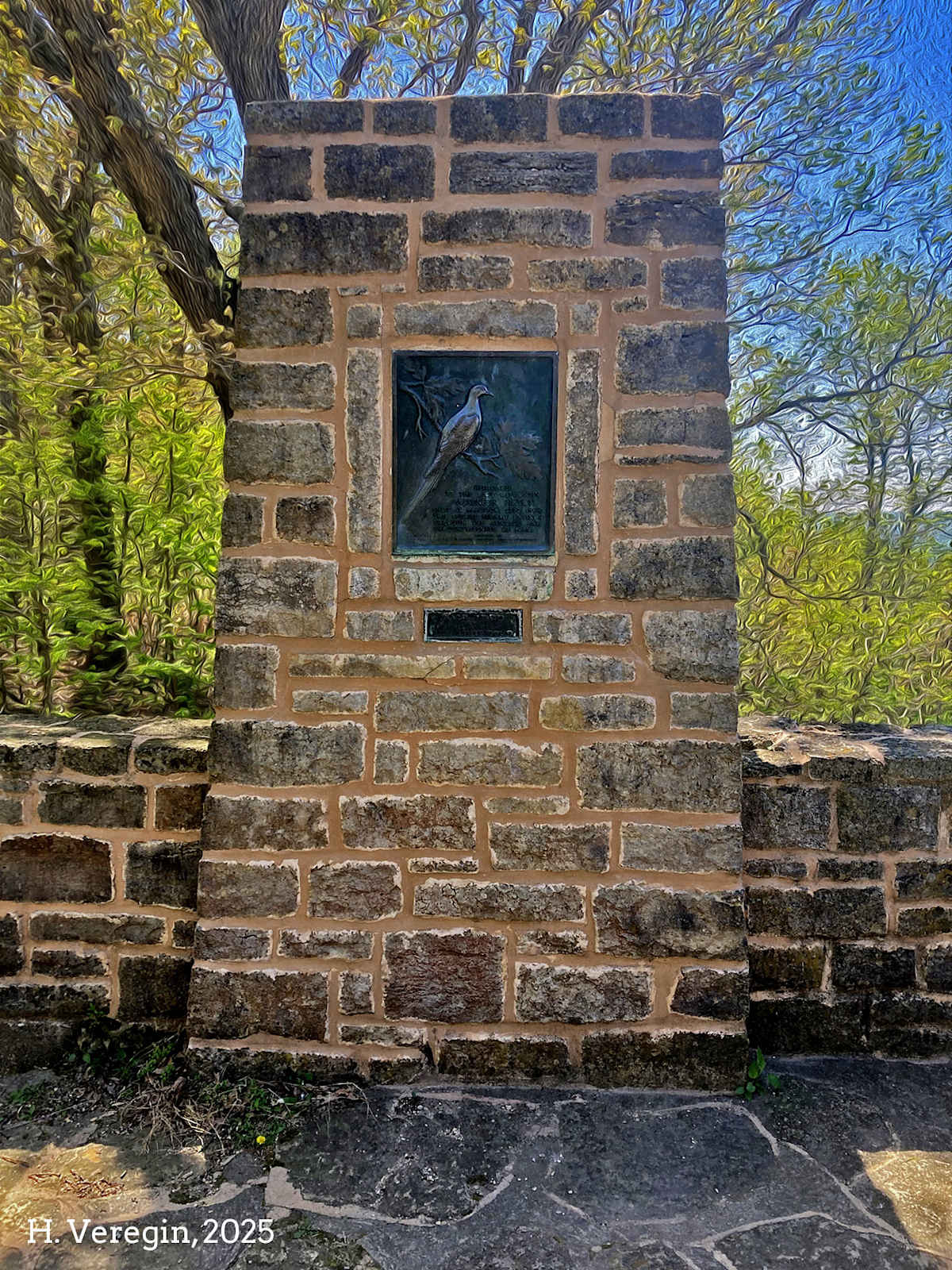
A stone monument stands in Wyalusing State Park (Grant County) overlooking the bluffs of the Mississippi River. It’s a memorial to the passenger pigeon, once abundant throughout the continent, but now extinct.
The monument was erected in 1947 by the Wisconsin Society for Ornithology, which first conceived of the idea in 1941. A brass plaque depicts a passenger pigeon based on a sketch by Owen Gromme, then Curator of Birds at the Milwaukee Public Museum. The bird is perched on the limb of an oak tree. The oak barrens of central, west-central and southwest Wisconsin once supported a communal passenger pigeon nesting area encompassing 850 square miles. [1][2][3]
The inscription on the monument reads,
Dedicated to the last Wisconsin passenger pigeon shot at Babcock, Sept. 1899. This species became extinct through the avarice and thoughtlessness of man.
The inscription was written by A. W. Schorger, an authority on the passenger pigeon, whose research showed that the shooting at Babcock occurred sometime between September 9 and 15, 1899. [4] Babcock is an unincorporated community in Wood County, about fifteen miles southwest of Wisconsin Rapids. A historic marker in Babcock admits to the crime:
Babcock is noted for being the site of the last known, natural sighting of a passenger pigeon… The last passenger pigeon was killed here in 1899. [5]
The statement needs some clarification. The Babcock pigeon was the last wild passenger pigeon killed in Wisconsin, but a few other birds lingered on elsewhere into the early twentieth century.
The scale of the destruction is astounding. The passenger pigeon, Ectopistes migratorius, was once the most abundant bird in North America. It is estimated that in the late nineteenth century there were as many as five billion passenger pigeons, primarily in the eastern and midwestern US. Flocks of the birds were so large and dense they darkened the sky as they passed. Witnesses described the sound of the massive flocks as like the thunder of an army of galloping horses laden with sleigh bells. [1]
In a talk he delivered at the annual meeting of the Wisconsin Society for Ornithology in Appleton in 1946, renowned naturalist Aldo Leopold put it in these terms:
The pigeon was no mere bird, he was a biological storm... Yearly the feathered tempest roared up, down, and across the continent, sucking up the laden fruits of forest and prairie, burning them in a travelling blast of life. [6]
The passenger pigeon looked more like a dove than the plump, waddling rock pigeons we see in cities today. They were also beautiful, the more-colorful males being slate blue with copper undersides and hints of purple. [1]
Their demise was mainly due to unregulated hunting. The expanding railroad network brought professional and amateur hunters to the nesting areas of the passenger pigeon, where they were killed en masse by every conceivable strategy. [1] The birds were simply killed more quickly than they could reproduce. Coupled with habitat destruction, the demise of the species was certain.
This pattern is reminiscent in some ways of the near-extinction of wading birds in the Florida Everglades in the same time period. In Florida, the mass killing was fueled by fashion: demand for feathers for ladies’ hats. Nicholas Ray’s odd 1958 film, Wind Across the Everglades, tells the story. [7]
The destruction of the passenger pigeon was not mourned by Wisconsin’s farmers. The birds devoured their crops. Aldo Leopold suggested that farmers viewed the killing as self-defense and would have considered it their duty to do away with the birds if the hunters had not already done so. [6]
What accounts for the rapaciousness of nineteenth century European Americans? Did the sight of endless flocks of pigeons suggest that the population of birds would never be depleted? But did they ever, as Leopold asked, confess a doubt about their actions? Did they ever wonder if the material comfort (or sheer enjoyment) they obtained through the slaughter outweighed what had been lost? And, do some of these old habits and attitudes still persist?
The passenger pigeon officially became extinct in 1914, when the last known member of the species, Martha, died in the Cincinnati Zoo. Her two male companions had died four years earlier. When she was found dead, Martha was packed in a 300-pound block of ice and shipped to the Smithsonian Institution in Washington, DC. [8] She’s cataloged in the Smithsonian National Museum of Natural History’s Division of Birds Collection as Specimen Number USNM 223979. [9]
Sources and Notes
[1] Why the Passenger Pigeon Went Extinct, Audubon Magazine, May-June 2014. https://www.audubon.org/magazine/why-passenger-pigeon-went-extinct
[2] Wisconsin Department of Natural Resources, Wisconsin’s Natural Communities: Oak Barrens. https://apps.dnr.wi.gov/biodiversity/Home/detail/communities/9168
[3] How large an area is 850 square miles? Larger than most Wisconsin counties. Only 26 of the state’s 72 counties have an area greater than 850 square miles.
[4] Aldo Leopold Foundation, A Monument for a Lost Bird. https://www.aldoleopold.org/blogs/a-monument-for-a-lost-bird
[5] Historical Marker Database. Babcock. https://www.hmdb.org/m.asp?m=18287
[6] On a Monument to the Pigeon, by Aldo Leopold. BirdWatching, May 7, 2024. https://www.birdwatchingdaily.com/news/conservation/monument-pigeon-aldo-leopold/
[7] There are also parallels to the near-extinction of the North American bison. In the last quarter of the nineteenth century, again facilitated by the railroad, millions of the animals were killed, ostensibly for their hides, which were used to make belts for industrial machinery. The slaughter of the bison, however, had an even darker motive. It aimed at eradication. The US Department of the Interior itself admits that uncontrolled bison hunting was part of the government’s deliberate “policy of eradication tied to intentional harm against and control of [Native American] Tribes.” https://www.doi.gov/pressreleases/interior-department-announces-significant-action-restore-bison-populations-part-new
[8] Smithsonian National Museum of Natural History, Martha, the Last Passenger Pigeon. https://naturalhistory.si.edu/research/vertebrate-zoology/birds/collections-overview/martha-last-passenger-pigeon
[9] Specimen Number USNM 223979. http://n2t.net/ark:/65665/3874def54-0dad-41cf-a660-661644cdeda9