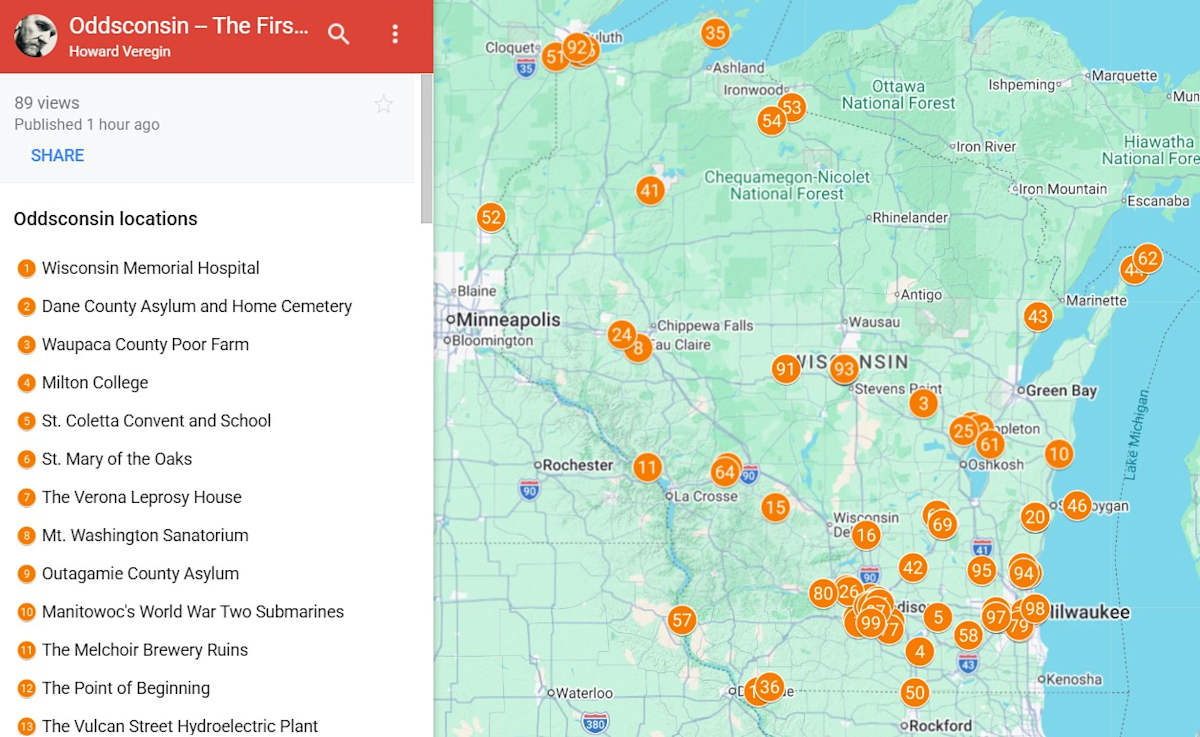
Over the past one hundred weeks, Oddsconsin has documented dozens of obscure and unusual locations and events that have shaped Wisconsin’s historical and geographical landscape.
We’ve looked at cemeteries, asylums, poor farms, churches, schools, libraries, prisons, POW camps, shrines and memorials.
We’ve visited an abandoned hospital, the ruins of a leprosy house, a former college, a big barn, an historic woolen mill, a shuttered convent, the site of a former resort, a bank, a former sanatorium, a defunct auto plant, a World War II submarine, a once-famous gas station chain, a former nuclear missile site, a military base, an early airport, the remains of lime kilns, a former sugar plant, an early electric plant, a water tower, an oil refinery, a brewery ruins, a mineral springhouse and even a sewage treatment plant.
We’ve followed roads, railroads, canals and trails. We’ve looked at aircraft accidents and maritime disasters, discussed geographical markers, state boundaries and county names. We’ve explored famous Wisconsin people and songs, examined Wisconsin driving behaviors and discussed flesh-eating beetles, cheese curing, the earth’s magnetic field, UFOs, World War I poison gas experiments and other historical events.
I’ve learned a lot about the state researching and writing these posts. I hope you find them as fascinating as I do. But there’s more out there. This map of the first one hundred Oddsconsin posts shows how much territory there still is to cover. I look forward to discovering even more strange and obscure facts about Wisconsin in the next one hundred Oddsconsin posts.
Thanks for reading Oddsconsin!